



| HEADLINE |

|
Bangladesh bears the brunt of Rohingya crisis
Published : Monday, 4 March, 2024 at 12:00 AM
Md Shakhawat Hossain


 The future looks increasingly bleak for over a million Rohingya refugees in Bangladesh, most of them were forced out of western Myanmar since the most current and most virulent wave of anti-Rohingya persecution began in 2017, when the military of Myanmar launched merciless onslaught against the Rohingya communities. The head of the UN agency for human rights later referred to the militarys conduct as "acts of horrific barbarity," potential "acts of genocide," and "a textbook example of ethnic cleansing".
 Bangladesh, a lower-middle-income nation, demonstrated the utmost compassion and understanding for human suffering by welcoming nearly a million Rohingya refugees. The country is forced to expend a significant portion of its meagre resources to cover the costs and effects on its economy, society, and environment.
Stepping into the 7th year, not even a single Rohingya has returned to Myanmar. Bangladesh seems solely carrying the burden of this huge refugee alone. The country is expending US$ 1.22 billion every year for the Rohingyas from her own limited resources. Bangladeshs Coxs Bazar is now hosting the largest refugee camp in the world, with one of the largest humanitarian operations in terms of scale and dimensions.
Additionally, the nation has never received a sizable amount of funding for Rohingya refugees. Instead, the amount of support has decreased with time. While donors only contributed 60% of the required cash in 2020, down from approximately 72% to 75% two years earlier, Bangladesh received roughly 51.4% in 2023 and around 49% in 2022.
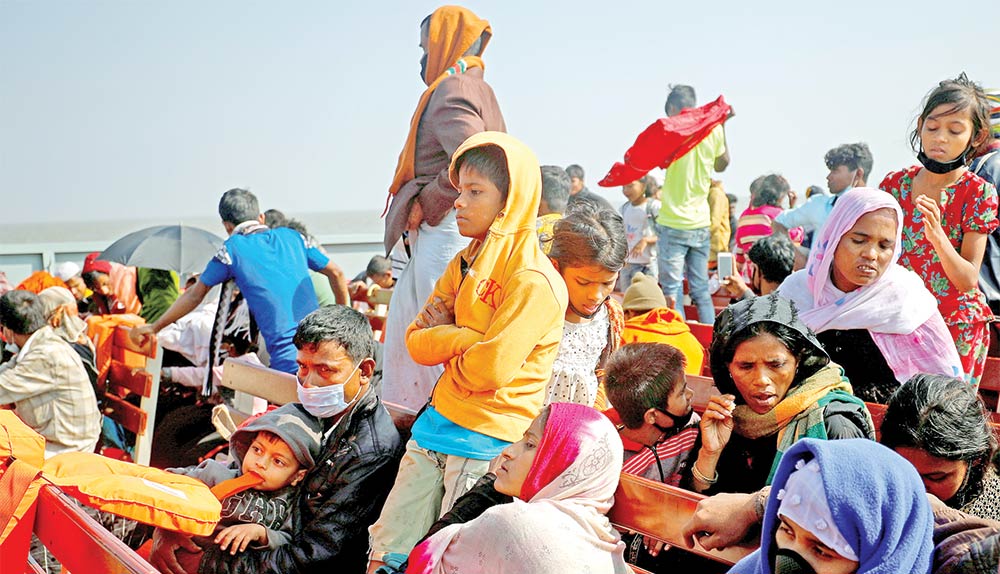
The hardship of the impoverished and illiterate Rohingya people is less of a bother now that the foreign funders have refugees to tend to who look like them and have sought safety in their wealthy European society. Every day, the condition in the camps for refugees worsens as they continue to ignore the Rohingyas. The UN was forced to reduce essential food aid from $12 to $10 per person per month due to funding shortfall. The rampant malnutrition in the camps is worsen as a result of this decrease, which comes as Bangladesh already faces a crisis of food inflation.
A further factor contributing to the violence has been the kidnapping, drug peddling, robbery, gold smuggling, and other crimes committed by some Rohingyas, especially young men who have joined armed groups and criminal gangs. For a period of six years, there have been over 500 kidnappings and 186 murders in the camps housing Rohingya people in Bangladesh.
The southern part of Bangladesh is experiencing an increase in dread, anxiety and public killings due to rising crime rates. Anger towards the Rohingyas is rising. People in Coxs Bazar fear that because they are now a minority due to the Rohingya population in the area, their safety may be in danger. Bangladesh has faced the threat of terrorism because some of the international NGOs donated for flourishing the terrorist activities. For that reason the security of Bangladesh is a concern issues for the government. The use of drug and the existence of drug trafficker also increased at an alarming rate to the Rohingya people. Bangladesh can tolerate the existence of drug trafficker and the terrorist.
The recent conflicts in Rakhine impose a negative impact on the situation, while Arakan Army (AA), breaking a temporary ceasefire, brokered by Nippon Foundation chairperson Yohei Sasakawa, on November 28, 2022, in the wake of Operation 1027, started to attack junta positions in Rakhine again from November 13, 2023. AA has achieved notable victories in Rakhine State reportedly, taking control of over 170 junta outposts and six Towns (Pauktaw, Kyauktaw, Minbya, Mrauk-U, Taungpyoletwe and Myebon).
These fresh intense fighting between the junta and the AA impacted directly on the remaining little over than a half million Rohingyas living in Rakhine now, creating a possibility of a fresh influx in Bangladesh. 5 Rohingyas were sent back by the Bangladesh Border Guard recently after they entered into Bangladesh with news that, hundreds more across Teknaf border are waiting to enter Bangladesh.
Bangladesh is already struggling to maintain over a million Rohingyas with a declining international aid. Immense financial burden forced Bangladesh to seek loans for the Rohingyas well-being. In December, Bangladesh sought a $1 billion loan from the WB and ADB-a financial package consisting of $535 million in loans and $465 million in grants. In such situations, how can Bangladesh welcome any more Rohingyas?
Myanmar parts, Rohingya, international community and rights groups need to understand that, Bangladesh neither can keep on sheltering Rohingyas for a longer period nor allow any new influx- due to her impact on economy, high population density and national security concerns. Arakan Army and Myanmar military need to check their activities along Bangladesh border. Respecting Bangladeshs territorial integrity and for the sake of peace and stability in this region, they must make sure that no 2017 like things will ever happen again.
The writer is an Assistant Professor and Chairman, Dept. of Criminology & Police Science, University of Chittagong
Loading...
Loading...
Also read





Editor : Iqbal Sobhan Chowdhury
Published by the Editor on behalf of the Observer Ltd. from Globe Printers, 24/A, New Eskaton Road, Ramna, Dhaka.
Editorial, News and Commercial Offices : Aziz Bhaban (2nd floor), 93, Motijheel C/A, Dhaka-1000.
Phone: PABX- 41053001-06; Advertisement: 41053012; 01793317829, 01550707291, E-mail: [email protected], [email protected] Online: email: [email protected] 41053014; 01550707297 Advertisement: 01550707296
Published by the Editor on behalf of the Observer Ltd. from Globe Printers, 24/A, New Eskaton Road, Ramna, Dhaka.
Editorial, News and Commercial Offices : Aziz Bhaban (2nd floor), 93, Motijheel C/A, Dhaka-1000.
Phone: PABX- 41053001-06; Advertisement: 41053012; 01793317829, 01550707291, E-mail: [email protected], [email protected] Online: email: [email protected] 41053014; 01550707297 Advertisement: 01550707296


