



| HEADLINE |

|
Make boycott of Israeli products more effective
Published : Saturday, 20 April, 2024 at 12:00 AM
Md Tarek Ali


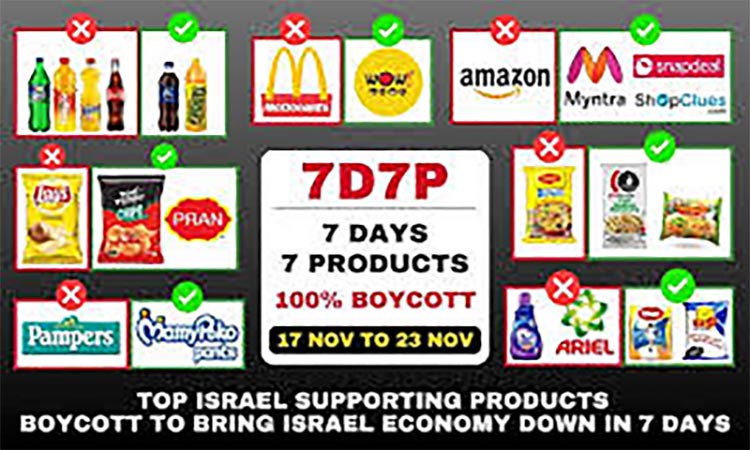 Recently, the Israeli-Palestinian conflict has once again captured the worlds attention, prompting widespread debate and calls for action. One such response is the introduction of boycotts against Israeli products as a form of protest against the policies and actions of the Israeli government. Although the motives behind this boycott may be noble, the practical implementation and effectiveness of such actions often raise complex questions.
The decision to boycott Israeli products stems from a desire to harness economic pressure to bring about a change in Israeli policy, particularly in its treatment of Palestinians. Supporters of the boycott argue that it is a peaceful means of protest and solidarity for Palestinians. However, the success of such a boycott depends heavily on the willingness and ability of consumers and businesses to participate.
The implementation of the boycott of Israeli products poses a number of obstacles. First, Israeli products can be difficult to identify and classify due to the globalised nature of the supply chain. Many products sold worldwide contain ingredients from various countries, including Israel, making it difficult for consumers to accurately identify their source. In addition, some products may be marked as originating from other countries in order to circumvent boycott efforts.
In addition, enforcing a boycott requires extensive support and coordination among consumers, businesses, and organizations. While some individuals may be committed to avoiding Israeli products, others may be unaware of or indifferent to the cause. It can also be difficult to convince businesses to stop selling Israeli products, especially if they perceive a potential loss of profit or backlash from pro-Israel consumers.
In reality, the extent to which a boycott of Israeli products can be implemented varies significantly depending on the region, the level of awareness and support for the cause, and the availability of alternative products. In some areas, especially those with strong pro-Palestinian sentiments, boycotts can gain significant traction and lead to a significant drop in sales of Israeli products. However, in other regions where there is less awareness or where there is less concern about the Israeli-Palestinian conflict, the impact of the boycott may be minimal.
Furthermore, the effectiveness of boycotts in achieving expected goals is often debated. Although boycotts have the potential to increase awareness of economic coercion and human rights violations, critics argue that they can have a limited practical impact on government policy. Governments and corporations are often adept at finding alternative markets or suppliers to reduce the impact of boycotts, thus reducing their effectiveness as a tool for change.
Despite these odds, the boycott of Israeli products has gained momentum in many parts of the world, fueled by grassroots activism, social media outreach, and advocacy efforts. Supporters of the boycott argue that while it does not directly change government policy, it sends a strong message of solidarity with the Palestinian people and contributes to the broader movement for justice and equality. Since some time, a number of events have drawn attention to the boycott of Israeli products. The rise of the boycott, divestment, and sanctions movement has led to increased surveillance of companies and institutions with ties to Israel.
The decision to boycott Israeli products is a complex and multifaceted issue that raises important questions about activism, consumer behaviour, and international politics. While the motives behind such boycotts can be noble, their implementation and effectiveness depend on a variety of factors, including awareness, support, and the globalised nature of the economy. Finally, the success of the boycott depends on the collective action and commitment of individuals and organisations to bring about change and uphold the principles of justice and human rights.
The writer is a student, Department of Sociology University of Rajshahi
Loading...
Loading...
Also read







Editor : Iqbal Sobhan Chowdhury
Published by the Editor on behalf of the Observer Ltd. from Globe Printers, 24/A, New Eskaton Road, Ramna, Dhaka.
Editorial, News and Commercial Offices : Aziz Bhaban (2nd floor), 93, Motijheel C/A, Dhaka-1000.
Phone: PABX- 41053001-06; Advertisement: 41053012; 01793317829, 01550707291, E-mail: [email protected], [email protected] Online: email: [email protected] 41053014; 01550707297 Advertisement: 01550707296
Published by the Editor on behalf of the Observer Ltd. from Globe Printers, 24/A, New Eskaton Road, Ramna, Dhaka.
Editorial, News and Commercial Offices : Aziz Bhaban (2nd floor), 93, Motijheel C/A, Dhaka-1000.
Phone: PABX- 41053001-06; Advertisement: 41053012; 01793317829, 01550707291, E-mail: [email protected], [email protected] Online: email: [email protected] 41053014; 01550707297 Advertisement: 01550707296


