



| HEADLINE |

|
BIMSTEC Day Special
Exclusive Interview of His Excellency Indra Mani Pandey, Secretary General of the (BIMSTEC)
Published : Thursday, 6 June, 2024 at 12:00 AM


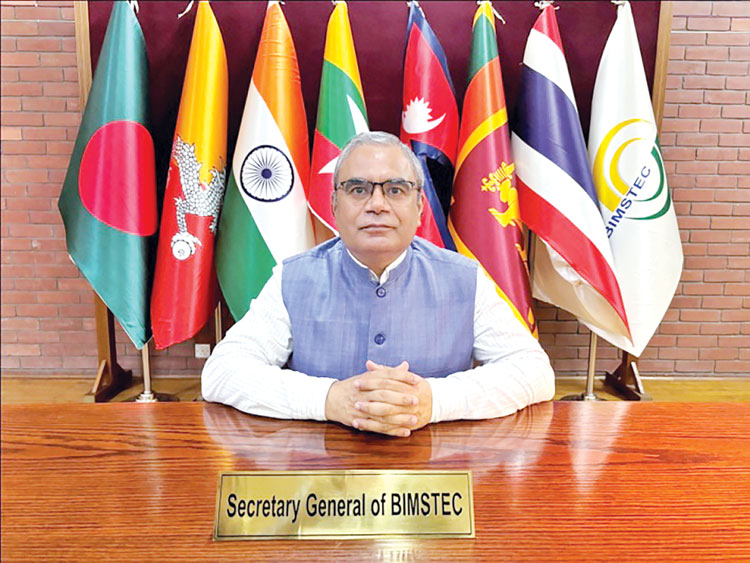 Since its inception on 6 June 1997, BIMSTEC (Bay of Bengal Initiative for Multi- Sectoral Technical and Economic Cooperation) had shown promises as an ideal regional platform. It aimed to facilitate co-operation between member states to accelerate economic and social development. While a few promises had been kept , some concrete progress made, it is yet to go a long away to deliver and live up to its key objectives and goal.
However, BIMSTECs newly appointed Secretary General, His Excellency Indra Mani Pandey is ever optimistic on BIMSTECs future and has shared his plan and opinions on how to rejuvenate and re-energise the regional platform in an exclusive interview given to The Daily Observer.
The interview has been conducted by our Editorial Chief, Shahriar Feroze.
Daily Observer: What is your top priority, in terms of revitalizing BIMSTEC as the newly appointed secretary general, having taken charge of the Secretariat in January this year (2024)?
H E Indra Mani Pandey: The role of the Secretary General and the Secretariat, which the Secretary General heads, is to assist member States in implementing their decisions by translating them into concrete initiatives for cooperation. The Secretariats role is to coordinate and organise meetings, prepare documents for the meetings, facilitate communication and consultation amongst the member States and report to them on progress in implementation. My priority is to ensure that the Secretariat functions efficiently and effectively and is able to provide the requisite support to member States as per its mandate.

Daily Observer: With just 5 summit meetings held in the last 27 years and limited success, the question is often raised, what is the future of BIMSTEC? What is your opinion?
H E Indra Mani Pandey: It is not right to say that BIMSTEC has achieved limited success. Of course, it could have achieved much more. Also, its success should not be measured in terms of the number of Summits held so far. The member States have decided that henceforth the Summits will be held regularly, once in every two years.
BIMSTEC has gradually evolved into a robust regional organisation. It has a well functioning Secretariat since 2014.The recent entry into force of the BIMSTEC Charter is a significant milestone. The Charter articulates the long-term collective vision of its member States for cooperation through the BIMSTEC framework and sets out the priorities of the member States. It establishes the legal and institutional framework for cooperation in the region; confers legal personality on the BIMSTEC; enables the admission of new members and observers; and empower conclusion of agreements with other countries and organisations.
BIMSTEC has a well established Agenda for regional cooperation. BIMSTEC Leaders have identified various areas of cooperation, which have been organized into 7 Sectors. BIMSTEC also has well established mechanisms, including core and sectoral mechanisms, at the level of Senior Officials and Ministers as well as Working Groups, Expert Groups, and BIMSTEC Permanent Working Committee.
At the 6th Summit, scheduled to be held in Bangkok, the Leaders are likely to adopt the "Bangkok Vision 2030", aimed at achieving a Prosperous, Resilient, and Open BIMSTEC by 2030. This is the first time that a Vision Document will be adopted by BIMSTEC.
International organisations have shown interest in partnering with BIMSTEC to pursue regional cooperation. BIMSTEC has MoUs with ADB (Asian Development Bank) and IFPRI (International Food Policy Research Institute) and MoUs with IORA (Indian Ocean Rim Association), the World Bank, UNODC (UN Office on Drugs and Crime), UNESCAP (UN Economic and Social Commission for Asia and the Pacific) etc are under consideration.
This shows that international organisations are keen to work with the BIMSTEC and trust it as a partner in pursuit of regional cooperation in the Bay of Bengal region, including realisation of SDGs, which all BIMSTEC member States are committed to.
The member States have also set up an Eminent Persons Group and mandated the Group to make recommendations to reform revitalise and repurpose BIMSTEC. The EPG is expected to submit its Report to the Leaders at the 6thSummit. The recommendations of EPG would herald a new era of regional cooperation within the BIMSTEC framework.
Daily Observer: What is your view on the often perceived missing elements such as - political will of leaders for regional cooperation, shared goodwill, and bureaucratic red tape that are preventing BIMSTEC from achieving the levels of regional co-operation and integration that can yield benefits for the people of the region?
H E Indra Mani Pandey: Based on my interaction with the Leaders of BIMSTEC member States, I am assured that there is the requisite political will among the BIMSTEC Leaders to shape BIMSTEC into an effective and efficient regional organisation in order to realise their vision for a secure and developed Bay of Bengal region. I think the concerned Ministries and relevant Organisations of the member States need to be more earnest and efficient in taking the requisite steps to translate the Leaders vision into tangible progress on the ground for the benefit of the people. I hope that media would strive to present a true picture of the BIMSTEC and its future.
Daily Observer: Why is it that leaders and institutions in the region have yet failed to make strides in some particularly important and urgent issues for the region? For example, efforts & initiatives to promote agriculture and ensure food security remain fairly insufficient. Also, when it comes to climate change, although all the countries in the region are vulnerable, and there is a BIMSTEC Action Plan on Climate Change, collective action on the ground using the BIMSTEC platform isn visible or is non- existent. Would you please explain why BIMSTEC is failing to deliver in these particular areas?
H E Indra Mani Pandey: BIMSTEC has succeeded in establishing the requisite mechanisms to forge cooperation in these two and other sectors. An Action Plan on Climate Change has been adopted and is being implemented. The BIMSTEC Climate and Weather Centre, which has been setup in India, has been working with the Meteorological Departments of the member States to assist them with weather forecasts and forecasts on natural disasters, such as floods, cyclones, and hurricanes. Given the importance of mountain economy for our members, an Expert Group on Mountain Economy has been set up and an Action Plan has been adopted.
In the field of Agriculture, live-stock and fisheries, there are two Expert Groups, which have delineated their own Action Plans. In fact, a number of workshops and seminars for capacity building have already been held.
As regards dealing with the adverse impact of climate change like disasters, the BIMSTEC Expert Group on Disaster Management is currently engaged in finalizing a Plan of Action to improve Preparedness and Coordination for responding to Natural Disasters in the Bay of Bengal Region and 3 rounds of BIMSTEC Disaster Management Exercise have been held.
There is no doubt that progress in implementing sector-specific Action Plans has been uneven and slow in some sectors. We are poised to take steps to reform and revitalise BIMSTEC to be able to make tangible progress in realisation of regional cooperation. And, BIMSTEC seeks to partner with the UN and other International and Regional Organisations, where necessary, to realise its goals.
Daily Observer: In which sector do you think BIMSTEC has fared best, and in which sectors it is yet to deliver concrete results? (BIMSTEC has 7 main sectors of cooperation and several sub-sectors)
H E Indra Mani Pandey: As I mentioned above, there has been progress in forging regional cooperation in all the 7 sectors of cooperation, which were delineated in 2022 during the 5thSummit, following a process of rationalisation and reorganisation of various sectors and sub-sectors of cooperation. There is no denying that the progress has not been uniform in all the Sectors.
However, the member States attach the same priority to cooperation in all the 7 Sectors. They have established an Eminent Persons Group to make recommendations to reform, revitalise, and repurpose BIMSTEC and it is poised to make better progress in future in all sectors.
Daily Observer: Against the backdrop of todays fast-changing geopolitical events and manmade humanitarian crises, do you think the BIMSTEC framework has all the necessary tools and is nimble enough to be able to respond quickly and adapt to deliver and meet expectations of the people of the region?
H E Indra Mani Pandey: Yes, the BIMSTEC has the requisite institutional mechanisms to be able to respond to the emerging security and developmental challenges. All the BIMSTEC countries face similar developmental and security challenges and they believe that, by working together, they can deal with these challenges more efficiently and effectively. All the member States are like- mindedandarecommittedtopursueregionalcooperationthroughBIMSTECbybuildingon their convergences and setting aside their divergences.
BIMSTEC Leaders have continued to identify more and more areas of cooperation, which demonstratesthattheyareawareoftheirevolvingprioritiesinthechangingglobalscenario. The establishment of the EPG, with the mandate to review the BIMSTEC institutional mechanisms in their entirety and to make recommendations to the Leaders on what should be done to make BIMSTEC more effective and efficient, reflects the commitment of the Leaders to ensure that the BIMSTEC is able to fulfil its promises.
In the evolving global scenario, particularly in view of the stalemates in UN and International Organisations, regional platforms like BIMSTEC have been seen as very effective means for forging plurilateral cooperation amongst the countries of a region to realise their shared security and developmental goals. BIMSTEC is poised to play that role in the Bay of Bengal region.
Daily Observer: Security is one of the seven main sectors of cooperation in BIMSTEC, with India designated as the lead member State for the sector. What are BIMSTECs current strategies for dealing with regional security, Counter-Terrorism & Transnational Crime related issues?
H E Indra Mani Pandey: Yes, India has been designated as the lead member State to pursue cooperation in security sector. The security sector has a range of mechanisms to promote regional cooperation in different aspects of security. These include, for example, a Joint Working Group on Counter Terrorism and Transnational Crime. It has several sub-Groups working in specific areas, such as intelligence sharing; prevention of illicit trafficking in narcotic drugs, psychotropic substances and precursor chemicals; anti-money laundering and combating financing of terrorism; countering radicalization and terrorism etc. Additionally, BIMSTEC has a mechanism of Meeting of the National Security Chiefs to enhancecooperationwithintheBIMSTEConsecuritymatters.Anumberofareasforforging cooperation have been identified, such as maritime security, cyber security and space security. A track 1.5 security dialogues and a think tanks dialogue on regional security have been initiated.
The cooperation in CTTC has made significant achievements. The BIMSTEC Convention on Cooperation in Combating International Terrorism, Transnational Organized Crime and Illicit Drug Trafficking has entered into force. The BIMSTEC Convention on Mutual Legal Assistance in Criminal Matters has been signed and is being ratified and the BIMSTEC Conventions on Extradition and Transfer of Convicted Offenders respectively, are being negotiated.
Daily Observer: Bangladesh is currently sheltering over a million Rohingya refugees. The number is fast growing. In recent times the refugees have manifestly posed significant threats to our security, environment, and economy. What role can BIMSTEC play in mitigating these adverse impacts?
H E Indra Mani Pandey: Bangladesh has been providing shelter and humanitarian support to Rohingyas for over half a decade and it has earned the praise for its laudable humanitarian gesture.
While BIMSTEC is an intergovernmental organisation and the decisions regarding what issues it should deal with are taken by the member States, the ongoing cooperation, in the existing 7 sectors, contributes, directly or indirectly, in mitigating the impacts you have mentioned.
Daily Observer: On 20 May this year (2024), the BIMSTEC Charter which was signed in Colombo on 30th March during the 5th BIMSTEC Summit, entered in to force. What do you see as the main significance of the Charters entry into force in terms of BIMSTECs prospects?
The entry into force of the BIMSTEC Charter on 20thMay 2024 is a historic milestone.
The Charter articulates the long-term collective vision of the member States for cooperation through BIMSTEC platform and sets out the priorities of the member States. It establishes the legal and institutional framework for cooperation in the region; confers legal personality on the Organisation; enables the admission of new members and observers; and empowers conclusion of agreements with other countries and organisations.
The Charter allows the BIMSTEC to engage with the UN and other International Organisations as well as Regional Organisations to pursue developmental partnerships. It will help leverage their resources and capacities to enhance cooperation in Bay of Bengal region to deal with the shared developmental and security-related challenges.
Daily Observer: BIMSTEC has set up an Eminent Persons Group to review the mechanisms and processes of BIMSTEC and make it more dynamic. In your view, does this process hold the key to BIMSTECs progress as an effective and efficient platform for regional cooperation similar to ASEAN, and perhaps even the EU? For example, ASEAN is considered as the go-to platform for the world when it comes to engagement with South-east Asia. Will BIMSTEC succeed in developing similarly so that the international community turns to BIMSTEC as the pre-eminent platform to engage with the region?
H E Indra Mani Pandey: The Charter provides the foundation for BIMSTEC to continue its journey towards greater regional cooperation in Bay of Bengal. BIMSTEC is already being seen by the UN and other International Organisations as a reliable partner. The Recommendations of the Eminent Persons Group will help member States address the institutional challenges that BIMSTEC has faced in order to tap its immense potential for regional cooperation in Bay of Bengal region. While comparison with the EU and ASEAN is not warranted, BIMSTEC is poised to emerge as an eminent regional platform in Bay of Bengal region.
Daily Observer: As the largest country in BIMSTEC in terms of geographic size, population, and economy, what can India do more to make BIMSTEC a more efficient and result- oriented regional platform?
H E Indra Mani Pandey: While it is a fact that India is the largest member of the BIMSTEC, in terms of the size of its territories, population and economy, the BIMSTEC has been founded on the principle of equality of all the member States, big or small. This principle is also reflected in the decision to designate each Member State as a Lead Country to pursue cooperation in one of the 7 Sectors. In fact, all the member States are expected to participate equally in forging cooperation in all the sectors and sub-sectors of cooperation.
India, as one of the four founding members of the BIMSTEC, has been committed to expand and deepen regional cooperation, through BIMSTEC, in Bay of Bengal, which also reflects the convergence of Indias "Neighbourhood First" and "Act East" policies.
Loading...
Loading...
Also read






Editor : Iqbal Sobhan Chowdhury
Published by the Editor on behalf of the Observer Ltd. from Globe Printers, 24/A, New Eskaton Road, Ramna, Dhaka.
Editorial, News and Commercial Offices : Aziz Bhaban (2nd floor), 93, Motijheel C/A, Dhaka-1000.
Phone: PABX- 41053001-06; Advertisement: 41053012; 01793317829, 01550707291, E-mail: [email protected], [email protected] Online: email: [email protected] 41053014; 01550707297 Advertisement: 01550707296
Published by the Editor on behalf of the Observer Ltd. from Globe Printers, 24/A, New Eskaton Road, Ramna, Dhaka.
Editorial, News and Commercial Offices : Aziz Bhaban (2nd floor), 93, Motijheel C/A, Dhaka-1000.
Phone: PABX- 41053001-06; Advertisement: 41053012; 01793317829, 01550707291, E-mail: [email protected], [email protected] Online: email: [email protected] 41053014; 01550707297 Advertisement: 01550707296


