



| HEADLINE |

|
Media and the Power of Knowledge
Published : Saturday, 13 September, 2025 at 12:00 AM
By Steve Fuller


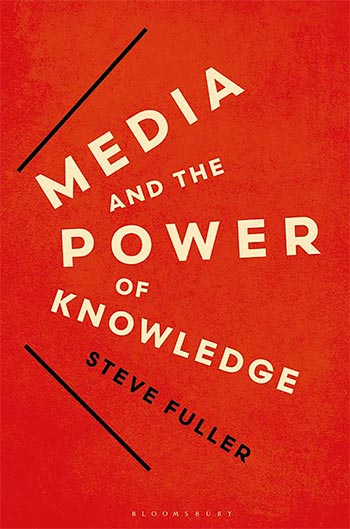 Steve Fuller's new book, "Media and the Power of Knowledge' (Bloomsbury, 2026), arrives at a moment when public debates about misinformation, media manipulation, and the crisis of expertise feel sharper than ever. Fuller, a sociologist best known for his provocative takes on science and democracy, offers here an expansive meditation on how communication technologies-from ancient oratory to Twitter-shape not just what we know, but how power itself is exercised.
The central claim is bracing: communication has never been an equal exchange. Despite our ideals of dialogue and open conversation, Fuller argues that media history has been built on asymmetry-between prophets and priests, experts and laypeople, senders and receivers. Whether in Plato's Athens, the Catholic Church, the age of radio, or the algorithm-driven feeds of today, knowledge tends to flow one way: from the few to the many.
Reviewed by Dr Matiur RahmanThe book begins with a sweeping chapter that reinterprets Marshall McLuhan's dictum "the medium is the message." Fuller traces a "deep history" of communication from Greek philosophy to digital society, highlighting how media encode power relations. He borrows Max Weber's distinction between "prophets" and "priests" to describe how some voices heat communication with radical possibilities, while others cool it down by enforcing order. In our digital era, the prophets are hackers and coders; the priests are experts, technocrats, and platform managers.
From there, Fuller revisits Walter Lippmann, the early 20th-century journalist who believed public opinion needed to be carefully managed. Lippmann's great debate with John Dewey over whether mass media empowered or manipulated democracy still echoes in today's worries about "fake news" and echo chambers. Fuller sees Lippmann's technocratic instincts as the root of what he calls "cognitive authoritarianism"-a system where citizens discipline their own speech and defer to experts.
However, the book is not simply a lament. In one of its most daring moves, Fuller argues that what many call the "post-truth" condition may in fact be democracy in its most radical form: a world where individuals, not experts, decide what truths to live by. In such a landscape, the role of intellectuals is less about preaching eternal verities than about performing integrity and reminding society that other futures are possible. It's a provocative idea-one that will unsettle those who see post-truth politics as pure decline.
Religion, unsurprisingly, is never far away. Fuller likens Socrates and Jesus to early case studies in media strategy, figures whose reputations depended on communication networks as much as on philosophy or faith. He even suggests that in today's demystified, post-truth environment, the Church may regain some advantage, since journalism, science, and the state-the secular heirs to religion-are now equally under suspicion.
The book closes with a surprising defence of Twitter. Where others see triviality, Fuller sees continuity with older traditions of aphoristic thought. Just as Augustine and Bacon once compressed insights into pithy lines, so too do tweets distil meaning for an age of short attention spans. In this sense, the tweet is not the death of knowledge but another form of it.
Stylistically, Fuller's writing is dense, restless, and sometimes dizzying, full of sudden leaps from Plato to Elon Musk, from neo-Platonism to TikTok. Some readers may find this exhausting; others will find it exhilarating. Either way, the book succeeds in its primary task: to make us think differently about the media systems we take for granted.
Media and the Power of Knowledge is not a manual for fixing our information crisis. It is, instead, a challenge to see that crisis as part of a much longer story in which media, power, and truth have always been entangled. Fuller doesn't offer easy answers-but he does provide the intellectual tools to ask more complex questions. In an age when both prophets and priests compete for our attention online, that might be exactly what we need.
The reviewer is a researcher and development professional
Loading...
Loading...



Editor : Iqbal Sobhan Chowdhury
Published by the Editor on behalf of the Observer Ltd. from Globe Printers, 24/A, New Eskaton Road, Ramna, Dhaka.
Editorial, News and Commercial Offices : Aziz Bhaban (2nd floor), 93, Motijheel C/A, Dhaka-1000.
Phone: PABX- 41053001-06; Advertisement: 41053012; 01793317829, 01550707291, E-mail: [email protected], [email protected] Online: email: [email protected] 41053014; 01550707297 Advertisement: 01550707296
Published by the Editor on behalf of the Observer Ltd. from Globe Printers, 24/A, New Eskaton Road, Ramna, Dhaka.
Editorial, News and Commercial Offices : Aziz Bhaban (2nd floor), 93, Motijheel C/A, Dhaka-1000.
Phone: PABX- 41053001-06; Advertisement: 41053012; 01793317829, 01550707291, E-mail: [email protected], [email protected] Online: email: [email protected] 41053014; 01550707297 Advertisement: 01550707296


