



| HEADLINE |

|

NCTB changes historical, political narratives in textbooks



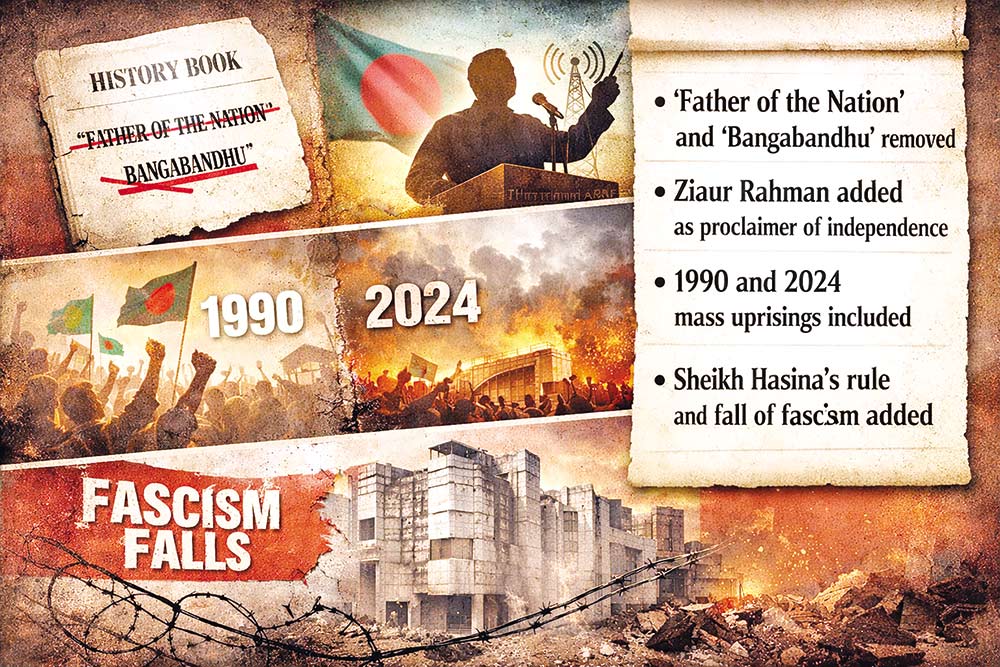 The National Curriculum and Textbook Board (NCTB) has carried out extensive revisions to Bangladesh's school textbooks for the 2026 academic year, triggering widespread public discussion over significant changes to the country's historical and political narratives. Among the most notable revisions are the removal of Bangabandhu Sheikh Mujibur Rahman's historic March 7, 1971 speech and the inclusion of new lessons on the July 2024 mass uprising, alongside an expanded portrayal of martyred President Ziaur Rahman as the proclaimer of independence.
According to NCTB officials, the revisions were made in response to strong criticism of the 2025 editions and were guided by recommendations from a high-level expert committee and the National Curriculum Coordination Committee. Changes have been implemented across secondary-level textbooks, with particular emphasis on constitutional history, governance, civic education, and updated content in Bengali and English literature.
Removal of March 7 Speech and Honorific Titles
The revised textbooks for classes six through twelve reflect substantial content restructuring. The English First Paper textbooks for classes eleven and twelve no longer include Sheikh Mujibur Rahman's March 7 speech. Similarly, the class eight literary anthology Sahitya Kanika has reduced its prose selections from twelve to eleven pieces, with comparable omissions across Bengali textbooks for classes six to eight.
A significant editorial change is the removal of the honorific title "Bangabandhu" from Sheikh Mujibur Rahman's name in most textbooks, including the Bangladesh and World Introduction series for classes six to eight. NCTB sources stated that the decision was taken "to reduce political exaggeration and ensure a more objective presentation of history," though the title has been retained in limited contexts.
Other removals include Sheikh Mujibur Rahman's essay This Struggle Is the Struggle for Independence. References to the Liberation War and the Awami League's historical role have also been reduced, except for brief mentions in the class seven textbook, which discusses the 1970 general election and includes a photograph of Sheikh Mujibur Rahman.
Expanded Role of Ziaur Rahman in Independence History
In contrast, the revised editions place increased emphasis on the role of Major Ziaur Rahman in Bangladesh's independence. The Civics and Good Governance textbooks for classes eleven and twelve, particularly in the chapters From Pakistan to Bangladesh and Political Figures Gaining Independence of Bangladesh, highlight Ziaur Rahman's declaration of independence. Students are instructed to ensure "equal and balanced discussion of all political leaders."
The online edition of the class six Bangladesh and World Introduction textbook states that Ziaur Rahman declared independence on March 26, 1971, and reaffirmed it on March 27 on behalf of Sheikh Mujibur Rahman.
Incorporation of the July 2024 Mass Uprising
The 2026 curriculum introduces new lessons on the July 2024 mass uprising, often referred to as the July Revolution. These lessons describe the student-led and public movement of July-August 2024, highlighting its progression, the sacrifices made by citizens, and its political consequences.
Textbooks now include references to the collapse of the Awami League government, the fall of Sheikh Hasina-who was sentenced to death for genocide-the end of what the texts describe as "fascism," and the broader democratic transformation that followed. The July uprising is positioned alongside the 1990 mass movement, with the stated aim of instilling the spirit of the July Revolution in future generations.
Political Developments and Governance Narratives
The revised Civics and Good Governance textbooks provide a more legalistic and detailed account of Bangladesh's political evolution. They discuss the 15th Amendment, the elections of 2008, 2014, 2018, and 2024, and allegations of ballot-stuffing, uncontested elections, and the use of dummy candidates. The texts state that attempts by the Awami League to extend its rule until 2041 "were rejected by the people."
The curriculum contextualizes autocratic governance under Sheikh Mujibur Rahman's Fourth Amendment and General Ershad's military rule, while highlighting political reforms and economic, social, and democratic developments during Ziaur Rahman's tenure.
Changes at the Primary Level
At the primary level, textbooks have been streamlined to reduce content load. The class four mathematics textbook has been reduced from 14 to 11 chapters, primary science from 13 to 11 chapters, and English textbooks from 42 to 19 contents.
Several poems have been removed from Bengali textbooks, including Palki Gan, Swadhinatar Sukh, Abol-Tabol, Moder Bangla Bhasha, and Ekusher Kobita. New prose and poems such as Greetings, Language Game, Doel Pakhi, and Mainamati have been added.
Chapters covering civil rights, social institutions, state resources, the background of the Liberation War, culture, religious harmony, gender equality, and traditional festivals have been omitted from the Bangladesh and World Introduction textbooks. According to NCTB, these removals were made to prioritize lessons on democratic struggles, the July 2024 uprising, and revised historical interpretations.
New chapter titles include Popular Uprising in Independent Bangladesh in the class six history textbook, Bangladesh's Liberation Struggle and Mass Movement in class seven, and Bangladesh Liberation War and Democratic Struggle in the class eight curriculum.
Objective and Contextualized History
NCTB officials maintain that the revised textbooks aim to present history and civic education in a more objective, balanced, and politically contextualized manner. The updated curriculum seeks to emphasize mass movements, diverse political narratives, and the role of ordinary citizens in shaping Bangladesh's democratic journey.

Loading...
Loading...



Editor : Iqbal Sobhan Chowdhury
Published by the Editor on behalf of the Observer Ltd. from Globe Printers, 24/A, New Eskaton Road, Ramna, Dhaka.
Editorial, News and Commercial Offices : Aziz Bhaban (2nd floor), 93, Motijheel C/A, Dhaka-1000.
Phone: PABX- 41053001-06; Advertisement: 41053012; 01793317829, 01550707291, E-mail: [email protected], [email protected] Online: email: [email protected] 41053014; 01550707297 Advertisement: 01550707296
Published by the Editor on behalf of the Observer Ltd. from Globe Printers, 24/A, New Eskaton Road, Ramna, Dhaka.
Editorial, News and Commercial Offices : Aziz Bhaban (2nd floor), 93, Motijheel C/A, Dhaka-1000.
Phone: PABX- 41053001-06; Advertisement: 41053012; 01793317829, 01550707291, E-mail: [email protected], [email protected] Online: email: [email protected] 41053014; 01550707297 Advertisement: 01550707296


