



| HEADLINE |

|

Book festival fizzles as textbooks miss deadline



 Bangladesh's much-touted tradition of handing out free textbooks on the first day of the academic year-popularly branded as the "book festival"-has collapsed yet again in 2026, laying bare chronic administrative failures at the National Curriculum and Textbook Board (NCTB) and raising serious questions about the state's ability to deliver even the most basic educational service on time.
While the Ministry of Education claims that 85.9 million primary-level textbooks-more than 85.9 million copies-have reached schools nationwide, ground reports paint a starkly different picture. Thousands of students, especially at secondary and Ebtedayi Madrasa levels, have entered classrooms empty-handed.
According to NCTB data, more than 30 million secondary-level textbooks remain undelivered out of a total requirement exceeding 210 million copies. On January 11, the board admitted that 29.2 million books-13.63 percent of the total-had yet to reach students. Just a week earlier, on January 4, NCTB had claimed nearly 85 percent completion across both primary and secondary levels. Deadlines have since slipped again the promised January 15 delivery failed, forcing the ministry to push the final cut-off to January 30.
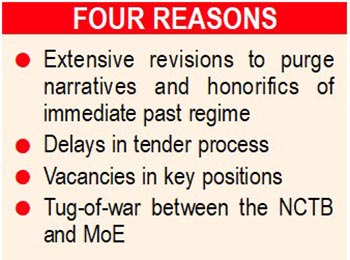
Behind the missed deadlines lies a familiar cocktail of delays, confusion, and institutional inertia. Officials blame extensive curriculum revisions to purge narratives and honorifics of the immediate past regime and those required rewriting, editing, expert review, layout redesign, and multiple layers of approval before printing could even begin.
"For heavily revised books, the process is long-writers, editors, subject experts, approvals, and finalisation must all be completed before tenders are floated," an NCTB source said.
But the tender process itself was delayed, throwing printing and binding schedules off track. Printing houses say that even if printing wraps up by January 15, binding, inspection, and shipment inevitably take more time. Although printing contracts remain valid until February 3, distribution bottlenecks continue to choke the supply chain.
Administrative paralysis has only worsened matters. Key posts at the NCTB-including the chairmanship-have remained vacant for nearly a year and a half. At the same time, a prolonged turf battle between the NCTB and the Directorate of Primary Education over textbook printing responsibility has further slowed progress. The board blames the Ministry of Education; the ministry counters that it is trying to dismantle entrenched printing syndicates allegedly inherited from the previous government.
Parents and teachers, however, are unimpressed by the blame game.
"The most basic educational requirement at the start of the year is new textbooks," said one schoolteacher.
"Classes cannot begin properly, and the syllabus cannot move forward without them."
The fallout is already being felt in classrooms. Teachers say outdated books are useless for this year's revised curriculum, particularly in Classes VII and VIII, forcing lessons to stall or proceed without proper materials.
Educationist Professor Siddiqur Rahman warned that the damage is cumulative. "Every year we hear the same assurances and the same excuses. But the academic calendar does not wait. Losing the first two or three weeks affects learning outcomes for the entire year," he said.
Students in remote char, haor, and hill tracts are suffering the most, deepening existing educational inequality. Local education officials warn that geographic disadvantage is now being compounded by administrative failure.
The inability to deliver textbooks on time, they say, undermines the constitutional promise of equal access to education and deprives students of the chance to grasp their syllabus from day one.
Educationists and field officials are calling for urgent course correction. They urge the NCTB and the Ministry of Education to streamline textbook preparation, ensure early tendering and printing, and fix clear accountability for logistics and delivery. Many also stress that textbook distribution must be insulated from political cycles, noting that upcoming parliamentary elections and a February referendum risk further disruption.

Loading...
Loading...
Also read



Editor : Iqbal Sobhan Chowdhury
Published by the Editor on behalf of the Observer Ltd. from Globe Printers, 24/A, New Eskaton Road, Ramna, Dhaka.
Editorial, News and Commercial Offices : Aziz Bhaban (2nd floor), 93, Motijheel C/A, Dhaka-1000.
Phone: PABX- 41053001-06; Advertisement: 41053012; 01793317829, 01550707291, E-mail: [email protected], [email protected] Online: email: [email protected] 41053014; 01550707297 Advertisement: 01550707296
Published by the Editor on behalf of the Observer Ltd. from Globe Printers, 24/A, New Eskaton Road, Ramna, Dhaka.
Editorial, News and Commercial Offices : Aziz Bhaban (2nd floor), 93, Motijheel C/A, Dhaka-1000.
Phone: PABX- 41053001-06; Advertisement: 41053012; 01793317829, 01550707291, E-mail: [email protected], [email protected] Online: email: [email protected] 41053014; 01550707297 Advertisement: 01550707296


