Chief Adviser (CA) Professor Muhammad Yunus has stated that the July Uprising Memorial Museum will stand as a guiding light for the nation in moments of uncertainty, describing its rapid construction as a rare global example achieved while memories of the martyrs remain vivid.
Speaking on Tuesday after reviewing the final-stage work of the museum at Gonobhaban, the former official residence of ousted prime minister Sheikh Hasina, Yunus told the institution was built at a time when the sacrifices of July were still deeply felt across the country.
He noted that such immediacy gives the museum a powerful historical and moral significance.
The chief adviser said the country should never again face circumstances that would require the creation of such a memorial. However, he added that if the nation ever loses its way, the museum would offer direction and clarity.
Urging broad public engagement, Yunus said every citizen should visit the museum and spend a full day there, while students should be encouraged to tour the site in groups.
He said the experience would help visitors grasp the extent of brutality endured during that period of repression.
Referring to the symbolic Aynaghar installation inside the museum, Yunus said visitors should be allowed to remain there for hours, or even an entire day if they wish, to better understand the conditions in which detainees were held.
He said such immersion would make the reality of past abuses impossible to ignore.
Yunus stressed the need for national unity to ensure such violence is never repeated, saying the country must remain collectively committed to preventing a return to those dark days.
He recalled how students and young people resisted oppression without weapons, demonstrating that courage and unity can stand up to force.
The chief adviser also expressed appreciation for Cultural Affairs Adviser Mostofa Sarwar Farooki and all those involved in building the museum.
Farooki, speaking at the site, said the pace of work was unprecedented and credited young volunteers who worked for months without pay to bring the project to its current stage.
He said several remaining sections would be completed within days, allowing the museum to open to the public ahead of the February 12 national election.
He described the July Uprising Memorial Museum as a lasting historical record that would influence Bangladesh’s political understanding across generations.
Farooki added that the museum would contribute significantly to political discourse, education, research, and cultural and literary practice in the years to come.
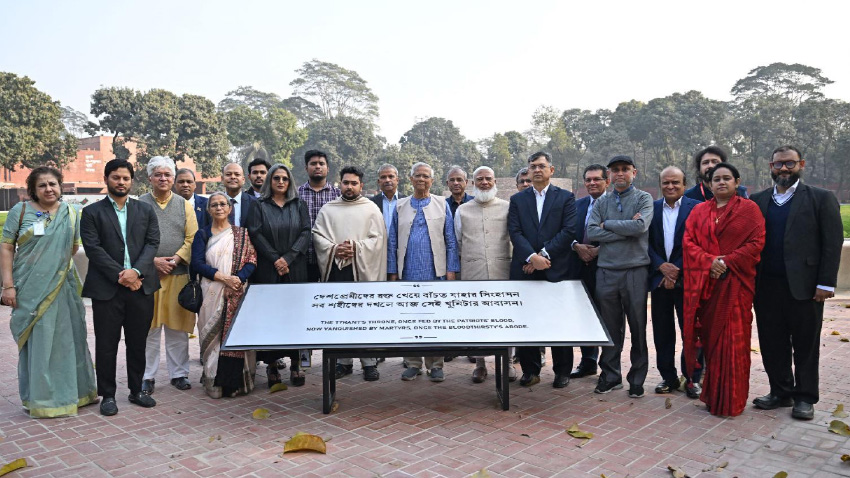
Earlier, Yunus arrived at the museum around 3 pm and toured exhibits detailing the causes of the mass uprising and the history of what was described as 16 years of misrule by the Awami League under Sheikh Hasina.
The visit was attended by BNP Standing Committee member Salahuddin Ahmed, Jamaat-e-Islami Ameer Dr Shafiqur Rahman, National Citizen Party Convener Nahid Islam, advisers to the interim government, and victims and family members of those subjected to enforced disappearances.