



| HEADLINE |

|

Short On Gas, High On Costs
Power plants are feeling the pinch



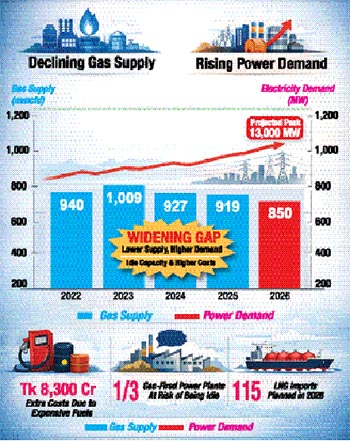 Petrobangla's declining gas supply to power plants is forcing Bangladesh to rely on furnace oil and diesel, sharply increasing electricity costs and risking idle generation capacity.
The state-owned corporation has failed to meet its target of supplying 1,040 million cubic feet of gas per day (mmcfd) to power plants, compelling the Bangladesh Power Development Board (BPDB) to run liquid fuel-based plants. This has pushed power generation costs up by Tk 8,372.88 crore, while capacity charges of new power plants added an extra Tk 3,374 crore to the overall electricity cost.
Petrobangla plans to cut gas supply to power plants by 79mmcfd to 850mmcfd in the current fiscal year, one of the lowest allocations to the sector in the past five years. Domestic gas production is also expected to decline, dropping by 65mmcfd to an average of 1,746mmcfd in 2026 from 1,809mmcfd in 2025.
BPDB data show a fluctuating gas supply trend: 940mmcfd in 2022, 1,009mmcfd in 2023, falling to 927mmcfd in 2024, and 919mmcfd in 2025. Officials warn that if supply falls to 850mmcfd, electricity generation from gas-fired plants could drop to 4,560 megawatts (MW), well below the installed capacity of 12,204MW.
BPDB Chairman Rezaul Karim said, "We are not receiving gas as per commitments. Petrobangla has been supplying an average of 959mmcfd against the promised 1,040mmcfd, leaving a daily shortfall of 81mmcfd. This forces us to ration gas at our plants and rely on furnace oil and diesel to ensure nationwide power supply."
To mitigate shortages, Petrobangla plans to raise gas supply to industries and captive power users by 52mmcfd to 1,105mmcfd, and to the fertiliser sector by 88mmcfd to 229mmcfd. It also plans to import six additional LNG cargoes, bringing the total to 115 in 2026.
Engr Md Rafiqul Islam, Petrobangla Director (Operations) warned that around one-third of Bangladesh's gas-fired power generation capacity may remain idle due to the ongoing shortage. BPDB officials noted that generation could increase to 6,840MW if supply rises to 1,200mmcfd.
The plants most affected include the 584MW Meghnaghat Unique Power Plant, the 718MW Meghnaghat (JERA) Power Plant, and the 583MW Summit Power Plant, many of which are currently operating under severe rationing.
BPDB officials note that generation could rise to 6,840 MW if gas supply is restored to 1,200 mmcfd, highlighting the potential of existing plants if supply stabilises.
This crisis underscores the urgent need to increase domestic gas production, ensure steady supply to power plants, and diversify fuel sources to avoid continued reliance on expensive imported fuels and rising electricity costs.

Loading...
Loading...
Also read



Editor : Iqbal Sobhan Chowdhury
Published by the Editor on behalf of the Observer Ltd. from Globe Printers, 24/A, New Eskaton Road, Ramna, Dhaka.
Editorial, News and Commercial Offices : Aziz Bhaban (2nd floor), 93, Motijheel C/A, Dhaka-1000.
Phone: PABX- 41053001-06; Advertisement: 41053012; 01793317829, 01550707291, E-mail: [email protected], [email protected] Online: email: [email protected] 41053014; 01550707297 Advertisement: 01550707296
Published by the Editor on behalf of the Observer Ltd. from Globe Printers, 24/A, New Eskaton Road, Ramna, Dhaka.
Editorial, News and Commercial Offices : Aziz Bhaban (2nd floor), 93, Motijheel C/A, Dhaka-1000.
Phone: PABX- 41053001-06; Advertisement: 41053012; 01793317829, 01550707291, E-mail: [email protected], [email protected] Online: email: [email protected] 41053014; 01550707297 Advertisement: 01550707296


