



| HEADLINE |

|

Ride-sharing rules on paper, gaps persist on roads
Published : Sunday, 2 August, 2026 at 12:00 AM
Tanvir Raihan


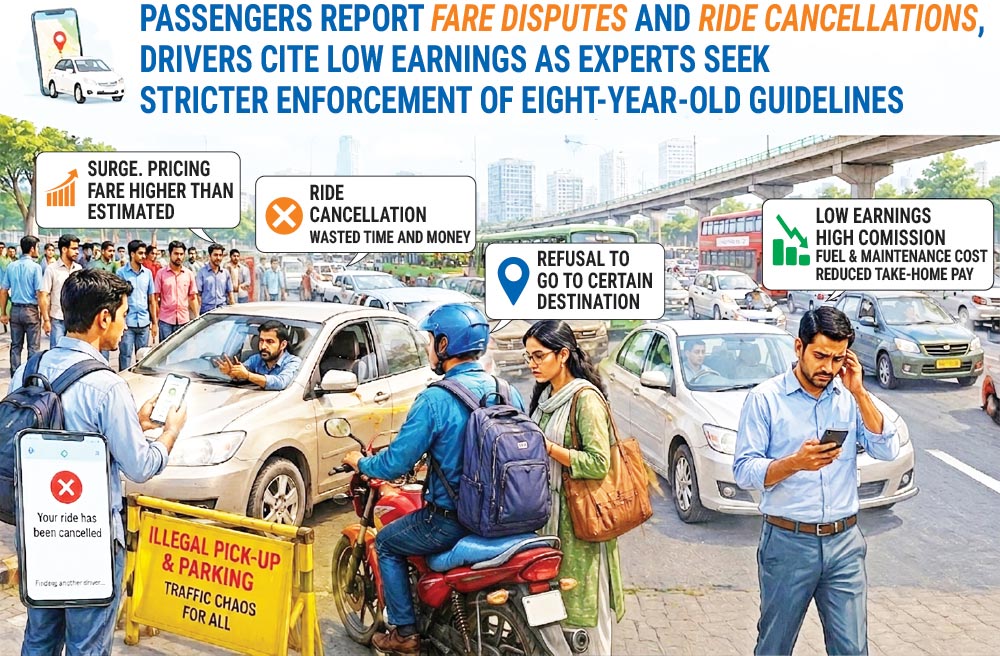 Nearly eight years after Bangladesh introduced the Ride-Sharing Service Guidelines, 2017 to regulate app-based transport services, many of its key provisions remain only partially enforced, leaving passengers frustrated, drivers under financial pressure and regulators struggling to ensure accountability. As ride-sharing has become an indispensable part of urban transport, experts warn that weak enforcement of existing rules is undermining consumer protection, passenger safety and public confidence in the sector.
Passengers continue to complain about frequent ride cancellations, drivers demanding fares higher than those shown on mobile applications, refusal to travel to certain destinations and requests for riders to cancel bookings themselves. Excessive surge pricing during rain, traffic congestion and peak hours, along with delays in reaching pickup points, have also become common grievances.
Several users told The Daily Observer that the fare displayed on ride-sharing applications often differs from the amount ultimately demanded by drivers.
Office worker Zahid Kamal said ride-sharing services had become increasingly unpredictable.
"Travelling through ride-sharing apps today feels uncertain. The same destination may cost completely different fares depending on the time, weather or the driver's willingness to accept the trip," he said.
Drivers, however, say they are also struggling. They argue that high commission rates charged by platform operators, combined with rising fuel and maintenance costs, have significantly reduced their earnings. They also allege that driver accounts are sometimes suspended after disputes with passengers without a transparent review process.
Abul Kalam, a ride-sharing driver operating near the National Press Club, said the current payment structure was unsustainable.
"The platforms pay us only Tk 8 to Tk 9 per kilometre, which is not enough to operate profitably. Better regulations governing communication between drivers and passengers would reduce misunderstandings," he said.
The Ride-Sharing Service Guidelines, 2017 require operators to obtain licences from the Bangladesh Road Transport Authority (BRTA), establish local offices, register vehicles, ensure licensed drivers, provide GPS tracking, digital payment systems and emergency SOS facilities.
The policy also mandates driver training, online complaint management, preservation of trip records, integration with BRTA databases, emergency communication with police control rooms and advance disclosure of estimated fares. Industry stakeholders, however, say many of these requirements remain inadequately implemented.
Passengers also allege that some drivers switch off ride-sharing applications after contacting customers and negotiate fares directly, bypassing digital platforms. Experts warn that the practice reduces transparency, weakens passenger protection and deprives authorities of digital trip records that could prove crucial during investigations.
Illegal parking and passenger pick-up by ride-sharing vehicles at busy intersections and commercial areas have also become common, contributing to traffic congestion in the capital.
Former ride-sharing driver Kamrul said his account was blocked following a disagreement with a passenger. Unable to recover the account, he now operates independently instead of using ride-sharing platforms.
Former President of the Dhaka Ride-Sharing Drivers' Union Sajib Hossain said the guidelines require a tripartite agreement among the platform operator, vehicle owner and driver, but in reality most drivers simply accept online terms and conditions without fully understanding their legal implications.
He also claimed that complaint resolution is often delayed because the servers of some international ride-sharing companies are located outside Bangladesh.
"Drivers deserve stronger legal protection, lower commission rates and greater accountability from platform operators," he said.
The Directorate of National Consumer Rights Protection (DNCRP) said complaints relating to ride-sharing services can be submitted directly or through its online platform.
Md Masum Arefin, Director (Complaints and Investigation) at the directorate, said authorities investigate allegations such as excessive fare collection and may impose administrative penalties if violations are established.
Consumer rights advocates, however, said many passengers remain unaware of the complaint mechanism, while others lose confidence because complaint resolution often takes considerable time.
According to BRTA, 19 ride-sharing companies are registered in Bangladesh, although only three or four remain actively operational. Around 35,000 vehicles are registered under the system, including approximately 26,000 to 27,000 under Uber and 5,000 to 6,000 under Pathao.
A BRTA engineering official said legal action would be taken against companies that fail to comply with regulatory requirements or renew their operational certificates.
Professor Dr Md Hadiuzzaman of the Department of Civil Engineering at the Bangladesh University of Engineering and Technology (BUET) said the sector now required stronger institutional oversight.
"There are significant gaps in driver training, data protection, parking management and regulatory monitoring. Addressing these shortcomings is essential to ensuring safer and more accountable ride-sharing services," he said.
Additional Secretary Md Anisur Rahman of the Road Transport and Highways Division said the government was updating the Ride-Sharing Service Guidelines to reflect current realities. The revised policy, he said, would strengthen regulation, improve accountability and ensure stricter enforcement against operators failing to comply with legal requirements.
Experts say ride-sharing has become an essential component of Bangladesh's urban transport system, but its long-term sustainability will depend on effective enforcement of existing regulations, stronger consumer protection and greater accountability from platform operators.

Loading...
Loading...
Also read



Editor : Iqbal Sobhan Chowdhury
Published by the Editor on behalf of the Observer Ltd. from Globe Printers, 24/A, New Eskaton Road, Ramna, Dhaka.
Editorial, News and Commercial Offices : Aziz Bhaban (2nd floor), 93, Motijheel C/A, Dhaka-1000.
Phone: PABX- 41053001-06; Advertisement: 41053012; 01793317829, 01550707291, E-mail: [email protected], [email protected] Online: email: [email protected] 41053014; 01550707297 Advertisement: 01550707296
Published by the Editor on behalf of the Observer Ltd. from Globe Printers, 24/A, New Eskaton Road, Ramna, Dhaka.
Editorial, News and Commercial Offices : Aziz Bhaban (2nd floor), 93, Motijheel C/A, Dhaka-1000.
Phone: PABX- 41053001-06; Advertisement: 41053012; 01793317829, 01550707291, E-mail: [email protected], [email protected] Online: email: [email protected] 41053014; 01550707297 Advertisement: 01550707296


