



| HEADLINE |

|

Will 13th nat'l election deliver on citizens' hopes?



The 13th National Parliamentary Election, set against the backdrop of the July-August 2024 mass uprising, is being hailed as a constitutional milestone. With nearly 13 crore registered voters-including 4.4 million casting their ballots for the first time-the election is seen as a critical step toward restoring representative governance after more than a decade of authoritarian practices.
College student Hridima said, "Our activities represent our country, because we are Bangladesh. If the elections are not fair, the youth will be disappointed. My dream is that Bangladesh will be youthful." Housewife Selina Ahmed connected voting to citizenship and voter security, stating, "The previous government took away the voting rights of citizens. I want to cast my own vote through a fair election." Marketing manager Zahid Habib described the ballot as symbolic restitution, saying, "This election is not just a change of power for me, but also a restoration of self-respect and voting rights. Whatever government comes, their main principle should be - 'Bangladesh first'. Let this election be the stepping stone for the democratic rebirth of Bangladesh."
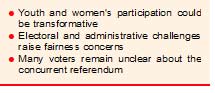
An NGO worker, requesting anonymity, emphasized the transformative potential of conscious participation. "I believe youth and women's active participation can transform education, health, and jobs, and I dream of a Bangladesh where everyone lives with safety, dignity, and equal opportunity."
These voices reflect hopes that February 12 could re-anchor the republic to constitutional norms, though analysts warn that expectations cannot compensate for structural weaknesses. Abdus Salam, a resident of Old Dhaka, stressed voter priorities: "I expect the new government to control prices, create youth jobs, and secure educated futures, while avoiding election conflict and delivering real solutions to the economy, corruption, and unemployment."
The interim administration, formed after Sheikh Hasina's fall on 5 August, has a constitutional duty to ensure a level playing field. Yet reports indicate administrative paralysis and selective enforcement, including extortion networks allegedly run by BNP and Jamaat leaders, violent territorial disputes, targeted killings, forced collection of voter data, and recovery of pre-cast ballots, official seals, and ballot papers from Jamaat-linked candidates. These developments raise concerns about electoral engineering rather than management.
Private school teacher Delwar Hossain warned, "If the national elections follow a false blueprint, it could deeply undermine the country's sovereignty." Constitutional experts note such manipulation violates Articles 7, 11, and 119, which enshrine popular sovereignty and democratic governance. While the previous regime relied on institutional repression, the post-uprising period has produced informal coercion and mob dominance. Delwar noted, "The responsible institutions remain silent spectators," allowing partisan actors to consolidate influence outside legal frameworks. Women and youth are particularly affected.
Middle-aged textile trader Hasibul added, "After a long time, the election mood has returned, and I hope fair polls bring leaders who uphold the July-August values. Despite violence and attacks on women, I dream of a just, corruption-free Bangladesh with dignity and equal opportunity for all."
Young voters say they will support candidates, not parties, but only those committed to women's empowerment. Twenty-nine-year-old Tarannum, who skipped two previous elections, evaluates candidates based on past records, "Whether their words match their deeds." Another student admitted he would vote based on family advice.
Besides the national polls, voters will also cast a referendum vote at the same time. But the referendum remains poorly understood by many. Retired teacher Borhanuddin Ahmed said he would vote 'no', while Ashraf Bhuiyan admitted, "I have no idea what happens if the 'yes' vote wins." Nazmul Haque added, "I hear that this time there will be two votes. One is a 'yes'-'no' vote, the other is for parties. We are still thinking about whether to go to the centre or not."
Such confusion reflects a failure of civic education, risking the referendum becoming a tool of legitimacy rather than democracy. Delwar concluded, "Elections are not about transferring power. They determine the future direction of the state." At present, that direction remains dangerously unclear.
The post-uprising period left a power vacuum, replacing state repression with street-level dominance. Raids, attacks, and harassment have become common amid institutional silence, leaving civil rights and personal security under threat.
College student Hridima said, "Our activities represent our country, because we are Bangladesh. If the elections are not fair, the youth will be disappointed. My dream is that Bangladesh will be youthful." Housewife Selina Ahmed connected voting to citizenship and voter security, stating, "The previous government took away the voting rights of citizens. I want to cast my own vote through a fair election." Marketing manager Zahid Habib described the ballot as symbolic restitution, saying, "This election is not just a change of power for me, but also a restoration of self-respect and voting rights. Whatever government comes, their main principle should be - 'Bangladesh first'. Let this election be the stepping stone for the democratic rebirth of Bangladesh."
An NGO worker, requesting anonymity, emphasized the transformative potential of conscious participation. "I believe youth and women's active participation can transform education, health, and jobs, and I dream of a Bangladesh where everyone lives with safety, dignity, and equal opportunity."
These voices reflect hopes that February 12 could re-anchor the republic to constitutional norms, though analysts warn that expectations cannot compensate for structural weaknesses. Abdus Salam, a resident of Old Dhaka, stressed voter priorities: "I expect the new government to control prices, create youth jobs, and secure educated futures, while avoiding election conflict and delivering real solutions to the economy, corruption, and unemployment."
The interim administration, formed after Sheikh Hasina's fall on 5 August, has a constitutional duty to ensure a level playing field. Yet reports indicate administrative paralysis and selective enforcement, including extortion networks allegedly run by BNP and Jamaat leaders, violent territorial disputes, targeted killings, forced collection of voter data, and recovery of pre-cast ballots, official seals, and ballot papers from Jamaat-linked candidates. These developments raise concerns about electoral engineering rather than management.
Private school teacher Delwar Hossain warned, "If the national elections follow a false blueprint, it could deeply undermine the country's sovereignty." Constitutional experts note such manipulation violates Articles 7, 11, and 119, which enshrine popular sovereignty and democratic governance. While the previous regime relied on institutional repression, the post-uprising period has produced informal coercion and mob dominance. Delwar noted, "The responsible institutions remain silent spectators," allowing partisan actors to consolidate influence outside legal frameworks. Women and youth are particularly affected.
Middle-aged textile trader Hasibul added, "After a long time, the election mood has returned, and I hope fair polls bring leaders who uphold the July-August values. Despite violence and attacks on women, I dream of a just, corruption-free Bangladesh with dignity and equal opportunity for all."
Young voters say they will support candidates, not parties, but only those committed to women's empowerment. Twenty-nine-year-old Tarannum, who skipped two previous elections, evaluates candidates based on past records, "Whether their words match their deeds." Another student admitted he would vote based on family advice.
Besides the national polls, voters will also cast a referendum vote at the same time. But the referendum remains poorly understood by many. Retired teacher Borhanuddin Ahmed said he would vote 'no', while Ashraf Bhuiyan admitted, "I have no idea what happens if the 'yes' vote wins." Nazmul Haque added, "I hear that this time there will be two votes. One is a 'yes'-'no' vote, the other is for parties. We are still thinking about whether to go to the centre or not."
Such confusion reflects a failure of civic education, risking the referendum becoming a tool of legitimacy rather than democracy. Delwar concluded, "Elections are not about transferring power. They determine the future direction of the state." At present, that direction remains dangerously unclear.

Loading...
Loading...
Also read



Editor : Iqbal Sobhan Chowdhury
Published by the Editor on behalf of the Observer Ltd. from Globe Printers, 24/A, New Eskaton Road, Ramna, Dhaka.
Editorial, News and Commercial Offices : Aziz Bhaban (2nd floor), 93, Motijheel C/A, Dhaka-1000.
Phone: PABX- 41053001-06; Advertisement: 41053012; 01793317829, 01550707291, E-mail: [email protected], [email protected] Online: email: [email protected] 41053014; 01550707297 Advertisement: 01550707296
Published by the Editor on behalf of the Observer Ltd. from Globe Printers, 24/A, New Eskaton Road, Ramna, Dhaka.
Editorial, News and Commercial Offices : Aziz Bhaban (2nd floor), 93, Motijheel C/A, Dhaka-1000.
Phone: PABX- 41053001-06; Advertisement: 41053012; 01793317829, 01550707291, E-mail: [email protected], [email protected] Online: email: [email protected] 41053014; 01550707297 Advertisement: 01550707296


