



| HEADLINE |

|

Bangladesh-US cotton pact sparks uproar in Indian parliament
Published : Tuesday, 17 February, 2026 at 12:00 AM
Business Desk


 A sweeping new tariff pact between Bangladesh and the United States has detonated a political storm in India, with opposition leaders warning that the deal could hammer Indian cotton farmers and textile exporters while handing Dhaka a decisive competitive edge in the lucrative American apparel market.
At the centre of the controversy is a provision granting zero-tariff access to Bangladeshi garments entering the US - provided manufacturers use American cotton and man-made fibre. The arrangement, unveiled Monday last week, ties preferential market access to the volume of US textile exports to Bangladesh, creating what critics in New Delhi describe as a "conditional advantage" that may tilt regional trade dynamics.
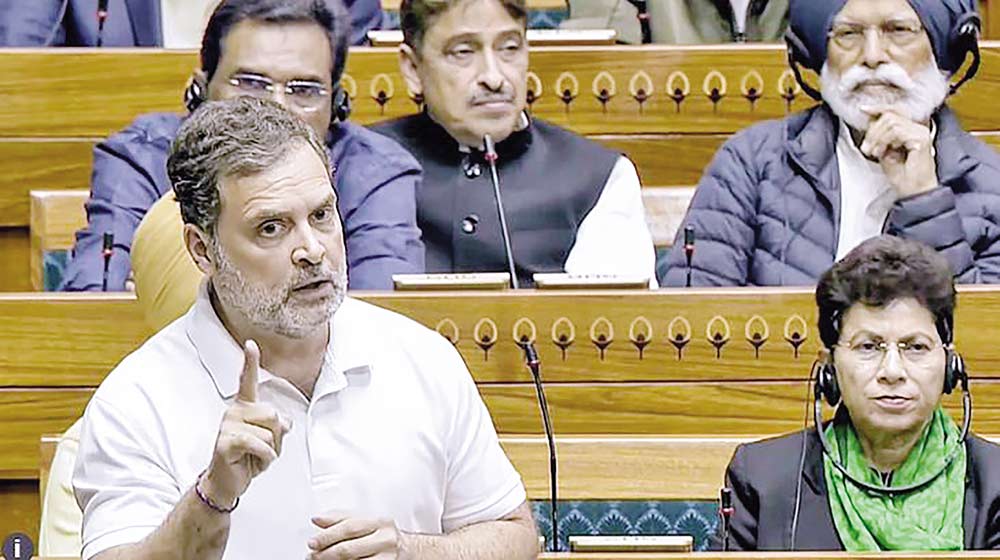
Leader of the Opposition in the Lok Sabha, Rahul Gandhi, launched a blistering attack on Prime Minister Narendra Modi, accusing his government of concealing key implications of India's own interim trade framework with Washington.
While Bangladeshi garments made from US cotton will attract zero tariffs, Indian-made textile imports to the US are set to face an 18 per cent reciprocal duty under the proposed India-US arrangement. Gandhi told Parliament that when he pressed ministers on why Bangladesh had secured a superior concession, he was informed that India could obtain similar treatment only by importing American cotton.
"That choice is a trap," Gandhi wrote on X. "If we import American cotton, we damage our own farmers. If we do not, we fall behind Bangladesh in textiles." The stakes are high. Bangladesh's ready-made garment sector, valued at $38.48 billion in 2024, accounts for more than 80 per cent of the country's export earnings and employs around four million workers. The US remains its single largest market, absorbing $7.34 billion worth of Bangladeshi apparel last year alone.
Bangladesh's interim leader, Muhammad Yunus, confirmed that Washington had "committed to establishing a mechanism" under which textile and apparel goods made with US-produced cotton would receive zero reciprocal tariffs in the American market. The move is widely viewed in Dhaka as a strategic breakthrough at a time of intensifying competition from regional rivals, including India and Vietnam.
In New Delhi, however, the reaction has been sharply divided. Indian cotton exporters fear that Bangladesh - traditionally a major buyer of Indian raw cotton - may pivot decisively towards US suppliers to maximise tariff-free access. Gandhi warned that Dhaka was already signalling a potential reduction, or even halt, in cotton imports from India.
The India-US Interim Agreement, presented as a foundation for deeper economic cooperation, outlines phased tariff reductions on a wide array of American industrial and agricultural products entering India, from animal feed grains and soybean oil to wine and tree nuts. In return, Washington will levy an 18 per cent tariff on selected Indian exports, including textiles, footwear, plastics, leather goods and certain machinery.
Supporters of the agreement argue that eventual tariff elimination on sectors such as generic pharmaceuticals, gems and aircraft components will offset near-term pain. Yet critics contend that textiles and cotton - sectors underpinning millions of livelihoods - have been exposed at a perilous moment.
"The textile industry and cotton farming are the backbone of India's rural economy," Gandhi said. "A visionary government would have negotiated protection, not vulnerability."
For Bangladesh, the pact could reinforce its dominance in US apparel shelves. For India, it has ignited a fierce debate over whether strategic trade diplomacy has yielded advantage - or conceded ground.
Loading...
Loading...
Also read



Editor : Iqbal Sobhan Chowdhury
Published by the Editor on behalf of the Observer Ltd. from Globe Printers, 24/A, New Eskaton Road, Ramna, Dhaka.
Editorial, News and Commercial Offices : Aziz Bhaban (2nd floor), 93, Motijheel C/A, Dhaka-1000.
Phone: PABX- 41053001-06; Advertisement: 41053012; 01793317829, 01550707291, E-mail: [email protected], [email protected] Online: email: [email protected] 41053014; 01550707297 Advertisement: 01550707296
Published by the Editor on behalf of the Observer Ltd. from Globe Printers, 24/A, New Eskaton Road, Ramna, Dhaka.
Editorial, News and Commercial Offices : Aziz Bhaban (2nd floor), 93, Motijheel C/A, Dhaka-1000.
Phone: PABX- 41053001-06; Advertisement: 41053012; 01793317829, 01550707291, E-mail: [email protected], [email protected] Online: email: [email protected] 41053014; 01550707297 Advertisement: 01550707296


