



| HEADLINE |

|

Govt urges calm despite limited fuel stock



 Bangladesh currently has around 15 days of diesel reserves and varying levels of stock for other fuels, authorities said on Friday, as the government closely monitors potential disruptions to energy supply caused by the ongoing conflict in the Middle East.
Power, Energy and Mineral Resources Minister Iqbal Hasan Mahmood said the country's energy system is expected to remain manageable if the conflict ends within the next couple of weeks, but warned that prolonged instability could increase pressure on fuel imports.
"We have about 15 days of storage in our hand. Everything depends on the war," the minister said, adding that the government is also considering purchasing liquefied natural gas (LNG) from the spot market if necessary.
He urged people not to panic and called for more economical use of energy.
"As long as the conflict remains, pressure on energy will continue. Please do not panic or engage in panic buying of fuel. We are trying to run the system efficiently with the resources we have," he said.
Sets limit on fuel oil sales
Import Dependency Raises Concerns
Bangladesh imports nearly all of its liquid fuels and relies heavily on the Middle East for energy supplies. Most shipments pass through the Strait of Hormuz, a key global energy route that has been affected by the ongoing conflict.
"We are not a country that produces liquid fuel; we are an import-dependent country," the minister said. "Most of our fuel comes from the Middle East and passes through the Strait of Hormuz. The war has disrupted normal shipping processes in several ports."
Bangladesh currently has 109 Bangladesh-flagged oceangoing vessels, most of which are bulk carriers and oil tankers operating across global trade routes, including the Gulf region.
Current Fuel Stock Situation
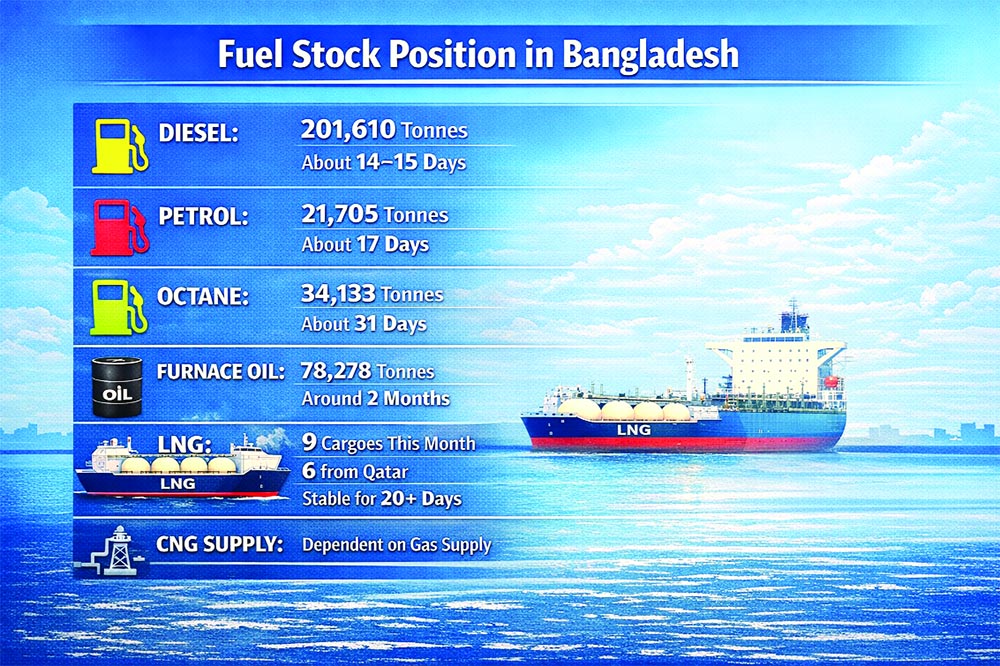
According to the Bangladesh Petroleum Corporation (BPC), the country currently holds 201,610 tonnes of diesel, enough to meet demand for about 14 days.
Stocks of petrol and octane stand at 21,705 tonnes and 34,133 tonnes, sufficient for roughly 17 days and 31 days, respectively.
BPC officials said most refined petroleum imports scheduled until June will come from Malaysia, China, Singapore and Indonesia, meaning those shipments will not be affected by disruptions around the Strait of Hormuz.
However, uncertainty remains regarding crude oil imports, which Bangladesh mainly sources from Saudi Arabia and the United Arab Emirates.
"The fuel supply situation is being closely monitored and contingency planning is underway," said AKM Azadur Rahman, BPC's commercial director.
He noted that while crude oil shipments pass through the Strait of Hormuz, refined petroleum suppliers from other countries have assured Bangladesh that deliveries will continue.
LNG Supply Stable for Now
Officials said the gas supply situation remains stable, with at least 20 days of supply secured.
Bangladesh currently meets about 65 percent of its piped gas demand from local fields, while the remaining portion comes from imported LNG.
The country primarily imports LNG under government-to-government agreements with Qatar, which accounts for around 65 percent of LNG supply.
Petrobangla officials said nine LNG cargoes are scheduled to arrive this month, including six from Qatar.
"Four of those cargoes have already crossed the Strait of Hormuz, so there is no risk regarding those shipments," said Petrobangla Chairman Mohammad Erfanul Haque, adding that authorities are also exploring alternative suppliers if disruptions occur.
Other Fuel Stocks
BPC data shows 78,278 tonnes of furnace oil currently in stock, enough to meet around two months of demand, mainly for power plants and industries.
Meanwhile, Bangladesh's liquefied petroleum gas (LPG) imports are less vulnerable to Middle East disruptions. Around 62 percent of LPG imports now come from the United States, reducing immediate risks to supply.
"Imports have increased slightly compared to previous months, and a major portion now comes from the US," said Md Rokonujjaman, head of sales at Omera Petroleum.
However, he warned that a prolonged crisis in the Middle East could still increase supply pressure and drive up prices as Bangladesh shifts toward alternative sources.
Call for Energy Conservation
The minister urged citizens to reduce unnecessary consumption of electricity and fuel, including limiting private vehicle use and avoiding excessive lighting and decorative illumination.
He also noted that Iran's indication that it does not plan to immediately close the Strait of Hormuz is a positive signal for import-dependent countries like Bangladesh.
Still, authorities say the situation remains fluid, and the government will continue monitoring global developments to ensure the country's energy security.
Meanwhile, The Ministry of Energy Division issued a notice on Friday imposing limits on fuel sales at filling stations across Bangladesh to prevent panic buying and ensure stable distribution of petroleum products nationwide.
Under the new directive, a motorcycle can purchase up to 2 litres of petrol or octane per day, while private cars are limited to 10 litres daily. For sports utility vehicles (SUVs) and microbuses, the daily limit is set at 20-25 litres, and pickup vans and local buses can purchase 70-80 litres of diesel per day.
Long-distance buses, trucks, covered vans, and container trucks will be permitted to take 200-220 litres daily, according to the Bangladesh Petroleum Corporation (BPC), which issued the instructions on behalf of the Energy Division.
BPC noted that recent reports in traditional and social media about fuel stock levels had triggered excessive consumer demand, prompting crowds at filling stations and large-scale purchases beyond normal requirements. The corporation emphasized that Bangladesh imports about 95 percent of its fuel oil, and import operations can occasionally face delays during global crises.
Authorities also highlighted that some dealers and consumers were attempting to stockpile fuel, leading the Energy and Mineral Resources Division to intervene. To curb the practice, filling stations are now instructed to provide receipts showing the type, quantity, and price of fuel purchased, and consumers must present their previous receipt for subsequent purchases.
Dealers are required to supply fuel based on official allocations and verified purchase records. Depots will review dealers' current stock and allocation records before approving additional supply, BPC said.
The corporation reassured the public that fuel imports are continuing according to schedule and shipments are arriving regularly. Fuel is also being transported from major installations to depots nationwide via rail wagons and tankers, and authorities expect a sufficient buffer stock to be built up within a short period.
With these measures, the government aims to prevent unnecessary panic, ensure fair access to fuel, and maintain stability in the distribution system across the country.

Loading...
Loading...
Also read



Editor : Iqbal Sobhan Chowdhury
Published by the Editor on behalf of the Observer Ltd. from Globe Printers, 24/A, New Eskaton Road, Ramna, Dhaka.
Editorial, News and Commercial Offices : Aziz Bhaban (2nd floor), 93, Motijheel C/A, Dhaka-1000.
Phone: PABX- 41053001-06; Advertisement: 41053012; 01793317829, 01550707291, E-mail: [email protected], [email protected] Online: email: [email protected] 41053014; 01550707297 Advertisement: 01550707296
Published by the Editor on behalf of the Observer Ltd. from Globe Printers, 24/A, New Eskaton Road, Ramna, Dhaka.
Editorial, News and Commercial Offices : Aziz Bhaban (2nd floor), 93, Motijheel C/A, Dhaka-1000.
Phone: PABX- 41053001-06; Advertisement: 41053012; 01793317829, 01550707291, E-mail: [email protected], [email protected] Online: email: [email protected] 41053014; 01550707297 Advertisement: 01550707296


