
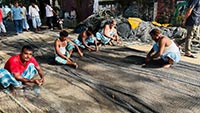
At sunrise on the coast of Bangladesh, the sea still appears generous. Wooden boats sail into the Bay of Bengal, as they have done for generations. Nets are cast in quiet hope, and for a moment everything seems unchanged. But listen to the fishermen when they come back, and another story comes forth, one of uncertainty, dwindling hauls and rising trepidation. The sea is indeed a thing of the past.
This is no sudden collapse. It is a quiet crisis slow-building over decades. And now it has come to the point where we do not ignore it anymore.
Illegal, Unreported and Unregulated (IUU) fishing is at the heart of this crisis. It represents almost 20% of the total fish catch worldwide, resulting in a loss of up to 23 billion dollars per year (FAO, 2020). But in Bangladesh, it's not only a story of lost revenue. It is about ecological decline, economic pressure and an increasing battle to retain control over national waters.
Bangladesh has a maritime territory greater than 200,000 square kilometers. It is huge, rich in resources and integral to the nation's economy and food security. The fisheries sector alone almost account for 3.57 % of the national GDP and sustained more than 17 million people either directly or indirectly. But despite this trend important, this sector is no longer being built on something solid.
According to scientific assessments, nearly 34% of marine fish stocks in the Bay of Bengal are fully exploited or overexploited; another 16% continue at risk due to unregulated practices. These are not distant forecasts, they're present realities. And its effects are evident in the water itself.A study of commercial marine fish landings in the northern Bay of Bengal from 1985 to 2013 tracked the status of major fish stocks. Early on, most stocks were "developing," but with mechanization and intensified fishing, they shifted to "fully exploited" (56.1%) and then "overexploited" (36.8%). A few stocks collapsed, with some, like pigface breams, remaining collapsed for many years, while others began rebuilding. No stocks remained in a developing state by the end of the study. Pelagic and demersal stocks showed similar trends. The shorter duration a stock spent in each category in recent years indicates faster transitions across exploitation states. The rates of decline for key commercial species are alarming. Biomass of silver pomfret is down 58% since 2000. Indian salmon has plummeted even further, down 63%. Shrimp catch efficiency has decreased by nearly 29% meaning that "we are putting in more effort for less fish." Even hilsa, a cultural and economic iconic fish of Bangladesh has reduced its average size by 33% in the last 15 years (World Bank, 2020; FAO, 2018; Mohammed et al., 2021).
These numbers tell a story that is clear: the ecosystem is under pressure.
But numbers alone do not account for why this is happening. To grasp that, you have to consider the mounting pressure on the sea from both within and beyond Bangladesh.
At the same time, bigger industrial ships that often cross borders bring different kinds of pressure. The Bay of Bengal is a shared space, and while maritime boundaries are legally defined, they remain hard to enforce in practice. Following the settlement of its maritime disputes in 2012 and 2014 Bangladesh has secured a quality expansion of ko its Exclusive Economic Zone. But that expansion came with new challenges.
However, enforcement practices shifted in recent years. From 2020 to 2024, Bangladesh seized only 18 boats but conducted 285 "drive-away" operations, where vessels were boarded and pushed out of national waters. Comparatively, India seized 3 boats and carried out 141 drive-away incidents during the same period. This means Bangladesh accounted for approximately 86% of drive-away actions and 86% of total boardings, while India accounted for 14%, highlighting Bangladesh's heavier enforcement activity at sea.
The shift from detentions to non-custodial "drive-away" operations suggests both active maritime monitoring and significant limitations in Bangladesh's capacity to detain, prosecute, and legally process offenders. While shoving ships away avoids immediate confrontations, it does little to prevent repeat violations, as many of the same boats return.
Bangladesh is actively patrolling its waters, but legal and operational constraints limit its ability to stop repeated incursions. The rise in "drive-away" actions and vessel turnaways highlights the persistent challenge of illegal fishing and the urgent need for stronger, sustainable enforcement measures.
There is a more structural problem behind these numbers. Surveillance capacity remains limited. Although we only track around a third of registered fishing vessels and even then, many of them are not equipped with Vessel Monitoring Systems (VMS) recent research behind our new briefing shows that large swathes of the fleet, where more data is collected, remain invisible. At the same time, over 70% of enforcement is still manual inspection, which makes catching disturbances and responding in real-time very difficult.
It's this gap between policy and practice that allows IUU fishing to flourish.
There is also a larger, more diffuse force behind this crisis is global demand. As global markets for seafood continue to grow, so too does the economic incentive for exploitation of marine resources. High-value shrimp and hilsa lures both legal and illegal operators. In many cases, profits are shared upward to traders and middlemen while risks remain with small-scale fishers.
This starts a system where e.g. illegal fishing is no longer an individual effort, but part of an entire economic model.
In Bangladesh, fish is the main protein source. The decrease in supply will inevitably impact food security, particularly among lower-income populations. Prices will rise. Access will shrink. Nutritional gaps may widen.
The other issue is national control. Bangladesh has invested significantly over the past years to secure its maritime boundaries but enforcement gaps risk compromising that. With illegal activities continuing to exploit these gaps, the nation risks an erosion not merely of resources but of sovereignty over its own waters. And yet, for all this, the crisis is largely invisible to the wider public.
Fish still arrive in markets. Life appears normal. But underneath that surface, the system is stretched.Moving forward will require more than just awareness it will take action that is evidence-based. Adding on to the success of VMS, enhancing satellite-based monitoring and reinforcing legal enforcement are pivotal actions. But those needs must be complemented with support for fishing communities. Enforcement will not succeed without addressing poverty and livelihood insecurity.Regional cooperation is equally essential. No country can manage the Bay of Bengal in isolation. Sharing data, coordinating patrols and aligning policies could turn a fragmented system into a unified response.
In the end, this isn't merely a fisheries issue. It is a test of governance, sustainability and longterm thinking.The boats will keep departing at sunrise. Fishermen will still throw their nets. But what they bring back and whether they can continue at all depends on decisions being made now.
Bangladesh's ocean is not empty yet. But the writing is freely available, it's clear enough from declining stocks, rising incursions and increased enforcement pressure.
And if we don't respond, the story of the Bay of Bengal could change from one of plenty to one of loss one net, one boat, one missed warning sign at a time.
The writer is a research fellow of Bangladesh Institute of Maritime Research and Development (BIMRAD) and PHD Fellow of BOBP-IGO, Chennai, India





