
Bangladesh's riverine geography has long produced a complex socio-economic crisis, at the center of which lies river erosion. Particularly in the char areas of the Padma River basin, this issue is not merely a matter of geographical transformation; rather, it reflects a deeper political economy where natural disasters, state policy, administrative structures, and power asymmetries collectively trap marginalized communities in a prolonged cycle of insecurity.
Although river erosion is often understood as a purely natural process, its impacts and scale are significantly shaped by human-induced policy failures, infrastructural weaknesses, and unplanned river management practices. Changes in river courses, uneven sediment deposition, and poorly designed embankments or dredging activities all accelerate erosion. However, the most affected victims of this complex process are the impoverished char dwellers, for whom state protection remains largely absent. Char areas may be understood as "liminal spaces"-where permanence and impermanence coexist simultaneously. Land is continuously created and destroyed, making ownership, settlement, and social security deeply uncertain. This uncertainty extends beyond economics into social capital, education, healthcare, and political representation.
As a result, char inhabitants effectively live in a form of "invisible citizenship," where their existence is only partially acknowledged by the state. The displacement caused by river erosion leads to long-term humanitarian consequences and accelerates internal migration. This rural-to-urban movement contributes to the expansion of urban slums, the growth of informal labor markets, and the intensification of social inequality. Consequently, river erosion is no longer a localized environmental issue; it has far-reaching implications for the national economy and urban governance. However, the most alarming dimension of this crisis is the emergence of a "seasonal administrative economy." During the monsoon season, when erosion and flooding intensify, administrative activity becomes highly visible-relief distribution, emergency assistance, and project announcements increase significantly. Yet this responsiveness is largely reactive rather than proactive.
As a result, the structural causes of the disaster remain unaddressed. This raises a critical question: Is disaster management truly driven by humanitarian responsibility, or has it evolved into a form of rent-seeking governance structure? Field observations and various studies suggest that although substantial funds are allocated for relief distribution, rehabilitation projects, and infrastructure development, a significant portion is lost to inefficiency, corruption, and nepotism. Consequently, genuine victims are deprived of assistance, while an opportunistic network benefits from what effectively becomes a "seasonal economy of disaster."
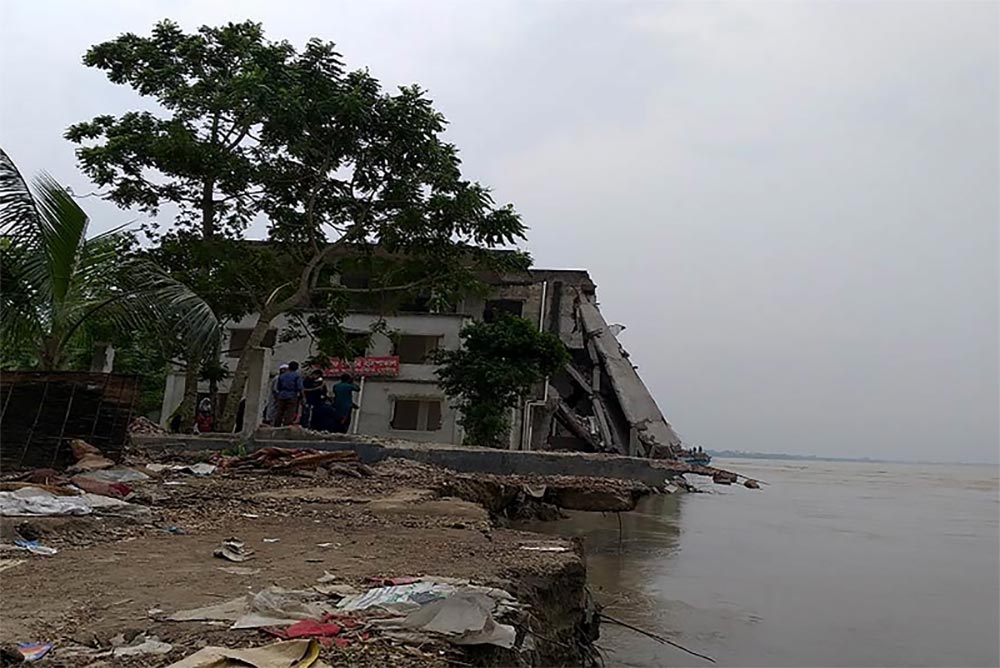
This phenomenon can be analyzed through the lens of "disaster capitalism," where crises are transformed into economic opportunities. In the context of Bangladesh, this takes a distinct form involving tacit coordination between local administration, political patronage, and influential actors. As a result, post-disaster reconstruction often shifts from genuine rehabilitation to a project-based economic cycle. Meanwhile, long-term rehabilitation strategies for char communities remain severely inadequate. Sustainable embankments, river training systems, planned resettlement, and alternative livelihood opportunities are insufficiently developed. Instead, short-term and ad hoc interventions dominate, failing to provide durable solutions.
In this context, river erosion must be redefined as a governance issue rather than merely a natural disaster. Engineering solutions alone are insufficient. What is required is an integrated policy framework that equally prioritizes environmental sustainability, social justice, and economic inclusion. Without participatory planning, transparency, and accountable administration, breaking this cycle of vulnerability will remain impossible.
In conclusion, while river erosion is an inevitable geographical reality for Bangladesh, its devastating impacts are not unavoidable. With political will, institutional capacity, and above all, ethical governance, its consequences can be significantly mitigated. Otherwise, river erosion will remain not just a natural disaster, but a symbol of structural inequality-where the poor lose everything, while a few opportunistic actors gain seasonal profit.
The writer is a student, Fulchhari Government College, Gaibandha





