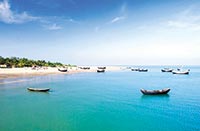
As the world's population continues to grow, pressure on natural resources is increasing significantly. It is projected that the global population will reach nearly nine billion by 2050, intensifying the demand for food, energy, and economic opportunities. In this context, the sustainable use of oceans and marine resources-commonly known as the Blue Economy-has emerged as a crucial pathway for ensuring economic growth, environmental sustainability, and food security.
The Blue Economy refers to the sustainable utilization of ocean resources for economic development, improved livelihoods, and job creation while preserving marine ecosystems. Today, ocean-based economic activities contribute an estimated US$3-5 trillion annually to the global economy. Marine resources provide a significant share of protein for approximately 4.3 billion people worldwide, while nearly 30 percent of the world's oil and gas production comes from offshore reserves. Beyond its economic significance, the Blue Economy also plays a vital role in maintaining ecological balance and promoting harmony between human development and nature.
For Bangladesh, the Blue Economy presents immense opportunities. As a coastal nation endowed with rich marine resources, Bangladesh stands to benefit greatly from the sustainable development of its maritime sector. The Bay of Bengal represents a vast reservoir of economic potential, offering opportunities in fisheries, mineral extraction, renewable energy, maritime transport, and tourism. Following the settlement of maritime boundary disputes through international arbitration in 2014, Bangladesh secured sovereign rights over approximately 118,813 square kilometres of maritime territory, further expanding the prospects for marine-based economic development.
One of the most promising sectors is deep-sea fisheries. Bangladesh's maritime area is nearly equal in size to its land territory, and marine fisheries already contribute significantly to the national economy. Around half a million coastal fishers depend directly on the sea for their livelihoods. The Bay of Bengal is home to approximately 475 species of fish, 36 species of shrimp, and numerous other commercially valuable marine organisms. Experts estimate that the country's maritime waters have the potential to yield up to eight million tonnes of fish annually. Given the growing global demand for seafood, Bangladesh could substantially increase its export earnings through sustainable fisheries management and modern harvesting techniques.
The country's Exclusive Economic Zone (EEZ) also holds promising reserves of minerals and energy resources. Studies conducted along the Cox's Bazar coast have identified economically significant heavy mineral deposits. Marine tourism is another sector with enormous potential. Tourism has become a major source of income for many countries, and Bangladesh possesses several unique attractions. Cox's Bazar, renowned as the world's longest natural sea beach, continues to attract visitors from home and abroad. The development of the Matarbari Deep Sea Port is expected to stimulate economic activities across the region and create new opportunities for tourism and commerce in nearby areas, including Kutubdia. Improved infrastructure, environmental management, and security in destinations such as Saint Martin's Island, Kuakata, and the Sundarbans could significantly boost international tourist arrivals and generate substantial revenue.
As a riverine country, Bangladesh can also strengthen its economy through the modernization of inland waterways and ports. Expanding waterborne transportation would reduce pressure on road networks, lower transportation costs, ease traffic congestion, and decrease road accidents. Efficient maritime and inland shipping systems are essential components of a thriving Blue Economy.
Moreover, industries such as shipbuilding and ship recycling, marine renewable energy, marine biotechnology, and seafood processing can further enhance economic development. Processed seafood products-including fish, shrimp, crabs, and shellfish-have strong demand in international markets. Establishing modern seafood-processing facilities would not only increase export earnings but also create employment opportunities across the value chain.
In conclusion, the Blue Economy offers Bangladesh a transformative opportunity to accelerate economic growth, strengthen food security, create jobs, and earn foreign exchange. However, realizing this potential requires a long-term strategy focused on sustainability, environmental protection, technological innovation, research and development, and human resource development. With effective policies and responsible management of its marine resources, Bangladesh can emerge as one of the world's leading examples of successful Blue Economy-driven development.
The writer is a student, Department of French Language and Culture, University of Dhaka





