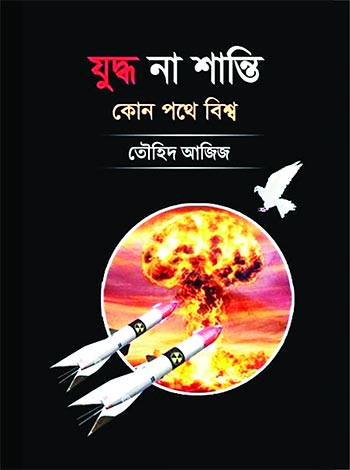
Journalist Towhid Aziz’s book ‘Juddho Na Shantee: Kon Pathe Bishwa’ is written against the backdrop of a complex and turbulent phase in contemporary global politics. The title itself clearly conveys the message the author seeks to deliver. It raises a fundamental question: will this world move toward the path of war or will it release the dove of peace and make the path of humanity more accessible and enlightened?
The book was published at the time when Israel and the United States are engaged in a fierce war against Iran. Although the author could not directly address this ongoing war here, because when he was writing this book, the atmosphere of war had just been created. The writer perceptively anticipated such thing & gave this title to his book after sensing that.The author suggests that the clamor of weapons is steadily increasing in today’s world, where powerful states appear more interested in showcasing military strength than in promoting human welfare.
The book’s cover visually reinforces this message. It depicts the horrors of war through images of nuclear explosions and missile strikes, juxtaposed with the symbol of peace�"a white dove. This stark contrast effectively captures the core message of the book. From the very beginning, the reader is drawn into a sense of unease and deep reflection, which aligns perfectly with the book’s purpose. As time has progressed, the Iran conflict has extended beyond a month, accompanied by threats of turning the entire country into a living hell. In such a reality, the ultimate outcome remains uncertain, raising concerns about whether this could be a precursor to a third world war.
In the book, the author highlights how global powers play various strategic games under the guise of democracy. He argues that despite their outward displays of friendship, these states never compromise their core interests. The author explores why the Middle East attracts such intense attention from Israel and the United States, why the U.S. maintains military bases across the region, and why divisions have been created among Muslim nations. He provides concise explanations, emphasizing that the root cause lies in the control of oil resources, which fuels these destructive conflicts.
Through various perspectives, the author illustrates the complex equations of global politics and how superpowers operate across the world. He references Samuel Huntington’s 1980s theory of the “Clash of Civilizations.” While conflicts such as Iran-Israel tensions, Gaza, and the Russia-Ukraine war may not perfectly align with Huntington’s framework, the author argues that they nonetheless reflect elements of civilizational conflict. According to this theory, after the Cold War, ideological divisions would decline, while cultural and civilizational conflicts would intensify. From this viewpoint, the Iran-Israel conflict can be seen as a clash of cultures. Similarly, the Russia-Ukraine war also reflects tensions between different cultural and civilizational identities, as Ukraine seeks closer ties with the Western world, while Russia asserts its own distinct political and cultural identity.
The book also includes several theoretical analyses, such as game theory, balance of power, and balance of terror. “Balance of power” refers to maintaining a country’s military or economic strength in such a way that it deters potential aggression. On the other hand, “balance of terror” describes a situation in which two states possess nuclear capabilities and are aware that any attack would provoke a devastating retaliatory strike. This mutual fear prevents either side from initiating nuclear war. This concept was particularly relevant during the Cold War, when the United States and the Soviet Union maintained nuclear deterrence against each other.
In the present context, both India and Pakistan are nuclear powers, where the concept of “balance of terror” may also apply. The fear of mutual destruction acts as a restraint, preventing large-scale conflict and thereby contributing to the maintenance of a balance of power and global stability.
Beyond conventional analysis, the book also includes the author’s previously published columns on international affairs, travel narratives, and a variety of essays. This makes the work both analytically rich and a valuable compilation of selected writings. From a critical perspective, some analyses may appear somewhat simplified, and certain topics could have benefited from deeper exploration. However, this does not diminish the book’s overall significance; rather, it makes the subject matter more accessible to general readers.





