



| HEADLINE |

|
All Societies Die: How to Keep Hope Alive


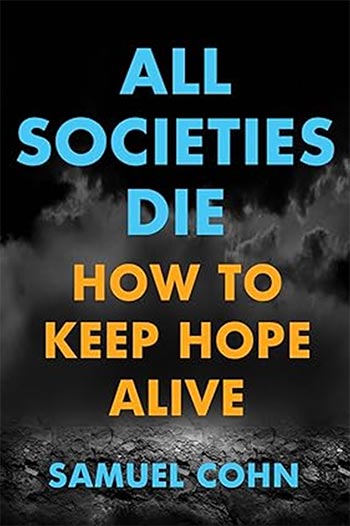 In 'All Societies Die: How to Keep Hope Alive', sociologist Samuel Cohn confronts one of the most unsettling questions in social science: Why do societies collapse? Rather than treating societal decline as an exceptional event, Cohn argues that the rise and fall of civilisations is a normal historical process. Yet the book is not a pessimistic meditation on inevitable doom. As its subtitle suggests, it is equally a study of resilience, collective action, and the possibilities for extending the life of societies through informed political and social choices.
Combining historical sociology, political economy, development studies, and comparative history, Cohn offers an ambitious framework for understanding both the decline of past civilisations and the challenges confronting the contemporary world.
Published by Cornell University Press in 2021, the book spans 272 pages. It offers a sociological exploration of social decline, resilience, and the possibilities for sustaining hope in the face of societal crises.
Reviewed by Dr Matiur Rahman
The book begins with a provocative proposition: all societies eventually die. Drawing upon examples ranging from the Byzantine Empire and the French Revolution to Somalia, Latin American drug cartels, and contemporary geopolitical crises, Cohn argues that societal collapse follows identifiable patterns rather than random accidents.
According to Cohn, societal decline emerges from interconnected processes that reinforce one another in what he calls the "Circle of Societal Death." These processes include environmental degradation, declining state legitimacy, corruption, economic stagnation, social fragmentation, violence, and weakening networks of cooperation. Once initiated, these forces can generate a self-reinforcing cycle that gradually undermines institutions and social cohesion.
The originality of the book lies in its effort to integrate diverse strands of sociological theory into a single explanatory framework. Cohn challenges simplistic explanations that attribute societal collapse solely to environmental disasters, moral decline, or poor leadership. Instead, he presents societal death as a multidimensional process involving economic, political, cultural, and demographic factors.
One of the book's greatest strengths is its remarkable historical scope. Cohn moves effortlessly across centuries and continents, connecting seemingly unrelated events and societies. The Byzantine Empire, revolutionary France, contemporary Somalia, and modern America are treated not as isolated cases but as variations of broader historical patterns.
This comparative approach enables readers to recognise recurring mechanisms of decline. The analysis highlights how fiscal crises, corruption, political polarisation, environmental stress, and the weakening of public institutions repeatedly emerge in societies approaching periods of instability. The book, therefore, contributes to a long intellectual tradition that includes theorists of civilizational change such as Ibn Khaldun, Oswald Spengler, and Arnold J. Toynbee, while grounding its arguments in contemporary sociological research.
Despite its title, 'All Societies Die' is not fundamentally a pessimistic book. Cohn insists that understanding the mechanisms of decline creates opportunities for intervention. Societies are not passive victims of historical destiny. Human agency, collective action, and institutional reform remain powerful forces.
The latter chapters focus on what sustains societal survival. Cohn emphasises trust, cooperation, investment in science and education, effective public institutions, social inclusion, and civic engagement. He argues that societies capable of fostering cultures of cooperation are more resilient than those dominated by division and distrust.
This hopeful orientation distinguishes the book from many contemporary works on democratic decline, climate catastrophe, or civilizational collapse. Rather than predicting imminent apocalypse, Cohn seeks to identify practical pathways toward societal renewal.
Second, the interdisciplinary nature of the work broadens its appeal. Scholars and students of sociology, political science, history, development studies, and public policy will find valuable insights.
Third, the book's comparative methodology encourages readers to think beyond national boundaries and short-term political debates. It situates contemporary crises within larger historical processes, providing a refreshing alternative to narrowly focused analyses.
The book's ambitious scope also creates certain limitations.Because Cohn covers such a vast range of cases and themes, some discussions remain necessarily brief. Readers seeking detailed historical analyses of specific societies may find the treatment somewhat selective. Additionally, the effort to identify common patterns across highly diverse societies occasionally risks oversimplifying unique historical contexts.
Some scholars may also question the predictive capacity of the "Circle of Societal Death." While the framework is compelling as a heuristic model, demonstrating precise causal relationships across all historical cases remains challenging.
Nevertheless, these limitations are largely unavoidable in a work attempting such a comprehensive synthesis. The book's greatest contribution may be its relevance to current global challenges. Rising inequality, environmental degradation, declining trust in institutions, political polarisation, and governance crises have become central concerns across much of the world. Cohn's analysis provides a framework for understanding how these seemingly separate problems can interact and reinforce one another.
For readers in developing countries, including Bangladesh, the book offers particularly valuable insights into the importance of institutional legitimacy, social trust, environmental sustainability, and inclusive development. Its lessons extend beyond academic debate and speak directly to questions of governance and social cohesion.
'All Societies Die: How to Keep Hope Alive' is an intellectually ambitious, accessible, and thought-provoking contribution to contemporary historical sociology. Samuel Cohn succeeds in transforming a grim subject-the death of societies-into a constructive discussion about resilience, reform, and collective responsibility. By combining historical analysis with practical optimism, he reminds readers that while societal decline may be a recurring feature of history, the future remains open to human action.
For scholars, students, policymakers, and general readers interested in the fate of civilisations and the future of democratic societies, this book is both a warning and an invitation: a warning about the forces that erode social order and an invitation to participate in sustaining it.
The reviewer is a researcher and development professional
Loading...
Loading...



Editor : Iqbal Sobhan Chowdhury
Published by the Editor on behalf of the Observer Ltd. from Globe Printers, 24/A, New Eskaton Road, Ramna, Dhaka.
Editorial, News and Commercial Offices : Aziz Bhaban (2nd floor), 93, Motijheel C/A, Dhaka-1000.
Phone: PABX- 41053001-06; Advertisement: 41053012; 01793317829, 01550707291, E-mail: [email protected], [email protected] Online: email: [email protected] 41053014; 01550707297 Advertisement: 01550707296
Published by the Editor on behalf of the Observer Ltd. from Globe Printers, 24/A, New Eskaton Road, Ramna, Dhaka.
Editorial, News and Commercial Offices : Aziz Bhaban (2nd floor), 93, Motijheel C/A, Dhaka-1000.
Phone: PABX- 41053001-06; Advertisement: 41053012; 01793317829, 01550707291, E-mail: [email protected], [email protected] Online: email: [email protected] 41053014; 01550707297 Advertisement: 01550707296


