
Over the past week, heavy to very heavy rainfall in the upstream hills of Cherrapunji and Meghalaya, combined with ongoing rainfall within Bangladesh, has pushed large volumes of hill water into the haor basins of Sylhet and surrounding districts. Although a full-scale flood has not yet formally occurred, this early influx of water-arriving before the completion of the boro harvest-has already created widespread waterlogging and uncertainty. Importantly, this situation did not arise without warning. Both the India Meteorological Department and the Bangladesh Meteorological Department had forecast heavy rainfall and the likelihood of early flash flood conditions in the region.
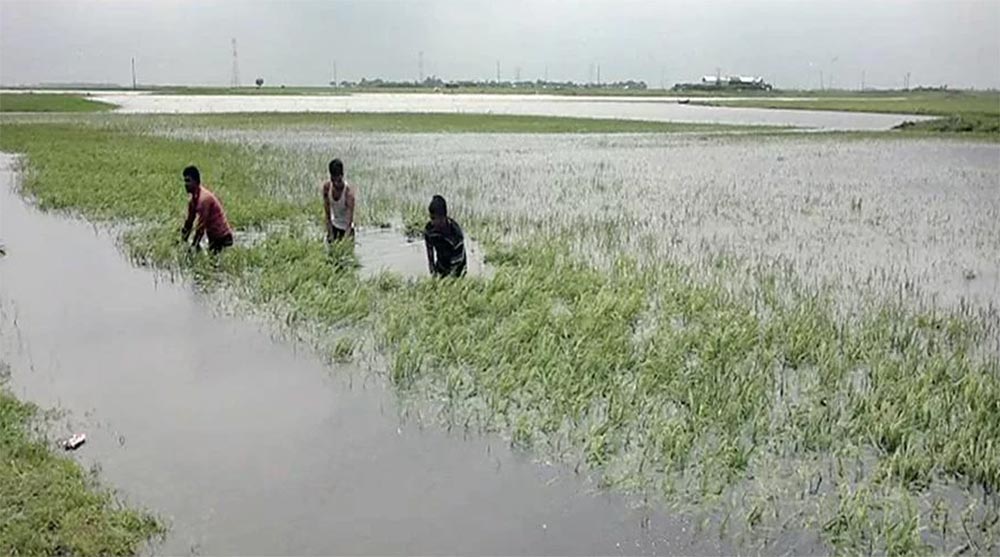
As flood waters from the hills of Cherrapunji and Meghalaya continue to surge into the haor basins of Sylhet and adjoining districts, vast stretches of ripened boro fields now submerging under water. While public attention has rightly focused on the immediate threat to rice production, an equally alarming but less visible danger is emerging beneath the surface-the growing risk to aquatic life, particularly fish populations, which may face severe stress or mortality if current conditions persist.
The haor region, comprising 373 wetlands, is not only a major rice-producing zone-contributing nearly 18% of Bangladesh's total rice-but also a vital fisheries hub. According to the Fisheries Resources Survey System, the haor fisheries sector produced 128,378 metric tons of fish in FY 2023-24. For millions of people, these wetlands are both a source of food security and livelihood. Yet, this delicate ecological balance is now under threat.
As of April 28, only about 50% of the total boro harvest has been completed across the haor districts. The situation varies across regions: Sunamganj has achieved roughly 44.5% harvest, Kishoreganj about 48%, Habiganj approximately 53%, and Netrokona between 55% and 62%. Across the broader Sylhet region, around 56% of cultivated land has been harvested. This means a significant portion of fully ripened paddy still stands in the fields-now submerging under rising water.
The reasons for this incomplete harvest are complex but interconnected. Persistent heavy pre-monsoon rainfall, combined with early flash water driven by upstream runoff from Meghalaya, has inundated fields before harvesting could be completed. The resulting waterlogging has rendered modern combine harvesters ineffective, as they cannot operate in muddy or flooded terrain. At the same time, farmers face acute labor shortages, soaring wage demands, high diesel prices, and fuel scarcity. Frequent lightning strikes have further made fieldwork dangerous, while the submergence of traditional drying yards (kholas) has made post-harvest processing nearly impossible.
While the scale of crop loss is undeniably severe, focusing solely on agriculture risks overlooking a cascading ecological crisis. Submerged paddy fields do not simply represent lost harvests-they may become large masses of organic material decomposing underwater. As these rice plants rot, microbial activity can increase rapidly, consuming dissolved oxygen (DO) from the water. At the same time, decomposition may release ammonia and other byproducts, altering water chemistry and potentially lowering pH. These combined changes can create a stressful, and sometimes harmful, environment for aquatic organisms.
Fish, which depend on sufficient dissolved oxygen levels, are particularly vulnerable under such conditions. Prolonged stagnation, combined with high organic load from decomposing crops, can lead to oxygen depletion, forcing fish to either migrate-if possible-or suffer stress and mortality. However, it is important to note that such outcomes are not guaranteed; they depend on the extent and duration of paddy submergence, water movement, and overall hydrological conditions within the haor system.
This is not merely a theoretical concern. During the early flash flood of the 2017 in haor region, similar conditions were observed. Large areas of unharvested boro paddy were submerged, and subsequent decomposition contributed to water quality deterioration. Reports from that time indicated abnormal ammonia buildup, declining dissolved oxygen levels, and a shift in pH, ultimately resulting in mass fish mortality across several haor systems. The parallels with the current situation are difficult to ignore.
What makes the present scenario even more concerning is its recurrence. Early flash floods, once considered occasional anomalies, are becoming more frequent and unpredictable. This reflects a broader pattern of climatic variability and intensified rainfall in upstream catchments, particularly in Meghalaya. The haor system, by its very nature, is highly sensitive to such hydrological changes. Yet, preparedness measures continue to focus predominantly on crop protection, often neglecting the interconnected aquatic ecosystem.
The implications are profound. Farmers risk losing their annual rice harvest, while fishing communities may simultaneously face declining fish stocks. This dual shock-agricultural and fisheries loss-can significantly undermine food security, income stability, and rural resilience in the region.
It is therefore essential to recognize that this is not just an agricultural disaster, but an ecosystem-level risk. Managing haor conditions requires an integrated approach that considers both crop production and aquatic health. Early warning systems based on upstream rainfall data must be strengthened. Rapid harvesting support-through coordinated labor deployment and appropriate machinery-should be prioritized before peak inundation. Equally important is the need for real-time monitoring of water quality parameters such as dissolved oxygen, ammonia, and pH to assess ecological risk.
The events of 2017 served as a warning. The unfolding situation today suggests that the lesson remains only partially learned. If submerged paddy continues to rot under stagnant water, conditions may develop that threaten aquatic life, including fish populations. In this context, the Department of Fisheries and relevant fisheries officials should remain vigilant, concerned, and prepared. Proactive monitoring, early detection of water quality deterioration, and rapid response planning could play a critical role in preventing or minimizing ecological damage. While fish mortality is not inevitable, the risk is real-and preparing for it now may determine whether the haor ecosystem faces another avoidable crisis.
The writer is a lecturer, Section of Inland Aquatic Resource Management, Department of Fisheries Resources and Management, Habiganj Agricultural University





