



| HEADLINE |

|

Once again, sacrificial hides end up in rivers, fields, bins
Published : Monday, 1 June, 2026 at 12:00 AM
Mizanur Rahman


 Every year, stakeholders in Bangladesh's leather industry hope that the sacrificial hide market will finally turn a corner. Every year, the government announces prices, promises strict market monitoring and industry leaders express optimism. Yet, once again, the reality on the ground has told a different story.
This Eid-ul-Azha, cattle hides were reportedly discarded in rivers, open fields and landfill sites in several parts of the country after sellers failed to find buyers willing to pay what they considered a fair price. Madrasas, orphanages and seasonal traders have once again borne the brunt of a market that struggles to translate official pricing into meaningful earnings.
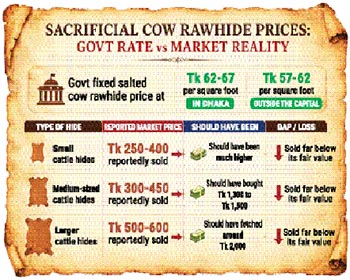
For this year's Eid season, the government fixed the price of salted cow rawhide at Tk 62-67 per square foot in Dhaka and Tk 57-62 outside the capital. On paper, the revised rates reflected a modest increase over last year and were expected to ensure reasonable returns for hide sellers.
Market observations, however, suggest that most transactions took place well below the announced rates.
In different parts of Dhaka, small cattle hides reportedly sold for Tk 250-400, medium-sized hides for Tk 300-450 and larger hides for Tk 500-600. Industry estimates indicate that these prices were significantly lower than what sellers should have received under the government's valuation framework.
Traders say cow rawhide prices have fallen by Tk 150 to Tk 200 per piece compared with last year in markets across the country, including the capital. Goat hides, meanwhile, attracted little interest from buyers.
Seasonal traders complained that under the government-fixed rates, a large cowhide should fetch around Tk 2,000, while medium-sized hides should sell for Tk 1,300 to Tk 1,500. In reality, however, even large hides were being sold at collection centres for only Tk 400 to Tk 600. In some cases, traders were forced to accept even lower prices.
A visit to several collection points revealed trucks, pickups and vans arriving with hides from different districts. Warehouses were stacked with piles of leather while workers rushed to preserve them with salt. Despite the large volume of supply, traders expressed frustration over the prices being offered.
Seasonal collectors said they purchased hides from mosques, madrasas and individuals based on government-declared prices. But upon reaching warehouses and wholesale markets, they often had to sell at less than half that value. After accounting for transportation, labour and storage costs, many reported substantial losses.
Traders also pointed to mounting debts owed by tannery owners and an ongoing liquidity crunch within the leather sector. According to them, many tanneries lack the financial capacity to purchase hides at higher rates.
Delayed payments from tannery owners have further tightened cash flow across the market, forcing many tanneries to limit purchases and putting additional downward pressure on prices.
Sector insiders say that although the government announces hide prices every year, effective implementation remains elusive at the field level. As a result, collectors, seasonal traders, orphanages and madrasas are routinely deprived of fair returns.
Reports from coastal and rural districts indicate that some people simply abandoned hides after failing to secure buyers.
In Shyamnagar upazila of Satkhira, local residents said hides were dumped near riverbanks because traders either offered extremely low prices or failed to appear altogether. A teacher at a local orphanage said the institution traditionally relies on hide-sale proceeds to support educational expenses for underprivileged students.
"Every year, a portion of our operating costs is covered through hide sales. This time, we were not even sure whether the proceeds would cover transportation costs," he said.
For many charitable institutions, the decline in hide prices has become more than a commercial concern; it has directly affected their ability to fund social and educational programmes.
Seasonal traders, who form the backbone of Bangladesh's Eid hide collection system, also described a difficult trading season.
Faruk Hossain, a Dhaka-based trader involved in the business for several years, said prices offered by wholesalers and tanneries were considerably lower than expected.
"A hide that could fetch Tk 800 or Tk 900 last year struggled to attract buyers at Tk 650 this year. Even Tk 750 would have been acceptable," he said.
In Chattogram, seasonal trader Mohammad Didar Hossain said he purchased hides from local collectors at around Tk 400 each but received offers of only Tk 150-200 from buyers further up the supply chain.
Traders argue that rising labour costs, transportation expenses and preservation costs have significantly increased their operational burden, while limited purchasing capacity among tannery owners has squeezed profit margins throughout the market.
"If we buy at higher prices, we risk substantial losses because the tanneries are not paying enough," one trader said.
One of the key questions emerging from this year's market is whether sacrificial hides are actually being sold at the prices announced by the government.
Industry representatives insist that many transactions occurred close to official rates. However, observations from local markets suggest such cases were relatively limited.
Business leaders note that the government's announced rates primarily apply to properly salted hides, whereas most ordinary citizens sell raw hides immediately after slaughter.
Once preservation, labour, transportation and storage costs are factored in, the final price offered to sellers often falls far below expectations.
The widening gap between official policy and market realities continues to undermine confidence among both sellers and collectors.
For decades, sacrificial hides have provided an important source of seasonal income for thousands of madrasas and orphanages across Bangladesh. The proceeds often help finance food, books, clothing and other essential expenses for students.
When hide prices collapse, these institutions lose one of their most dependable revenue streams.
Educators and social workers warn that repeated failures in the hide market could have long-term consequences for charitable and educational institutions that rely heavily on Eid-related donations.
Experts say Bangladesh's leather sector continues to suffer from deep-rooted structural weaknesses, including inadequate preservation facilities, limited storage capacity, poor market coordination and weak linkages between grassroots collectors and tannery owners.
Unless these challenges are addressed through comprehensive reforms and stronger market oversight, the annual cycle of disappointment surrounding sacrificial hides is likely to continue, leaving valuable resources wasted and vulnerable institutions deprived of much-needed income.
Loading...
Loading...
Also read



Editor : Iqbal Sobhan Chowdhury
Published by the Editor on behalf of the Observer Ltd. from Globe Printers, 24/A, New Eskaton Road, Ramna, Dhaka.
Editorial, News and Commercial Offices : Aziz Bhaban (2nd floor), 93, Motijheel C/A, Dhaka-1000.
Phone: PABX- 41053001-06; Advertisement: 41053012; 01793317829, 01550707291, E-mail: [email protected], [email protected] Online: email: [email protected] 41053014; 01550707297 Advertisement: 01550707296
Published by the Editor on behalf of the Observer Ltd. from Globe Printers, 24/A, New Eskaton Road, Ramna, Dhaka.
Editorial, News and Commercial Offices : Aziz Bhaban (2nd floor), 93, Motijheel C/A, Dhaka-1000.
Phone: PABX- 41053001-06; Advertisement: 41053012; 01793317829, 01550707291, E-mail: [email protected], [email protected] Online: email: [email protected] 41053014; 01550707297 Advertisement: 01550707296


