A new Al Jazeera investigation has brought renewed international attention to allegations of sexual violence, torture, and degrading treatment of Palestinians held in Israeli detention facilities.
A report, titled “They Were Laughing: Israel’s Use of Rape and Sexual Abuse in Prisons,” compiles testimonies from former detainees who describe severe physical and sexual abuse while in Israeli custody that includes they had been raped by dogs and female Israeli soldiers.
According to the investigation, these accounts are supported by findings from United Nations experts, human rights organizations, and legal observers who have raised concerns about the treatment of Palestinian prisoners since the start of the Gaza war in October 2023.
The allegations are among the most disturbing to emerge from the conflict. Former detainees interviewed by Al Jazeera described experiences that they say included rape, sexual torture, humiliation, beatings, starvation, medical neglect, and the use of dogs during abuse. The investigation argues that these practices are not isolated incidents but part of a broader pattern documented by international organizations and rights groups.
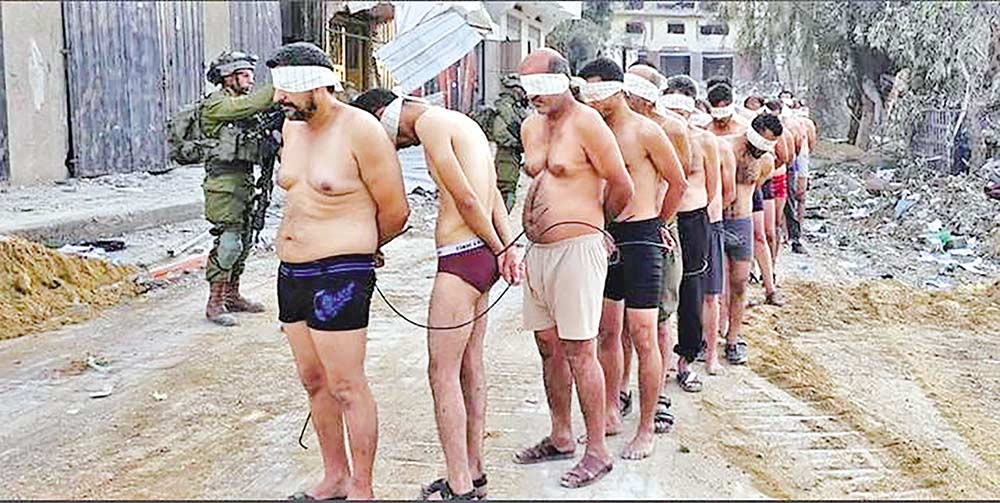
One of the central testimonies comes from Mohammed Zaki al-Bakri, a former detainee who described being held alongside seven other prisoners. According to his account, the prisoners were stripped of their clothing, blindfolded, and handcuffed. Al-Bakri told Al Jazeera that he and others were then raped while guards allegedly laughed and filmed the abuse. He further alleged that dogs were used during the assaults and were directed by officers. His testimony forms a key part of Al Jazeera’s documentary investigation, which examines what the report describes as widespread and systematic sexual violence against Palestinian detainees.
The soldiers and their guard dogs surrounded him that day. “There were six soldiers on the right and six on the left,” he recalled. “They would ask your name. If you said ‘Muhammad’, they would say, ‘No, say your name is b****.’”
Al-Bakri said he was held with seven other prisoners. They were all stripped, blindfolded and handcuffed.
“We were raped after being stripped of our clothes,” he said. “We were shouting, ‘Oh Lord, oh God’, but they were just laughing and filming us.” Al-Bakri then echoed what several rights agencies have also reported" that guards also used dogs during the sexual abuse of prisoners. “The dogs were following commands from the officers to [attack] us,” he said.
Al-Bakri is among multiple former prisoners who have given detailed testimonies to Al Jazeera for Bodies of Evidence: Israel’s Darkest Weapon, a documentary investigation into what International Criminal Court (ICC) judges, the United Nations and its special rapporteur on the occupied territories, Francesca Albanese, say amounts to the widespread and systematic use of rape and sexual torture by the Israeli army against Palestinians. Rights groups such as the Palestinian Centre for Human Rights (PCHR) and Euro-Med Human Rights Monitor have also documented testimonies of prisoners recounting how Israeli soldiers used dogs to rape them Al-Bakri is among multiple former prisoners who have given detailed testimonies to Al Jazeera for Bodies of Evidence: Israel’s Darkest Weapon, a documentary investigation into what International Criminal Court (ICC) judges, the United Nations and its special rapporteur on the occupied territories, Francesca Albanese, say amounts to the widespread and systematic use of rape and sexual torture by the Israeli army against Palestinians. Rights groups such as the Palestinian Centre for Human Rights (PCHR) and Euro-Med Human Rights Monitor have also documented testimonies of prisoners recounting how Israeli soldiers used dogs to rape them.
Like al-Bakri, Job thought he was an everyday middle-aged family man from Gaza. Both placed their children’s future above their own. Both prioritised their families’ safety since Israel launched its genocidal war in October 2023. Both had become accustomed to shepherding their families through the checkpoints, bombings and forced displacements that defined daily life in the besieged enclave.
That changed when both were taken prisoner, tortured and repeatedly raped by Israeli soldiers and guard dogs.
As with al-Bakri, Job’s memory of his rape is equally clear. “Female soldiers entered my room,” he told Al Jazeera. “They put iron handcuffs on my hands behind me. They untied the handcuffs from my legs and put on more handcuffs. Then they stripped me of my clothes.”
He was pinned to the ground with boots on his back and neck, while the female soldiers raped him using artificial objects.
“The soldiers around them were applauding and filming the scene. They were filming the rape scene.”
Job’s rape and sexual torture continued, all while being questioned for any knowledge of the Hamas-led attack of which he knew nothing.
Other former prisoners interviewed by Al Jazeera provided similar accounts. In a related feature published the same day, detainees described being chained, stripped, sexually abused, and filmed while in custody. Several testimonies included allegations that dogs were used as instruments of intimidation and assault. The consistency of these accounts across different detainees has drawn significant international attention and intensified calls for independent investigations.
The allegations extend beyond individual testimonies. According to the Al Jazeera investigation, United Nations officials and Special Rapporteur Francesca Albanese have cited evidence suggesting that sexual violence has been used systematically against Palestinian detainees. The report states that concerns about sexual abuse in Israeli prisons are not new, but that multiple observers believe such practices intensified following the October 2023 outbreak of war.
Human rights organizations have also documented similar claims. Israeli rights group B’Tselem has described the Israeli detention system as a network of “torture camps” and reported evidence of physical and psychological abuse, deliberate starvation, denial of medical care, and sexual violence. Its findings are based on interviews with former detainees and have been cited by international observers examining prison conditions.
Additional testimonies published earlier this year have reinforced these concerns. Former detainees have alleged rape with objects, severe beatings, electric shocks, and other forms of sexual torture. Rights groups reported that some prisoners suffered long-term physical injuries and psychological trauma. Multiple organizations have argued that such abuses reflect systemic problems rather than isolated misconduct by individual guards or soldiers.
International scrutiny increased further after reports concerning the Sde Teiman detention facility. A widely discussed case involved allegations that Israeli soldiers sexually assaulted a Palestinian detainee. According to reporting by the Associated Press, the prisoner suffered serious injuries, including a perforated rectum that required surgery. Charges against several soldiers were later dropped, with Israeli military authorities citing insufficient evidence and difficulties obtaining testimony from the former detainee. Human rights organizations criticized the decision, arguing that it reflected a broader climate of impunity.
The issue has also attracted attention from the United Nations. In May 2026, Reuters reported that the UN included Israel on its blacklist of parties suspected of committing conflict-related sexual violence. The report cited allegations involving detainees from Gaza and described claims of rape, sexual torture, and degrading treatment. Israeli officials strongly rejected the decision and characterized it as politically motivated.
Reports from journalists and aid activists have added to the growing body of allegations. The Committee to Protect Journalists documented testimonies from Palestinian journalists who claimed they were subjected to beatings, starvation, torture, and sexual violence while detained. Former aid activists detained after attempting to deliver assistance to Gaza also alleged sexual assault and physical abuse during their detention. Israeli authorities have denied wrongdoing in these cases.
Israeli authorities have consistently denied allegations of systematic abuse. Official responses from the Israeli Prison Service, military authorities, and government representatives have maintained that detention facilities operate according to legal standards and that complaints are investigated through established procedures. Israeli officials have rejected claims of institutionalized sexual violence and have argued that many accusations are politically motivated or unsupported by evidence.
Nevertheless, critics argue that the volume and consistency of testimonies, combined with findings from human rights groups, UN experts, and journalists, warrant independent international investigations. They contend that allegations involving rape and sexual torture are among the gravest violations of international humanitarian law and must be examined thoroughly regardless of the political context.
For survivors, the consequences extend far beyond physical injuries. Former detainees interviewed by journalists have spoken of enduring psychological trauma, humiliation, and social stigma. Some have chosen to speak publicly despite cultural pressures and personal risk, arguing that silence would allow abuses to continue unchecked. Their testimonies have become central to ongoing efforts to document conditions inside detention facilities and seek accountability for alleged violations.
As international pressure grows, the allegations documented by Al Jazeera and other organizations are likely to remain at the center of debates over human rights, accountability, and the conduct of parties involved in the conflict. Whether future investigations substantiate or refute specific claims, the testimonies have already intensified scrutiny of Israeli detention practices and renewed calls for transparency regarding the treatment of Palestinian prisoners.
Source:
Al Jazeera