



| HEADLINE |

|
BALANCING AI AUTONOMY AND HUMAN-CENTRIC COMMAND: A NEW PARADIGM FOR NATIONAL RESILIENCE AND BANGLADESH ARMY
Published : Thursday, 11 June, 2026 at 11:01 AM
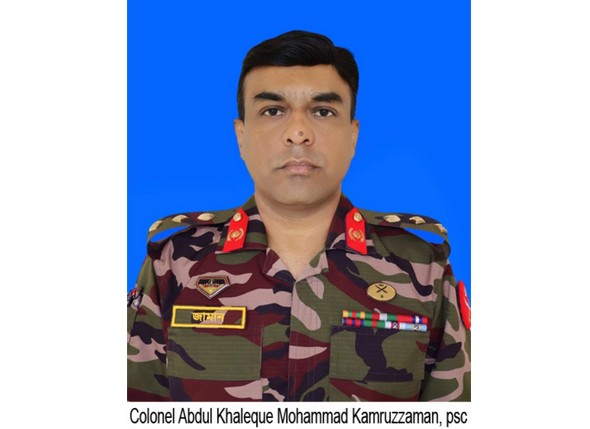
Colonel Abdul Khaleque Mohammad Kamruzzaman,psc


Since the induction of gunpowder, the warfare patterns have shifted to new dimensions. ‘Algorithmic Warfare’ is the new edition of war. At present, a country’s power cannot be measured only by its tangible forces. It is determined by the intelligent software that is driving them. One of the newly evolved concepts in the present day is ‘Hyperwar’.
This concept denotes the ability to decide and act much faster than human capability. Such decision-making is purely influenced by the speed of thought. AI is moving way beyond regular automation in advanced militaries. It has the concept of 'Swarm Intelligence'. It is a framework that maintains real-time coordination among all battlefield assets. In this setup, a swarm of AI-driven drones can take part in an operation.
Even if it absorbs heavy losses, it still remains capable of executing the mission. If a few drones are damaged or destroyed, AI redistributes the tasks among the surviving drones. Reshuffling the responsibilities among the remaining ones is the key to achieving the objective. As we move deeper into this era of automation, an unexpected strategic paradox begins to surface. If the machines are integrated into decision making process, how do we nurture human qualities, moral ethics and the unique bond between soldiers and citizen?
The truth is AI may be an unavoidable necessity, but a ‘Human-Centric Connection’ must remain the soul of national security. Perfect resilience doesn’t lie in sophisticated tools. It’s found in that perfect synergy between speedy technology and the incomparable human wisdom. The era of "Predictive Defence" has been established by a huge number of global data; information from social media trends and satellite images. Anticipated conflicts are predicted by AI before they erupt. It assists military forces to be ‘proactive’.
The AI might be capable of processing computer data, but it cannot realize the strife, uncertainty, panic and heroism of a soldier. The advanced militaries adopt the 'Human-Machine Teaming' method to overcome this limitation. It is also known as the ‘Centaur Model’. In this method, the AI sorts out the options and human leader decides the final action. AI is great at calculating odds. Yet it has no real understanding of humanity.
Therefore, modern armies still depend on the 'Cognitive Command' of a commander. A human commander can assess the political, social, and psychological impact of a battle. After analysing the data AI may recommend an attack. But it cannot comprehend how the ‘hearts and minds’ of local people will be antagonized by this attack. The human soldiers act as a shield against ‘Algorithmic Bias’ in modern armies. A mission becomes unsuccessful if inaccurate data is fed by AI.
In such a situation the human leader’s ‘Intuition’ plays a vital role. This tactical acumen helps the human leader to realize a likely trap or the presence of civilians nearby. Above all, military leadership encompasses many virtues which cannot be cloned by AI. The ‘Black Box problem’ is one of the major areas of concern in modern warfare. It generates controversy regarding the transparency of the decision-making process of AI. In a fast-paced operation, on several occasions the human operators have failed to validate the automated decisions of AI.
If an AI mechanism results a civilian catastrophe or strike on a hospital who should be held responsible as per international law? It remains as a big question. The advanced countries are adopting the ‘Human-in-the-Loop’ (HITL) protocol to resolve this issue. This framework assures human validation before the execution of any lethal action. Such a protocol upholds military ethics and international laws in combat operations. Such an essential link is not considered as a bottleneck. Rather it serves as a deliberate validation to preserve fundamental human values. An army is not just a stockpile of arsenals. The army is a complete institution built on trust and bravery.
The NATO countries term it as ‘Trust Calibration’. This is essential and vital as it can become a doubleedged sword. Too much reliance on AI might result in a fatal disaster. On the other hand, ignorance might result in missing critical life-saving data. The ultimate national strength comes down to finding that perfect balance. The humans must always be the main thinkers, using AI simply as a sharp 'second brain' instead of a replacement. In today’s warfare, the line between military targets and civilian infrastructure has practically blurred. To counter this shift, military thinkers have introduced 'Cyber-Physical Fusion’.
This strategy reiterates the synchronization of digital networks with critical national infrastructures such as power-grids, healthcare, transportation and water supply. Civil military collaboration in this aspect is very important. In recent times, the concept of ‘Active Cyber Defence’ has been a significant countermeasure among the European countries. This model utilizes AI to observe national infrastructures. National infrastructures are too vast to monitor by human eyes 24/7.
The ‘Active Cyber Defence’ model can identify cyberanomaly such as attempts to cut off power grid and take counter measures in microseconds. The military protects these national assets to ensure the functionality of the nation during any ongoing conflict. A key concept that has evolved in today’s world is the ‘Dual-Use Technology’. It refers to the development of AI tools for military defence which can be alternatively employed for the protection of public assets in peacetime. As an example, an AI algorithm developed for tracking enemy movements may be utilized for ‘Disaster Management Response’. Satellite data can be analysed by the military to forecast likely devastation and expedite the distribution of essential supplies to isolated populations.
'Civic Cyber Defence'- is a concept, where in technologically proficient citizens remain involved. These citizens work parallel to the military to safeguard the national cyber domain. In this partnership, the military plays the role of providing the tools and the tech-efficient citizens ensure watchfulness. As a result, the country remains as a ‘Hard Target’ to the aggressors. It also creates a strengthened society that perceives methods to identify misinformation and report cyber-threats. Such compactness serves as the eyes and ears of the country’s formidable defence system.
AI is considered as the ultimate offset in the defence policies of the world superpowers such as the United States, China and Russia. The best way to achieve tactical speed is observed in the U.S. Department of Defence through ‘Project Maven’. Autonomous detection of the targets by analysing numerous hours of footages is used in this system. In the meantime, China has developed the notion of an ‘Intelligentized Warfare’, which states that the next war will be won by the party that is better equipped with the ‘Information Processing Power’. Integrating AI into Bangladesh’s national defence is no longer optional but vital.
The shifting geostrategic dynamics in the Bay of Bengal demand a human-centric approach smartly guided by AI. This form of technological integration will lead us to maintain a credible and calculated restraint. Instead of an exorbitant arms race this initiative can be an effective measure to secure the maritime territory of the country. Bangladesh is one of the leading nations in mitigating natural disasters. The integration of military AI with the country’s 'Delta Plan 2100' offers a huge advantage in managing floods, cyclones and rising tides.
Under this management system, the citizens of the country will perceive soldiers as the tech-backed lifesavers rather than combat warriors. This might become a leading textbook example of ‘Dual-Use’ technology in uplifting a developing nation. The economy of Bangladesh is transitioning to a digital economy as mobile banking and e-governance are booming. This migration makes it vulnerable to hybrid warfare. To safeguard this digital growth a technologically sound ‘Smart Army’ is essential. The country’s lifelines, like the 'Rooppur Nuclear Power Plant' or the 'Padma Bridge', can be guarded by developing an integrated local cyber-defence. Such a ‘Digital Shield’ will provide a safer space for the people and for the economy to thrive.
Bangladesh is a leading peacekeeping contributor to the UN. The peacekeepers may be equipped with AI surveillance, multilingual AI, autonomous patrol drones, counter-IED mechanisms and mine-detection AI etc. Such capability enhancement will assist peacekeepers to lead global efforts from the front. Applying smart technology to shield the vulnerable people will make a strong statement in global arena. With this, the core philosophy 'Friendship to all, malice to none' will be upheld and well-projected. In the case of developing and middle-power countries, the geopolitics of AI comes with the need to develop Sovereign AI.
A country’s security cannot depend on external developers of algorithms or foreign cloud servers. The country should secure its land borders and secure its ‘Digital Borders’ as well. Dependence on foreign AI developers will surely introduce the risk of a ‘Digital Coup’. Such a coup implies an interruption of its systems during a conflict. Hence, ensuring a person-centric relationship also implies cultivating domestic AI expertise and keeping the data architecture located locally so that the brains of the country remain in its own possession. With eyes on the 2030s and beyond, the final aim of national defence is taking shape toward a paradigm of ‘Total Resilience’.
Defence policies of the bigger world powers are no longer viewed merely as a military operation, but as a total national effort in achieving security. The tool that combines all into one platform is the AI. With the combination of military AI and civilian infrastructure, including smart grids and secure communication networks, a country can establish its own ‘Digital Shield’ that will help the population to withstand any threats, both physical and non-physical. But the future strategic vision should underscore the fact that technology is an accelerant, and not a base. The ‘Will of the People’ is the true foundation of national defence.
A more advanced concept called ‘Societal Hardening’ also exists in practice. This approach places emphasis on developing a high-tech army integrated with a high-tech population. This synergy creates a morally impregnable and highly sophisticated defence shield. In conclusion, the global race for AI is creating an ethical divide across nations. The concept of responsible AI is being fostered by most democratic nations. For this, the adoption of the ‘Human-inthe-Loop’ (HITL) model is a key tool. A few nations opt for fully AI-driven autonomous lethal weaponry excluding any human-centric connection. The question remains: can a human-centric defence mechanism counter an AI-operated autonomous adversary? The ultimate reply lies in ‘Resilience’. A force that upholds its human connectivity is less vulnerable to a one-hack or one-error collapse of the systems. The human-centric connectivity is more versatile and possesses tactical restraint which AI does not inherently possess.
Loading...
Loading...
Also read









Editor : Iqbal Sobhan Chowdhury
Published by the Editor on behalf of the Observer Ltd. from Globe Printers, 24/A, New Eskaton Road, Ramna, Dhaka.
Editorial, News and Commercial Offices : Aziz Bhaban (2nd floor), 93, Motijheel C/A, Dhaka-1000.
Phone: PABX- 41053001-06; Advertisement: 41053012; 01793317829, 01550707291, E-mail: [email protected], [email protected] Online: email: [email protected] 41053014; 01550707297 Advertisement: 01550707296
Published by the Editor on behalf of the Observer Ltd. from Globe Printers, 24/A, New Eskaton Road, Ramna, Dhaka.
Editorial, News and Commercial Offices : Aziz Bhaban (2nd floor), 93, Motijheel C/A, Dhaka-1000.
Phone: PABX- 41053001-06; Advertisement: 41053012; 01793317829, 01550707291, E-mail: [email protected], [email protected] Online: email: [email protected] 41053014; 01550707297 Advertisement: 01550707296


