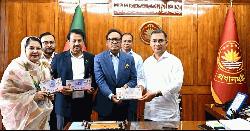
The budget speech was presented by Finance Minister Amir Khosru Mahmud Chowdhury in the National Parliament on Thursday, 11 June 2026
Following the approval of the proposed budget for FY 2026-27 at a special cabinet meeting, the Finance Minister presented it in the National Parliament.
The full budget speech is reproduced below: In the continuity of a decade-and-a-half-long struggle against fascism, Bangladesh has once again set out on the path of democracy through the blood-soaked mass uprising of students and people in 2024. Following that journey, in a free, fair, and peaceful general election on February 12, 2026, a government led by Bangladesh Nationalist Party was formed with a two-thirds majority. Having been entrusted with the responsibility of Finance Minister of this government, I stand in this great parliament today to present our first budget proposal.
At the very outset, I pay my humble respects to the brave martyrs of the great Liberation War, and to all those- including victimised women- who made the ultimate sacrifice. I also remember all the martyrs who gave their lives in the long struggle to establish democracy since independence, and all the wounded fighters who became victims of enforced disappearance, murder, attacks, lawsuits, and gunfire- whose sacrifice has opened a new horizon of democracy, rights, and hope in our national life.
At every critical juncture in the country and for the people, BNP, under the leadership of Shaheed President Ziaur Rahman and subsequently under the leadership of Desh Netri Begum Khaleda Zia, has always stood on the side of the people’s aspirations and moved the country forward. BNP has also led the long struggle of the people of this country against the fascist rule that had gripped the nation for over a decade and a half. The movement built under BNP leadership, based on Vision 2030 of 2016, the 27-point State Repair agenda of 2022, and the 31-point simultaneous movement agenda of 2023, laid the groundwork for the anti-fascist mass uprising. It was upon this ground that the historic student-people’s mass uprising of 2024 was organised. Under the leadership of Prime Minister Tarique Rahman, BNP incorporated the aspirations of the mass uprising and presented a further expanded proposal in the July National Charter, following the 31-point path to reforming and transforming politics and the state system. He has already made an announcement before the nation to implement that July National Charter to the letter.
BNP brought the question of political reform to long before this, because without political reform, it is not possible to recover and revitalise the economy that fascism had ruined and to rebuild the socio-cultural fabric that it had destroyed.
At the same time, it must be borne in mind that this political reform cannot be sustainable without the democratisation of the economy- that is, without an inclusive and accountable economic system for all people- and without the development of culturally humane relations.
During BNP governments in 1991-1996 and 2001-2006, the key economic indicators remained on a positive trajectory owing to a far-sighted and welfare-oriented economic philosophy. However, the past fascist government used state power to commit limitless corruption and unbridled plunder in the economy, rendering all institutions ineffective and destroying them. Under the slogan of so-called development, the fundamental foundation of the economy was weakened through plunder and capital flight. Not only to recover from this situation, but also to take it towards transition and prosperous reconstruction- the people have placed their trust in BNP, and the present government under the Prime Minister’s leadership has accepted that daring challenge.
To meet that challenge, as one of the principal conditions for restructuring politics and the economy, we are presenting the national budget not merely as an account of government income and expenditure, but as part of a road map for realising our immense economic potential alongside placing the economy on the path of economic stability. Our proposed budget will be a reflection of the government’s intention to ensure a safe, prosperous, and dignified life for people of all classes and professions.
As mentioned earlier, the dominant tendency of economic policy and planning under the fascist regime was to sacrifice the broader national interest in favour of the narrow partisan and factional agendas of a few. As a result, on one hand, the hard-earned wealth of the working people of this country was transferred to a handful of looters through corruption and criminal activity, and was siphoned abroad. On the other hand, macroeconomic failures were concealed with false statistics and empty rhetoric.
Consequently, the main driving force of state-building- the economic engine- gradually weakened over more than a decade and a half and was ultimately destroyed entirely. We are seeking to fulfil the promise of a new journey from within the very ruins of that destruction.
In our election manifesto, we had presented a blueprint for building a humane, democratic, and welfare-oriented Bangladesh, with emphasis on democracy, accountability, good governance, equity-based development, and the expansion of economic opportunity. After forming the government, we have already begun working towards those goals at the earliest possible time.
At the very outset of this unique journey, in pursuit of realising the new democratic aspirations created by the people’s glorious mass uprising, we have found ourselves faced with new and more intense challenges arising from geo-political instability. The reality of a new political-economic polarisation emerging across the world, alongside the war situation in the Middle East, has created major challenges for the entire world and particularly for us. With a firm resolve to address both the dilapidated state of the domestic economy and the new risks created by global instability, we have planned and formulated a macroeconomic strategy for this year’s budget with stability, investment, production, employment, and above all, equity as the central considerations.
We believe that through the implementation of this plan and strategy, Bangladesh will become a trillion-dollar economy by 2034. At the same time, through the democratisation of the economy, it will also achieve a Democratic Dividend by capitalising on the Demographic Dividend and the Longevity Dividend.
In light of that goal, in the coming fiscal year, we aim to bring inflation down to 7.5 per cent and raise economic growth to 6.5 per cent, and alongside establishing sustainable discipline in the economy, we wish to bring back ease to people’s lives.
To this end, the government has drawn up budget proposals keeping 10 main priorities in view:1. Development for All: Our goal is to establish a non-discriminatory and inclusive economy by ensuring equitable participation and partnership for all classes, all sectors, and all regions.
2. Quality Education and Healthcare for All: To make the younger generation into capable human resources through the implementation of a practical, skills-based, and values-driven education system as a fundamental right for all citizens. Secondly, to ensure quality universal health protection for all as a fundamental right.
3. Universal Social Protection: To strengthen the foundation for establishing a welfare state by building a social protection system for citizens of all ages and all levels, creating a universal lifecycle-based protection network.
4. Investment-driven, Employment and Production-oriented Economy: To create opportunities for entrepreneurship and employment and income growth for the youth through planned industrialisation, export diversification, and expansion of technology-based economic activities. To establish agriculture as a strategic sector for production, livelihoods, and national food security.
5. Deregulation and an Affordable and Simplified Business Environment: To build a transparent, simple, and affordable business-friendly environment by eliminating delays and unnecessary steps in government work through deregulation.
6. Financial Sector Stability: To restore the confidence and accountability of depositors by establishing discipline, transparency, and accountability in the banking and financial sector. To encourage investment through capital market reform.
7. Energy Security: To build self-reliant energy security in order to establish an affordable, reliable, and environment-friendly power and energy system, alongside ensuring uninterrupted supply of electricity and fuel to sustain productive activities.
8. Development of Information and Communications Technology: To transform Bangladesh into one of the world’s leading ICT-exporting countries by building a purposeful, dynamic, and genuinely technologically inclusive Bangladesh.
9. Life, Nature, Environment, and Water Resource Management: To build a sustainable, green, and environmentally resilient habitable future by transforming afforestation into a green revolution through public participation to protect the country from the impact of climate change and preserve biodiversity; by incorporating environmental considerations into development activities; and by restoring navigability of rivers and restarting canal-excavation programmes.
10. Transparent, Efficient, and Accountable Institutions and Administrative System: To build a merit-based and accountable institutional and administrative system alongside making the implementation of public investment efficient and effective, with the aim of building sustainable state capacity.
Alongside these priorities, we wish to bring sectors that have remained disconnected from the mainstream economy, such as the Creative Economy, Sports Economy, Green Economy, and Blue Economy, to the very centre of the national economy.
In increasing investment and in determining and implementing budget priorities, the principles we are primarily considering are: Value for Money, the optimal utilisation of limited resources; Return on Investment, assessment of effective economic benefits from projects where public resources are being deployed; Job Creation, the specific role of government investment in creating employment; and Environmental Consideration- careful attention to the protection of life, nature, and the environment.
The present government has already begun the process of curtailing the monopoly of a handful of beneficiaries and laying the foundation for a competitive, productive, equitable, inclusive, and dignified Bangladesh. This budget reflects the initial steps of that process. We are confident that this budget will serve as the policy plan for the coming year in making development non-discriminatory, employment safe and decent, the state accountable, and in ensuring the active participation of citizens of all classes and professions in the journey of development.
Chapter Two: Economic Context(A) Comparative economic Picture
I am presenting a comparative picture of economic indicators between the period of the past fascist government and that of BNP’s previous government.
In FY 2005-06, GDP growth was 6.78 per cent. Subsequently, under the ousted government, it fell to 4.22 per cent in FY 2023-24 and further to 3.49 per cent in FY 2024-25.
General inflation in 2005-06 was 7.17 per cent, which rose to 11.66 per cent in July 2024.
Due to unequal distribution of resources, lack of good governance, and corruption, economic inequality has increased. The income-based Gini Coefficient was 0.467 in 2005, which rose to 0.499 according to the latest survey of 2022.
The revenue-to-GDP ratio has remained at a low level; it is still hovering at around 8 per cent. The tax-to-GDP ratio is 6.8 per cent, which is the lowest in South Asia.
In December 2005, the non-performing loan (NPL) rate in the overall banking sector was 13.6 per cent. In contrast, in the first quarter of FY 2025-26, NPLs rose to 35.73 per cent, amounting to approximately Tk 6 lakh 44 thousand crore.
In 2005, the Capital Adequacy Ratio in the overall banking sector was 7.3 per cent; by the end of 2025 it has turned negative, standing at -2.64 per cent.
Private sector credit growth, which was 18.3 per cent in FY 2005-06, fell significantly to 6.5 per cent in 2024-25.
Through plunder, mismanagement, scams, and wrong policy decisions, the capital market was completely destroyed and investor confidence was entirely eroded. In every instance that the BNP government was in power in this country, no crisis ever occurred in the banking, financial, or capital market sectors.
In 2006, foreign debt was Tk 1 lakh 30 thousand crore, which increased by approximately 6.5 times by 2024 to reach Tk 8 lakh 12 thousand crore.
The domestic debt we left behind has grown by more than 16 times, from Tk 65 thousand crore to Tk 10 lakh 77 thousand crore, which is truly alarming.
Interest expenditure grew by more than 13 times, from Tk 8,500 crore in FY 2005-06 to Tk 1 lakh 14 thousand 700 crore in FY 2023-24.
According to analyses by the IMF and World Bank, Bangladesh’s debt rating has been downgraded from the ‘low’ risk category we left behind to a ‘moderate’ risk country.
In FY 2005-06, growth in exports and imports was 21.6 per cent and 12.2 per cent respectively. In contrast, in FY 2023-24, both indicators showed negative growth.
The exchange rate of the Taka against the US Dollar rose from Tk 68 in FY 2005-06 to Tk 122 in FY 2023-24, which is affecting the balance of foreign transactions and foreign currency reserves.
(B) Global Geo-political Context and Its Impact (Middle East Crisis)
Ten days after our government was formed, the Middle East crisis began, creating sudden economic risks.
The Middle East crisis caused the prices of fuel oil, LNG, and fertiliser in international markets to more than double.
The rise in fuel prices has increased production costs in electricity, agriculture, transport, and industry, resulting in increased inflationary pressure and subsidy burden. The increase in import expenditure has placed pressure on foreign currency reserves.
The Middle East is the most important destination for our expatriate workforce. Therefore, prolonged instability in that region may impact employment and the flow of remittances.
Uncertainty has become a permanent backdrop (Neo-Normal) in today’s global economy. War, volatility in global fuel markets, rising interest rates, trade tariff uncertainty, and supply chain disruptions- any one of these events can, within a short period, create significant pressure on the country’s import-dependent economy. Therefore, our goal is to continue advancing by managing the impact of external shocks on domestic stability.
Chapter Three: Government’s Medium-Term Economic Policy Strategy
A review of the current reality in the country makes it clear that the economy still faces various challenges due to the irregularities, weak management, and corruption of the fascist government. However, we believe that recovery from this situation is possible through political will, correct policies, effective reforms, and practical planning. The government is working tirelessly to recover the economy, restore market confidence, and create new growth opportunities.
The foundation of a strong and prosperous economy is built on the creativity, labour, skills, and productive capacity of every citizen of the country. For this reason, the present government has embarked on the path of inclusive economic transformation, so that the benefits of development reach people of all levels of society.
With that objective in mind, we have formulated a medium-term strategic framework to achieve economic stability, restructuring, and investment-driven growth in the country’s economy.
Under this framework, by FY 2030-31, we aim to raise the country’s real GDP growth to 8.5 per cent, bring inflation down to 5 per cent, raise the volume of foreign direct investment to 2.7 per cent of GDP, and raise total investment to 40 per cent of GDP.
To infuse momentum into the economy, our government will implement this plan in three phases, which we consider as the 3R strategy, Recovery and Stabilisation, Restoration, and Reconstruction for Acceleration Strategy.
The first phase of our plan is the economic recovery programme, which is of one year’s duration. The second phase is the economic transition, which will be completed within one to three years of the present government’s term. The third phase is the construction of a prosperous economy, which will be completed within the next five years.
Since Bangladesh’s economy is import-dependent, the significant depreciation of the Taka against foreign currencies and the high exchange rate play a major role in domestic inflation. To maintain a stable currency exchange system, emphasis is being placed on strengthening foreign currency reserves.
To control inflation, the money supply in the market will be kept regulated through effective coordination of monetary and fiscal policy. However, care will be taken to ensure that the flow of credit to the private sector is not disrupted.
A complete overhaul of the revenue system to increase domestic revenue mobilisation is one of the present government’s principal objectives. As part of this, an initiative has been taken to separate revenue policy from revenue administration. In this regard, tax policy will be formulated with the coordination of tax-related experts.
Tax compliance will be fully brought under automation to prevent tax evasion, and public trust will be restored by resolving harassment in the tax system.
Currently, the tax-to-GDP ratio is 6.8 per cent; we will raise it to 9.6 per cent by FY 2030-31, and the revenue-to-GDP ratio from the current 8 per cent to 11 per cent.
Due to the acceptance of corruption-related and unplanned projects during the fascist government’s time and the borrowing of enormous sums to finance them, our Debt Sustainability is at risk. We want to return from the current ‘moderate’ risk to ‘low’ risk debt rating. Therefore, we aim to restore discipline in debt management by keeping the budget deficit at a tolerable level through revenue growth.
We believe the time has come to move beyond the past pattern of debt-driven growth and build an economy centred on production, employment, and private investment. Accordingly, a policy strategy to reduce debt dependence and increase investment is being adopted.
To sustain economic recovery and keep investment flows active, one of the principal priorities of the government’s medium-term strategy is to restore confidence in the banking and financial sector by bringing discipline to it. To this end:
Non-performing loans are being reduced, transparency in loan approval and rescheduling processes is being ensured, and accountability in bank management is being strengthened.
Risk-based supervisory mechanisms will be introduced to restructure the financial capacity of weak banks, and where necessary, recapitalisation and management reform programmes will be undertaken. It is to be noted that the government is spending approximately Tk 40,000 crore in the current fiscal year for the recapitalisation of weak banks. An initiative has been taken to restructure banks with the aim of returning depositors’ funds. We have taken effective measures to repatriate money that was siphoned abroad.
Political appointments and interference in bank operations have been stopped. Necessary amendments to the law have been made to free it from family influence.
International standard risk management, capital adequacy, and corporate governance will be ensured in the banking sector, so that financial institutions can become stable and competitive over the long term.
Financial inclusion will be expanded to broaden financing opportunities for women, young entrepreneurs, and marginalised communities.
Our government is determined to implement structural reforms in the banking and capital market sectors with the aim of building a modern, strong, and sustainable financial system as part of the country’s economic reconstruction.
We are converting debt-dependent investment to equity. Our goal is to move away from the current debt-based economy and build an investment and FDI-based economy.
For long-term investment financing, the bond market and alternative financing mechanisms will be developed to reduce pressure on bank-dependent financing. The development of corporate bonds, mutual funds, green bonds, sukuk, and other long-term investment instruments is ongoing.
To build alternative sources of long-term financing, the corporate bond market will be expanded and a framework for issuing municipal bonds for local government and urban infrastructure development will be formulated.
The government is giving the highest importance to employment expansion in industry, services, small and medium enterprises, information technology, and modern agro-based industries. Technical and vocational training expansion based on labour market demand, financial support for young entrepreneurs, and increasing employment opportunities for women and marginalised communities are being pursued.
With the goal of building a ‘merit-based Bangladesh’, merit, integrity, competence, experience, and training qualifications will be considered the primary criteria in all types of recruitment, transfer, and promotion.
Read the full Budget Here: