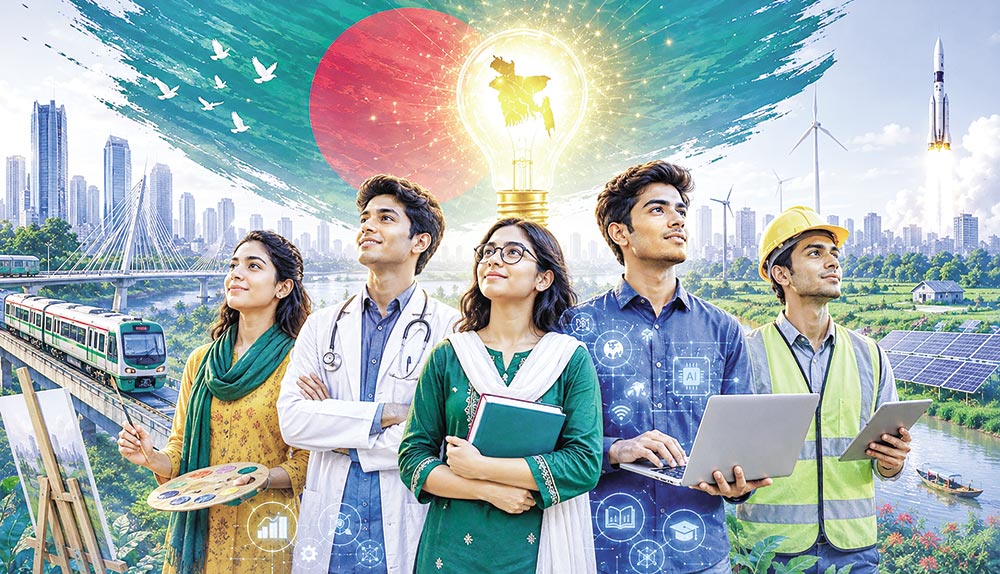
The FY2026-27 national budget has placed the creative economy at the heart of Bangladesh’s future growth strategy, unveiling a wide-ranging package of policy reforms and investments aimed at shifting the country towards a knowledge-driven, innovation-led and digitally enabled economy.
A total allocation of Tk 300 crore has been earmarked in the proposed budget, which was presented to Parliament on Thursday by Finance Minister Amir Khasru Mahmud Chowdhury.
According to the budget speech, the creative economy has been identified as a key emerging growth frontier alongside sports, as well as green and blue economy sectors, signalling a strategic move away from traditional production-based growth towards high-value, idea-driven industries.
The Finance Minister told the Jatiya Sangsad that the government’s medium-term vision is to build a “modern, dynamic and truly economically inclusive Bangladesh”, where creativity, innovation and technology serve as core engines of growth.
Under the plan, the contribution of creative industries-including arts, music, film, digital content, handicrafts, innovation and freelancing-to GDP is projected to reach 1.5 per cent, alongside the creation of around five lakh new jobs in the coming years.
A flagship initiative includes the development of specialised zones for arts, music and cultural activities, as well as a Central Creative Hub on 160 acres in Purbachal under a public-private partnership (PPP) model. Feasibility studies will also be conducted for additional hubs in Karwan Bazar, the Parbati area near the Survey General Office in Tejgaon, and unused BSCIC industrial plots.
Creative hubs are also planned nationwide through Shishu Academy and Shilpakala Academy facilities at divisional, district and upazila levels. In parallel, innovation hubs will be established in science and technology universities and gradually extended to other higher education institutions, incorporating cultural spaces, reading facilities, exhibition centres and performance venues.
To enhance global visibility of Bangladeshi products, the government plans to launch a national branding initiative titled “Created in Bangladesh”, aimed at integrating rural artisans into international value chains.
The budget also proposes expanded cultural tourism through heritage restoration, thematic pilot projects, international festivals and nationwide talent competitions under the revamped “Notun Kuri” and “Notun Kuri Smart” programmes.
For the film and OTT sectors, the proposals include international-standard studios, start-up grants and performance-based incentives for export-oriented ventures.
In a major incentive for young creators, income from all forms of content creation has been proposed for full income tax exemption. Existing tax benefits for IT freelancing will also be extended to all categories of freelance income, encouraging greater formalisation of foreign earnings through banking channels.
A key pillar of the budget is the expansion of the information and communication technology (ICT) sector as a major export industry, supported by skills development, digital infrastructure expansion and stronger industry-academia collaboration.
The speech also highlights significant investment in human capital, with education spending rising to Tk 1.36 lakh crore-almost double the previous fiscal year. Priorities include curriculum reform, digital learning platforms and vocational training aligned with future labour market demands.
Officials say initiatives such as compulsory third-language learning, multimedia classrooms and the “one teacher, one tablet” programme are intended to prepare a generation capable of contributing to global creative industries, including animation, gaming, design and digital content production.
The budget further emphasises entrepreneurship and start-up development, with targeted support for young innovators, freelancers and women-led ventures, alongside improved access to finance.
Policy measures also aim to strengthen the innovation ecosystem through increased research funding, university-industry partnerships and incentives for technology-driven enterprises, as Bangladesh seeks to transition from a labour-intensive export model to a knowledge- and idea-based economy.
Digital infrastructure expansion, including broader broadband coverage and e-commerce facilitation, is expected to underpin growth in creative sectors such as online media, advertising and cultural production.
Analysts say the explicit recognition of the creative economy marks a significant policy shift, elevating sectors such as film, music, design and digital content as central to future growth and employment generation.
However, experts caution that sustained success will depend on effective implementation, stronger intellectual property protection and continued investment in education and digital infrastructure.
Despite these challenges, the FY2026-27 budget signals a clear strategic direction: repositioning Bangladesh’s development model around innovation, creativity and digital transformation to build a more diversified and future-ready economy.





