A Tk 1,117-crore military communications project intended to establish a tactical radio assembly and technology transfer facility for the Bangladesh Army has come under intense scrutiny over alleged irregularities in tendering, questions surrounding the credibility of participating firms, and concerns about the actual scope of technology transfer promised under the scheme.
According to project documents, the initiative involves the procurement and assembly of VHF and HF radio systems from US defence technology giant L3Harris. However, critics argue that the project resembles an expensive assembly operation rather than a genuine technology transfer programme.
Questions have also emerged regarding the project's physical scale and cost structure. Despite an overall allocation exceeding Tk 1,100 crore, only a fraction of the proposed infrastructure will reportedly be dedicated to core production activities.
Industry observers have questioned whether such a limited operational footprint can justify a project of this magnitude.
Several defence and procurement experts have also expressed concern over the project's human resource component. Documents indicate that only a handful of specialised personnel will be directly involved in the programme, raising doubts about the extent to which local expertise can be developed through the initiative.
Tender Process Raises EyebrowsThe project's procurement process has become a focal point of controversy. Sources familiar with the matter allege that international competitive tendering norms may not have been fully observed.
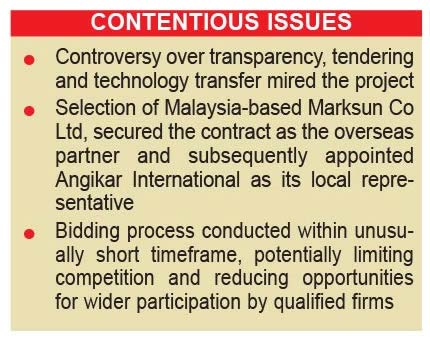
Documents suggest that Angikar International Pvt Ltd submitted its bid on March 31, 2026. Critics claim the bidding process was conducted within an unusually short timeframe, potentially limiting competition and reducing opportunities for wider participation by qualified firms.
Questions have also been raised over the selection of Malaysia-based Marksun Co Ltd, which secured the contract as the overseas partner and subsequently appointed Angikar International as its local representative.
Industry insiders have pointed to concerns regarding the track record, technical capacity and previous business activities of both entities. Some observers have further noted that the online presence and corporate information of the companies warrant closer examination.
Technology Transfer or Assembly LineA review of the agreement suggests that Bangladesh may receive only semi-knocked-down (SKD) kits for assembly rather than comprehensive manufacturing technology.
Experts argue that if original designs, source codes and core intellectual property remain under foreign control, the project's technology transfer claims could be significantly overstated.
Assembly of imported components and genuine transfer of technology are fundamentally different concepts, said a defence industry analyst familiar with similar programmes.
Analysts warn that Bangladesh could remain dependent on foreign suppliers for critical components, upgrades and future maintenance, undermining the project's stated objective of building indigenous capability.
Strategic and Security ConcernsThe proposed location of the facility inside a sensitive cantonment area has also prompted debate. Critics argue that the arrangement warrants rigorous scrutiny given the strategic nature of the technology involved and the need to protect national security interests.
Some defence analysts have additionally questioned whether the agreement could increase long-term dependence on foreign approvals for procurement, maintenance and future expansion of communications systems.
Calls for Independent ReviewAmid growing controversy, procurement experts and former officials have called for an independent review of the project's tender process, financial structure, technology transfer provisions and strategic implications before any final disbursement of public funds.
A senior government official, speaking on condition of anonymity, acknowledged that the project is being closely examined by policymakers.
The government will assess all relevant aspects before taking any final decision regarding fund release, the official said.





