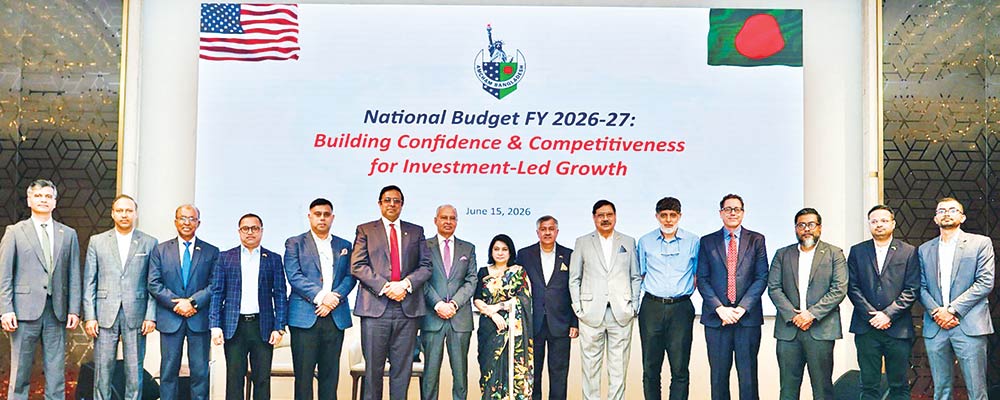
The proposed national budget for FY2026-27 can support economic recovery and investment-led growth, but only if long-standing structural weaknesses are addressed and key reforms are implemented, business leaders and economists said at a post-budget discussion hosted by the American Chamber of Commerce in Bangladesh (AmCham) in Dhaka on Monday.
Speaking at the event, titled “National Budget 2026-27: Building Confidence and Competitiveness for Investment-Led Growth”, at Sheraton Dhaka, AmCham President Syed Mohammad Kamal welcomed several business-friendly measures, including VAT exemptions on recycled cotton, a zero turnover tax for startups and technology firms, and continued incentives for renewable energy.
However, he said several key concerns of the private sector remain unresolved and stressed the need for a more rational tax framework to encourage investment, business expansion, and sustainable economic growth.
Delivering the keynote address, Policy Exchange Bangladesh Chairman and CEO M. Masrur Riaz described the budget as a realistic attempt to support recovery while preparing the economy for long-term transformation.
He said the government's efforts to reduce pressure on businesses, promote investment, and strengthen social protection send positive signals, but warned that achieving the budget's objectives would be difficult without effective implementation.
He pointed to the ambitious 6.5 per cent GDP growth target, higher revenue expectations, persistent inflation and weaknesses in the banking and energy sectors as major challenges.
The discussion repeatedly returned to one concern: whether the government can generate the revenue needed to make the budget work. Speakers argued that revenue targets appear difficult to achieve in the current economic environment and cautioned that excessive government borrowing from banks could reduce credit available to businesses, increase borrowing costs, and ultimately slow investment and job creation.
Centre for Policy Dialogue Executive Director Dr. Fahmida Khatun said rising inflation has increased poverty.
She noted that out-of-pocket healthcare spending in Bangladesh remains among the highest in South Asia, forcing many families to bear most medical expenses themselves. She argued that stronger investment in health, education and skills development is essential because long-term resilience depends not only on financial assistance but also on people's ability to withstand economic shocks and recover from crises.
Former AmCham President Syed Ershad Ahmed called for greater emphasis on logistics development across the country, saying improved infrastructure is necessary to strengthen competitiveness and support future growth.
During a panel discussion moderated by AmCham Vice President and MetLife Bangladesh CEO Ala Uddin Ahmed, participants agreed that social safety net programmes remain important in protecting vulnerable groups from inflation. They, however, urged better targeting and distribution to ensure support reaches those who need it most.
Panelists also included former Standard Chartered Bank Bangladesh CEO Naser Ezaz Bijoy and PRAN-RFL Group President and CEO Ahsan Khan Chowdhury while treasurer Reza-Ur-Rahman Mahmud gave vote of thanks.
AmCham concluded that while the proposed budget contains encouraging measures for entrepreneurship, sustainability, technological advancement and renewable energy, stronger policy reforms are still needed to restore investor confidence and improve Bangladesh's competitiveness.





