



| HEADLINE |

|
Environmentalists seek cancellation of NBR order for excluding small solar users
Published : Monday, 22 June, 2026 at 12:00 AM
Special Correspondent


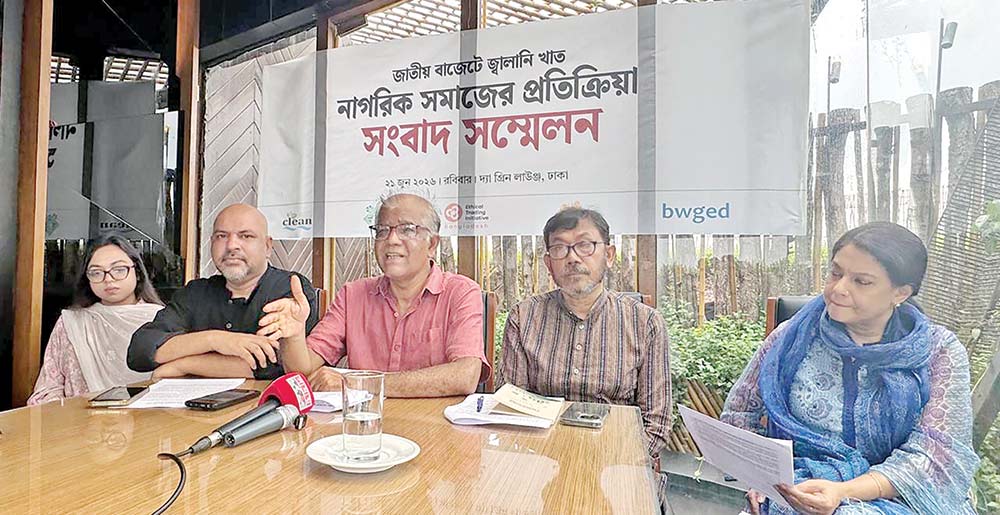 Environmental activists said on Sunday that the Statutory Regulatory Order (SRO) issued by the National Board of Revenue (NBR) has become an obstacle to the expansion of renewable energy in the country, particularly for ordinary consumers, small entrepreneurs, and farmers.
They demanded the cancellation of the SRO, arguing that it benefits large commercial establishments and power purchase agreement (PPA)-based solar projects, while leaving millions of residential consumers, farmers, and small entrepreneurs outside its scope.
"It seems that the Revenue Board is trying to work against government decisions. The SRO issued on June 8 imposes conditions that will make solar power installations nearly impossible for ordinary consumers, small entrepreneurs, and farmers. The government should withdraw it immediately," said Hasan Mehedi, CEO of CLEAN, a non-governmental organization, at a media briefing on Sunday.
Presenting a paper titled "Energy Sector in the National Budget: Civil Society Response" held at a restaurant organized by the Coastal Livelihood and Environment Action Network (CLEAN) and Bangladesh Working Group on Environment and Development (BWGED), with co-organizers including the Bangladesh Environmental Lawyers Association (BELA), Ethical Trading Initiative Bangladesh, and Foundation for the People.
Participants in the discussion included Munir Uddin Shamim, Director of ETI Bangladesh, climate activist Farah Anjum, and Networking Advisor of CLEAN Monwar Mostafa.
At the press conference, it was stated that although the proposed budget allocates Tk 17,193 crore to the energy and power sector, the allocation for renewable energy is only Tk 379 crore, which is merely 2.2 percent of the total allocation.
Hasan Mehedi said that the withdrawal of taxes and duties would reduce the cost of rooftop solar installation and increase generation by 30 to 37 percent. This would reduce the country's dependence on energy imports and facilitate achieving the national target of generating 10,000 megawatts of solar power by 2030. This is not just a tax break; it is an historic opportunity for Bangladesh's energy security, foreign currency savings, and climate adaptation. If the government wants to tap its benefit then the SRO must be amended.
Taking part in the discussion, Syeda Rizwana Hasan, Executive Director of the Bangladesh Environmental Lawyers Association (BELA) and former advisor it appears that there is a large gap between government plans and implementation process. There is no guidance regarding the vast number of diesel-powered irrigation pumps so far…if the government will use the agriculture ministry in this regard, the country would be more benefited, Rizwana said.
"It is a good beginning for the expansion of renewable energy in the country. We want to give the government time and see what it intends to do," she said.
"The pronounced budget and government policies should be complementary each other, as It is not just about rooftop solar targets; adequate allocation and implementation plans are needed to support the polices. Effective initiatives must also be taken in the budget to eliminate the ongoing load-shedding and energy disparities outside the capital,” the adviser of the interim government has said.
An estimated Tk 21,750 crore is required to achieve the government's renewable energy target by 2030.
"We suggested that the government establish a Tk 25,000 crore renewable energy fund, provide direct subsidies for residential solar power, rapidly implement corporate power purchase agreements (PPAs), mandate battery storage systems, and impose progressive emission taxes on fossil fuels," he said.
Loading...
Loading...
Also read



Editor : Iqbal Sobhan Chowdhury
Published by the Editor on behalf of the Observer Ltd. from Globe Printers, 24/A, New Eskaton Road, Ramna, Dhaka.
Editorial, News and Commercial Offices : Aziz Bhaban (2nd floor), 93, Motijheel C/A, Dhaka-1000.
Phone: PABX- 41053001-06; Advertisement: 41053012; 01793317829, 01550707291, E-mail: [email protected], [email protected] Online: email: [email protected] 41053014; 01550707297 Advertisement: 01550707296
Published by the Editor on behalf of the Observer Ltd. from Globe Printers, 24/A, New Eskaton Road, Ramna, Dhaka.
Editorial, News and Commercial Offices : Aziz Bhaban (2nd floor), 93, Motijheel C/A, Dhaka-1000.
Phone: PABX- 41053001-06; Advertisement: 41053012; 01793317829, 01550707291, E-mail: [email protected], [email protected] Online: email: [email protected] 41053014; 01550707297 Advertisement: 01550707296


