The devastating earthquakes in
Japan and
Venezuela on June 24 to June 25, 2026, have renewed focus on global seismic risks.
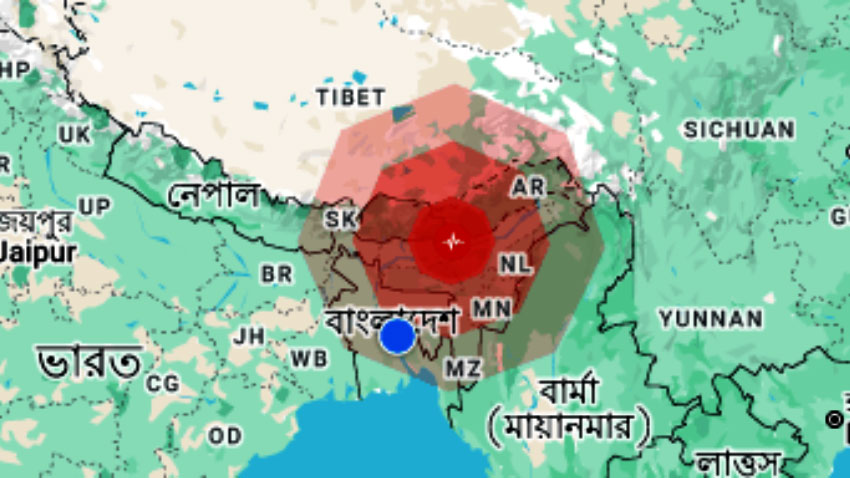
While Japan avoided structural damage through advanced engineering and Venezuela suffered under an unpredictable "doublet" quake, experts warn that Bangladesh faces a far more dangerous reality.
Located at the junction of the active Indian, Eurasian, and Burma plates, Bangladesh has not seen a massive earthquake in nearly a century.
However, a growing body of scientific data warns that Bangladesh, and its capital city of Dhaka, are at a high risk of disaster if such type of earthquakes take place.
The History of Earthquakes in BangladeshBangladesh sits over a complex network of active fault lines, notably the Madhupur Fault in central Bangladesh and the Dauki Fault system in Sylhet. Between 1869 and 1930, the country experienced five major earthquakes that exceeded a magnitude of 7.0 on the Richter scale.
The most destructive historical event was the Great Indian Earthquake of 1897. This 8.7-magnitude tremor caused catastrophic losses in Dhaka, Sylhet, Mymensingh, and Rangpur. More recently, a 5.7-magnitude earthquake on November 21, 2025, with its epicenter in Narsingdi, killed 10 people and injured over 629 across the country.
Seismologists state that these recurring minor to moderate tremors are clear indicators of stress accumulation along major underground faults.
High-Risk Areas and the Threat to DhakaAccording to the official seismic zoning map of Bangladesh, the country is split into distinct zones of risk:
• Highest Risk (Zone I): The northern and northeastern regions, including Sylhet, Rangpur, and Dinajpur, are highly unstable due to their proximity to the active Dauki Fault and the Himalayan front.
•
High-Density Risk (Zone II): The central region, which includes the Dhaka metropolitan area, falls under a major risk zone due to the nearby Madhupur Fault.
What Will Happen in Dhaka?A comprehensive survey conducted by the capital's development authority, Rajdhani Unnayan Kartripakkha (RAJUK) in 2023, reveals an alarming scenario. If a 6.9-magnitude earthquake strikes Madhupur Fault near Tangail, approximately 865,000 buildings in Dhaka could collapse. If this occurs during the daytime, it is projected to cause 210,000 deaths and 229,000 injuries.
The total economic damage is estimated at $25 billion (Tk 2.62 trillion), with an additional $44 billion required for rebuilding. Even a distant 7.1-magnitude quake on the Dauki Fault in Sylhet would collapse over 40,000 buildings within Dhaka city due to the fragile state of its soil and structures.
Major Concerns: Housing Regulation and MaintenanceThe primary factor driving Bangladesh's high vulnerability is the widespread disregard for safety regulations. The Institute for Planning and Development (IPD) notes that urban centers face extreme risks because building codes, master plans, and land-use zoning are routinely ignored.
Key Violations in the Housing Sector:
• Illegal Expansion and Weak Ground: Over 80% of buildings in the capital lack proper clearance from RAJUK, and 60% of approved buildings were constructed by violating their original structural designs. Many are built illegally on filled-up wetlands and marshy tracts that suffer from severe soil liquefaction during a tremor.
• Soft-Storey Structures: Thousands of buildings use the ground floor entirely for car parking without installing reinforced concrete shear walls. These "soft stories" easily pancake under horizontal seismic forces.
•
Maintenance and Fire Risks: Most highrise buildings lack standard fire safety measures, escape routes, or regular structural maintenance, creating a secondary hazard environment where gas and electrical line explosions would follow any tremor.
Expert Opinions on Structures and Prevention
Structural Condition Assessment
The late Professor Jamilur Reza Choudhury, a prominent construction and earthquake expert, in his lifetime repeatedly warned that a large percentage of buildings in Dhaka flouted the building construction rules, placing millions of lives at risk.
In 2019, Professor Mehedi Ahmed Ansary from the Department of Civil Engineering at the Bangladesh University of Engineering and Technology (BUET) emphasized that nearly 90 per cent of older structures in the capital completely bypassed modern seismic design codes. He points out that the unchecked boom of high-density housing has left no space between buildings, which will cause a domino effect of collapses and block narrow roads, making rescue operations impossible.
Expert Advice on PreventionTo avoid a mass casualty catastrophe, urban planners and structural engineers recommend immediate, legally binding steps:
1. Independent Regulatory Authority: Professor Ansary advises that the government must establish a dedicated urban planning and building safety authority that operates independently of bureaucratic and real estate developer influence.
2. Mandatory Retrofitting and Enforcement: Old, highly vulnerable buildings must be reinforced using modern engineering practices or demolished. The Bangladesh National Building Code (BNBC-2020) must be strictly enforced for all new construction.
3. Adopting Seismic Isolation Technology: Experts suggest transitioning toward advanced construction methods like "base isolation"- a system using rubber-lead bearings under foundations to absorb seismic shocks. Important public structures, select metro rail stations, and new power generation centers in Bangladesh have already begun incorporating this technology.
4.
Community Readiness: The government must fast-track the creation of dedicated urban emergency shelters and cultivate public awareness through regular drills. Currently, the Ministry of Disaster Management and Relief has identified 445 safe shelters across Dhaka and aims to create a database of 100,000 local volunteers to assist in post-disaster rescue.
External References and Resources• For detailed data on seismic risk zoning and official municipal vulnerability profiles, consult the UNDP Seismic Risk Assessment in Bangladesh.
• For an breakdown of building code violations and structural threat modeling in Dhaka, review the Prothom Alo Analytical Report on Dhaka Earthquake Preparedness.
• To monitor official tracking of emergency infrastructure planning, see the The Business Standard Report on Dhaka Emergency Safe Shelters.
Read More:
IF