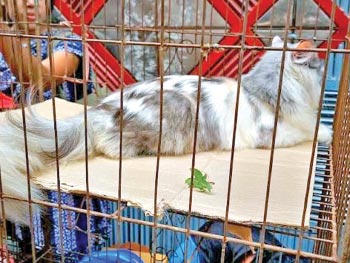
Animals belong to the wild. Forest, rivers and grasslands are not only their home but their rhythm, their way of existing. They are important for their aesthetic, economic, scientific, and survival value. Legally they are regarded as property as well. When they are removed from this world and taken to cages, the ecological balance of nature is disrupted. Recently, in Mirpur dozens of wild birds and turtles were rescued from illegal possession inside a local market. This is not an isolated incident. Over recent years, authorities have rescued wild animals from this market multiple times. The real question is not how many animals were rescued but whythis illegal trade continues to thrive in Bangladesh?Why is this continuing despite repeated raids?
These incidents in Mirpur show a consistent pattern of animal rights violations in Bangladesh. Illegal trade of these animals is only one side of the problem. Across the country, animals are consistently being neglected, abused and deprived of basic protection. In this type of incident, wild animals are only used as commodities for profit rather than living beings with intrinsic value. These offenders capture animals from their natural habitat using cruel methods. At each stage, animals face extreme stress, injury and sometimes death. Not only this, in our country stray dogs and cats repeatedly face violence, while animals like horses and cattle are seen working under harsh conditions without sufficient food and proper care. During Eid, we can see animals are often carried in overcrowded vehicles where they suffer and sometimes get injured. Ultimately, it portrays a system where human gain is prioritized over the basic rights of animals.
A similar activity repeats itself every week in Mirpur 1. In Mirpur Pet Market, every Friday people from different parts of the country gather to buy and sell animals. From pigeons and parrots to rabbits and other small animals, these are not unusual in the Bangladeshi context.These animals are commonly kept as pets in households. Behind this normal scenario, there are also cases where wild and native animals are traded here regularly. This is illegal under multiple legal frameworks in Bangladesh. Our constitution, article 18A ensures preservation of the natural resources, bio-diversity, wetlands, forests and wildlife . Also, the Animal welfare act 2019 ensures punishment for cruelty, illegal possession and unnecessary harm to animals. In addition, export and import of all wild animals, their parts and products are prohibitedand Bangladesh has been a signatory of CITES (Convention on International Trade in Endangered Species) since 1981. In spite of having such a strong legal framework, the reality is different. Animal rights violation continues to thrive, as illegal trade continues to operate in open markets like Mirpur which reflects weak legal system and irregular monitoring.
Different types of animals are involved in this trade. There have been reports of freshwater turtles, civets, monitor lizards, hornbills, northern slow loris and langurs being seized from this illegal market.These animals are not naturally suited for confinement, yet they continue to be part of the illegal trade indicating a deeper supply chain. This raises a serious concern that why is it not being stopped permanently?
One explanation can be attributed to how enforcement works. When officials get specific information, they raid the area and temporarily disrupt illegal activity.However, the raids often target only the visible end of the trade. The hunters who capture wildlife, the transporters who move them across the country, and the buyers who create demand frequently remain beyond the reach ofenforcement. As a result, the illegal market quickly recovers.This doesn’t solve the problem permanently. Each raid interrupts the trade for some time, the broader system remains the same.This shows the failure of our legal system and enforcement.
Another factor is a wider supply system that exists beyond the city itself. These animals do not simply come to this market; they go through multiple layers such as capture from natural habitats, informal transportation routes and people who move them before they reach sellers. Their trade is a criminal act; it is clearly stated under the Wildlife Conservation and Security Ordinance 2012. Illegal activities such as hunting, trading or dealing with wildlife or their products without proper permission, and possession of wildlife without authorization are subject to different levels of punishment under the law.
Md Fahim Farhad, student, Department of Journalism and Media Studies, Jahangirnagar University and Farzana Ahmed Sadia, student, Department of Law, Bangladesh University





