



| HEADLINE |

|

Algerian Independence Day
A national victory and a universal symbol of liberation



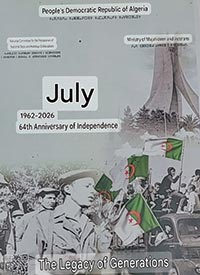
 Today, on July 5, 2026, Algeria commemorates its Independence Day, marking the restoration of national sovereignty after 132 years of French colonial rule. This day is a solemn moment of remembrance for the sacrifices of the Algerian people and a celebration of the birth of the modern Algerian state in 1962. It also carries a wider historical meaning, as Algeria’s struggle became one of the most important symbols of anti-colonial resistance in Africa and beyond.
The Algerian example had a particular character within the history of colonialism. France hadn’t merely treated Algeria only as an overseas colony. In 1848, coastal Algeria was formally incorporated into France as the departments of Algiers, Oran and Constantine. In official French thinking, Algeria was therefore presented as part of France itself. This made the Algerian struggle for independence especially significant, because it challenged not only colonial administration, but also the claim that Algeria was an integral part of France.
However, this formal integration did not create equality. The majority of Algerians remained politically, socially and economically disadvantaged under colonial rule. Access to land, education, citizenship rights and political representation remained deeply unequal. The contradictions between formal incorporation and practical exclusion became one of the central realities of colonial Algeria. For Algerians, independence was therefore not only a political objective. It was a demand for dignity, justice and the right of a people to determine their own future.
The War of National Liberation, launched on 1 November 1954, transformed this demand into a national and international cause. The struggle was long and costly, but it gradually placed the Algerian question at the center of global debates on colonialism and self-determination. The Evian Accords of March 1962 opened the way for a referendum on independence.
On July 1, 1962, Algerians voted overwhelmingly for independence with a result of 99.72%, and July 5 was later adopted as Independence Day, symbolically reversing the memory of the French conquest of Algiers in 1830.
Algeria’s independence had a global impact beyond its own national borders. It showed that even a deeply entrenched colonial system could be overcome through unity, sacrifice, political organization and international solidarity. For many peoples still living under colonial domination, racial oppression or foreign control, the Algerian Revolution became a practical example of resistance and liberation. It demonstrated that independence was not only an aspiration, but a possible historical outcome.
After independence, Algeria turned its own experience into a principle of foreign policy. The newly independent state placed anti-colonial solidarity at the centre of its international role. Algeria supported African liberation movements politically, diplomatically and, in several cases, through training and practical assistance. Algeria’s position was rooted in its own historical experience: a people that had achieved freedom after a long struggle could not remain indifferent to the struggles of other people seeking the same right.
This role was especially visible in Africa. Algeria became associated with the struggles of African liberation movements opposing colonial rule, settler domination and apartheid. Movements linked to Angola, Mozambique, Guinea-Bissau, Namibia, Zimbabwe and South Africa found in Algeria a source of political encouragement and international support. Through this engagement, Algeria contributed to the wider African movement for freedom and helped strengthen the international visibility of liberation causes.
The South African struggle against apartheid offers a clear example of this connection. In 1962, Nelson Mandela received military training from the Algerian National Liberation Front.⁴ This episode reflected the influence of the Algerian Revolution on anti-apartheid leaders and showed how Algeria’s own struggle had become a source of instruction and inspiration for other liberation movements.
Algeria’s influence was not limited to Africa. Its independence inspired movements and peoples across the Arab world, Asia and Latin America. The Algerian Revolution became linked to the broader principles of sovereignty, non-alignment, self-determination and resistance to domination. It helped strengthen the belief that newly independent states could defend their national choices while also supporting other people seeking freedom.
For this reason, Algeria’s Independence Day belongs not only to Algerian national memory , but also as a landmark event in the history of global decolonization. The Algerian struggle helped reshape the political imagination of the twentieth century by affirming that no people should be denied the right to govern themselves, preserve their identity and build their future according to their own will.
Today, the meaning of July 5 remains monumental. It recalls the courage of the martyrs and the resilience of the Algerian people. It also reaffirms Algeria’s continuing attachment to sovereignty, justice, solidarity and the right of peoples to self-determination. These values are not only memories of the past. They remain part of Algeria’s national identity and its engagement with the world.
As Algeria commemorates its Independence Day today , celebrating its hard-won independence and national sovereignty - we in Bangladesh too reflect back on the significance of the July Uprising as a defining chapter in our contemporary political journey -thus , the month of July offers a unique opportunity for both nations to deepen their bond.
By organizing joint cultural festivals, academic exchanges, youth dialogues, film screenings, and exhibitions highlighting their respective histories of resilience and aspirations for progress - Algeria and Bangladesh can transform this shared month of remembrance into a platform for mutual understanding. Such initiatives would not only honour each country's distinct historical experiences but also strengthen people-to-people connections, enrich cultural diplomacy while pave the path for enhanced bilateral cooperation grounded in shared values of dignity, self-determination, and inclusive development.
As Algeria celebrates its Independence Day, it honours a history built on sacrifice and a future founded on dignity. The Algerian Revolution proved that freedom can be achieved even under the most difficult conditions. It also proved that the freedom of one nation can inspire the freedom of many others. This is why Algeria’s independence remains a national victory, an African milestone and a universal symbol of liberation.
The writer is editorial chief, The Daily Observer

Loading...
Loading...
Also read



Editor : Iqbal Sobhan Chowdhury
Published by the Editor on behalf of the Observer Ltd. from Globe Printers, 24/A, New Eskaton Road, Ramna, Dhaka.
Editorial, News and Commercial Offices : Aziz Bhaban (2nd floor), 93, Motijheel C/A, Dhaka-1000.
Phone: PABX- 41053001-06; Advertisement: 41053012; 01793317829, 01550707291, E-mail: [email protected], [email protected] Online: email: [email protected] 41053014; 01550707297 Advertisement: 01550707296
Published by the Editor on behalf of the Observer Ltd. from Globe Printers, 24/A, New Eskaton Road, Ramna, Dhaka.
Editorial, News and Commercial Offices : Aziz Bhaban (2nd floor), 93, Motijheel C/A, Dhaka-1000.
Phone: PABX- 41053001-06; Advertisement: 41053012; 01793317829, 01550707291, E-mail: [email protected], [email protected] Online: email: [email protected] 41053014; 01550707297 Advertisement: 01550707296


