



| HEADLINE |

|
Metro Line One: Who is to finish the abandoned work?


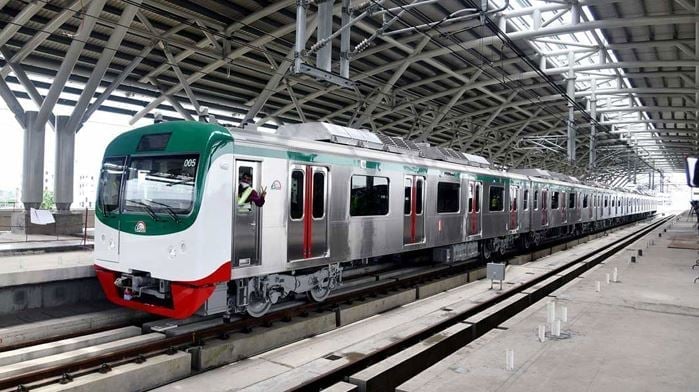
An adverse situation has arrived before Bangladesh, as the construction of a crucial section of Metro Line One is disrupted due to the abandonment of the construction company.
The company, named Kajima Corporation, has left the construction on June 1, 2026, regarding the delay in starting the construction process. A section of Metro Line One was supposed to connect the Purbachal, Dhaka Airport and Kamalapur areas, stretching almost 31 kilometres around the city. As Kajima backed out, concerns have arisen about the future of Metro Line One.
Despite being the lowest bidder for the project, Kajima Corporation stated that their bid was prepared two years ago. At present, the cost estimation has changed due to the volatile global situation and the Middle Eastern crisis, and as the construction still has not started, they are withdrawing from the project.
This 31-kilometre-long Metro Line One is the first project of Bangladesh that is planned to be constructed above ground and underground. The initial planning suggested the line is supposed to be divided into 12 parts, which are also known as 'packages'. Among them, the package designated for the Norda-Notun Bazar section was given to Kajima Corporation of Japan.
As the situation worsens, a pivotal question ascends: Who is to finish the remaining work that Kajima left behind? Government is actively working on different choices, and those choices come with their own hardships.
The Japanese ambassador gave letters to the government in which the government proposed an extension of the deadline. However, Kajima remained unsatisfied. As a consequence, they declared they would not do the work and left for Tokyo. Kajima was supposed to work on the 1.2 kilometres of underground metro rail and two stations at both ends, at Norda and Notun Bazar.
According to the officials of Dhaka Mass Transit Company Limited (DMTCL), no decisions have yet been finalised regarding this matter. Discussion is ongoing, and the future of the underground metro section is the leading agenda of the next board meeting.
Project sources confirmed DMTCL is currently considering multiple approaches. First, fresh tenders might be called where the entire process would start from scratch. Since Kajima was working on Package No. 5, a slight possibility suggests that contractors working on Packages 4 and 6 may be given the construction of Package 5.
To save time and money, those who pre-qualified in the first tender might get an invitation to work on the project.
Another recommendation implied the second-highest bidder of the previous tender may be automatically offered the construction. Although it might be unprofitable, the corporation working on packages 4 and 6 could be offered an allocation 20 per cent higher than Kajima’s offer. This method saves time and is cost-effective, which might get implemented.
Since this construction began in 2022, DMTCL has been unable to form contracts with all construction firms. Due to excessive delays, one firm has already left. Thus, construction on those two sections has come to a halt.
The 31.24-kilometre route from the Kanchan Bridge area to the capital’s Kamalapur is named the Mass Rapid Transit (MRT) Line One. 19.87 kilometres of the route are expected to be built underground, while the remaining kilometres would be built above ground.
If the work could finish according to the initial proposal, 800,000 passengers would have been able to commute daily. MRT Line One is expected to reduce traffic congestion by a significant margin, reduce consumption of fossil fuels and save time for the citizens.
The estimated cost of the country's first-ever underground metro rail was figured at Tk 52,561 crore. Project activities began in 2022, and it was funded by the Japan International Cooperation Agency (JICA).
Firms from various countries, including Bangladesh, China, India, Egypt, South Korea, Turkey and Thailand, participated in the international tendering process. After the tendering process, the cost estimation skyrocketed to Tk 96,500 crore, long before the main constructional work even started. The cost increased about 85 per cent.
Primary reasons for the unexpected cost increments included a sudden rise in construction material and depreciation of the Taka against the dollar.
SA
Loading...
Loading...
Also read




Editor : Iqbal Sobhan Chowdhury
Published by the Editor on behalf of the Observer Ltd. from Globe Printers, 24/A, New Eskaton Road, Ramna, Dhaka.
Editorial, News and Commercial Offices : Aziz Bhaban (2nd floor), 93, Motijheel C/A, Dhaka-1000.
Phone: PABX- 41053001-06; Online: 41053014; 01550707296 Advertisement: 41053012; 01550707291
E-mail: [email protected] [email protected]
Published by the Editor on behalf of the Observer Ltd. from Globe Printers, 24/A, New Eskaton Road, Ramna, Dhaka.
Editorial, News and Commercial Offices : Aziz Bhaban (2nd floor), 93, Motijheel C/A, Dhaka-1000.
Phone: PABX- 41053001-06; Online: 41053014; 01550707296 Advertisement: 41053012; 01550707291
E-mail: [email protected] [email protected]


