



| HEADLINE |

|

Cashless Journey Hits Cost Barrier as Bangla QR Fee Sparks Outcry
Published : Sunday, 12 July, 2026 at 12:00 AM
Jibon Islam


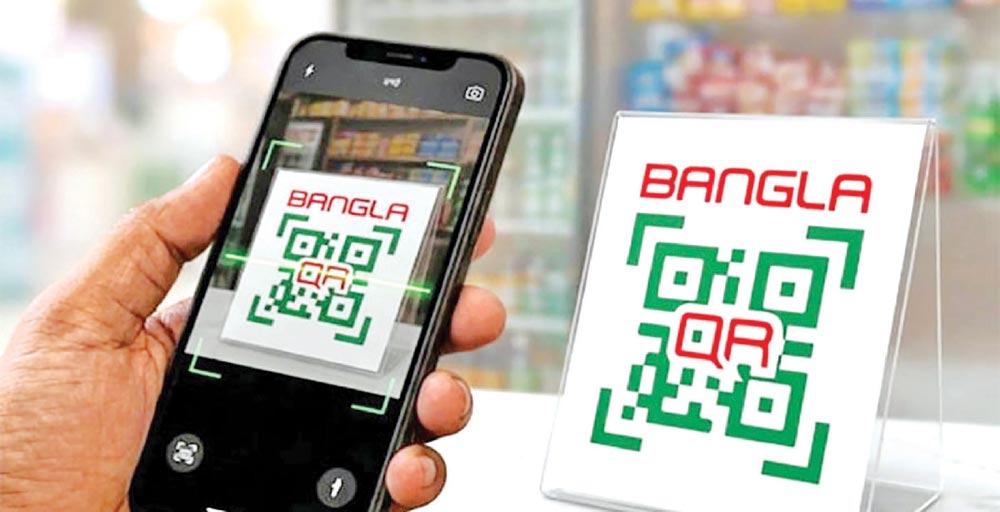 Bangladesh's drive towards a cashless economy has run into fresh headwinds, as businesses and consumers question the cost of the country's newly introduced universal Bangla QR payment system, arguing that digital transactions remain far more expensive than in many other countries where QR-based payments are offered free of charge.
The controversy erupted after Bangladesh Bank made the unified “Bangla QR” payment platform mandatory for all businesses and merchant outlets from 1 July, making compliance effectively compulsory.
The central bank says the single national QR platform will strengthen the digital payment ecosystem by improving interoperability, enhancing transaction security and increasing financial transparency, paving the way for a cashless economy.
However, the mandatory Merchant Discount Rate (MDR) has sparked strong backlash from small traders, who say the additional cost will squeeze already thin profit margins and discourage wider adoption of digital payments, threatening to undermine the cashless drive.
Under the new directive, all separate QR codes previously issued by individual banks and payment service providers have been replaced with a single national QR standard. The integrated platform enables customers to make payments seamlessly using accounts from any commercial bank, including Dutch-Bangla Bank, BRAC Bank and Islami Bank, as well as Mobile Financial Services (MFS) providers such as bKash and Nagad.
To ensure compliance, the central bank has warned that businesses failing to display the Bangla QR code could face difficulties in renewing their trade licences.
While Bangladesh Bank insists the new framework is essential to accelerating the country's transition towards a digital and cashless economy, merchants argue that the mandatory service charge undermines that very objective.
The revised policy imposes a minimum Merchant Discount Rate of 1 per cent, inclusive of VAT, on all Bangla QR transactions. Although consumers pay no additional charge, merchants must bear the entire cost. For example, a customer purchasing goods worth Tk 1,000 pays exactly Tk 1,000, but the merchant receives only Tk 990 after the mandatory deduction, with the remaining Tk 10 retained by the bank or payment service provider.
The fixed deduction has become a major source of frustration among small and medium-sized businesses, many of which say they cannot absorb the additional cost without increasing prices or reducing already narrow profit margins.
Many entrepreneurs argue that Bangladesh's pricing structure is out of step with international practice, noting that QR-based digital payments are free in several countries as governments encourage cashless transactions through zero-cost payment infrastructure.
"I previously used Pubali Bank's Bangla QR service, which charged only Tk 7. Since July 1, the minimum charge has increased to Tk 10," said Sakhawat Hossain, a retailer in Dhaka's Shantinagar area.
"The Governor assured us that digital transaction costs would fall, but instead they have gone up. This will discourage micro-businesses from adopting digital payments. The fee structure should be reviewed and made more business-friendly."
Mohammad Ali, a trader from Malibagh, said several banks had previously charged between 30 and 70 paisa per transaction before the new policy imposed a flat 1 per cent fee.
"Banks are capable of providing QR payment services at much lower costs. The sudden increase raises questions about whether the policy disproportionately benefits certain large Mobile Financial Services operators," he alleged.
Another retailer, Bayezid Ahmed, said the mandatory charge is particularly burdensome for small businesses with limited profit margins.
"If Bangladesh genuinely wants to become a cashless economy, both Bangla QR and Point of Sale (POS) transactions should be completely free. Simply reducing the charge is not enough�"it should be abolished altogether," he said.
Ahmed also urged the government to reduce mobile internet costs and remove fixed validity periods for data packages, arguing that affordable internet access is equally critical to expanding digital financial services and accelerating nationwide adoption of cashless payments.

Loading...
Loading...
Also read



Editor : Iqbal Sobhan Chowdhury
Published by the Editor on behalf of the Observer Ltd. from Globe Printers, 24/A, New Eskaton Road, Ramna, Dhaka.
Editorial, News and Commercial Offices : Aziz Bhaban (2nd floor), 93, Motijheel C/A, Dhaka-1000.
Phone: PABX- 41053001-06; Advertisement: 41053012; 01793317829, 01550707291, E-mail: [email protected], [email protected] Online: email: [email protected] 41053014; 01550707297 Advertisement: 01550707296
Published by the Editor on behalf of the Observer Ltd. from Globe Printers, 24/A, New Eskaton Road, Ramna, Dhaka.
Editorial, News and Commercial Offices : Aziz Bhaban (2nd floor), 93, Motijheel C/A, Dhaka-1000.
Phone: PABX- 41053001-06; Advertisement: 41053012; 01793317829, 01550707291, E-mail: [email protected], [email protected] Online: email: [email protected] 41053014; 01550707297 Advertisement: 01550707296


