



| HEADLINE |

|
Trump, Mojtaba trade threats


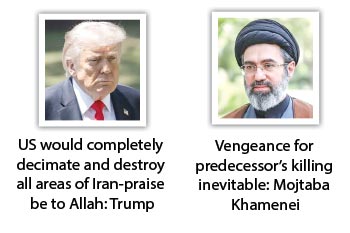 DUBAI, July 11:US and Iranian leaders traded further threats on Saturday as the interim deal to end the war buckles under repeated crossfire in the Middle East.
President Donald Trump upped threats of further missile attacks against Iran in a string of comments on his Truth Social that came after senior US officials demanded that Iran make a public statement saying the Strait of Hormuz is open and that ships crossing the vital corridor won’t be attacked.
US President Donald Trump said on Friday he had ordered the military to be prepared to launch strikes against Iran if the Iranian government carried out or attempted an assassination of the president.
"1000 Missiles are Locked and Loaded and aimed at the Islamic Republic of Iran, with thousands of more to immediately follow, should the Iranian Government act on its threat, pronounced in many corners of the Globe, to assassinate, or attempt to assassinate, the sitting President of the United States of America, in this case, ME!," he said in a Truth Social post.
"Orders have already been given, and the US Military is ready, willing, and able, for a one year period of time, subject to extension, to completely decimate and destroy all areas of Iran."
Trump made the comments after the funeral of Supreme Leader Ayatollah Ali Khamenei saw open calls for the US leader's killing.
Later Saturday, Iranian Supreme Leader Mojtaba Khamenei vowed that Iranians would continue to avenge the killing of his father, Ali Khamenei, who was mourned in funeral events throughout Iran this week. He said in remarks carried by state television that such revenge "is the will of our nation and must certainly be carried out."
Iran's supreme leader Mojtaba Khamenei said in a written message released on Saturday that vengeance for the killing of his father and predecessor in US-Israeli strikes was "inevitable", in his first statement since his father's funeral.
"Vengeance is the will of our nation and must inevitably be carried out," Mojtaba Khamenei said in a written message.
He became Iran's supreme leader after his father Ali Khamenei's killing in late February by US-Israeli strikes.
"This matter depends neither on my personal existence nor on that of other officials. Whether we are present or not, it will come to pass," he wrote in his first message since his father's funeral this week.
He said Iran had compiled a list of individuals to be targeted.
With both nations stepping up their threats, mediators have been working to bring diplomacy back on track.
Iran's Tasnim news agency reported on Friday that a Qatari delegation was visiting Iran to "try to reinforce Qatar's role as a mediator".
Trump has said talks with Iran will continue but has labelled them "a waste of time".
Iran's Foreign Minister Abbas Araghchi meanwhile insisted Tehran had stuck to its end of the bargain after the two sides signed a memorandum of understanding last month.
Tehran "has so far kept its word", he said. "Reality check: There can only be mutual compliance."
US and Iranian delegations have held one round of direct talks in Switzerland since the signing of their memorandum of understanding, as well as indirect negotiations in Qatar, but there has been no sign of diplomatic progress since.
A key roadblock to a final deal is the future of the Strait of Hormuz, which Iran closed to commercial shipping during the war in retaliation for US-Israeli strikes.
The waterway is a key conduit for oil and gas exports out of the energy-rich Gulf countries, and its closure has heavily impacted the world economy.
Iran insists on controlling the passage of ships and has announced plans to charge fees, saying there will be no return to the free navigation of the pre-war era, which Washington has rejected.
Araghchi on Saturday arrived in Oman, which sits on the other side of Hormuz, for talks on administering the strait.
Despite being one of the Gulf nations targeted during the war, Qatar has spearheaded efforts to get diplomacy back on track.
Aside from the Qatari delegation visiting Iran, Qatar's emir on Friday held a call with Prime Minister Shehbaz Sharif of Pakistan, which has also been mediating, according to Sharif's office.
The Pakistani leader said he had also spoken with Iran's President MasoudPezeshkian, urging him to safeguard the "hard-earned peace" in the region.
But Iran's chief negotiator in talks with Washington, Mohammad BagherGhalibaf, struck a defiant tone.
"Ending the war is a priority for the countries of the world, but everyone must know that this confrontation will never end with Iran's surrender," Iran's ISNA news agency quoted him as saying.
Iranians, he said, were "fully prepared to defend ourselves".
So far, Tehran has not submitted to US demands over the Strait of Hormuz, instead insisting that the route remain under its control and that it be allowed to charge ships moving through it.
The Iran war's opening moments on Feb. 28 saw an airstrike that killed Khamenei, 86. Iran only buried Khamenei this week following a dayslong funeral ceremony that saw his body taken to cities in both Iran and Iraq.
Trump added in his post that the US military would "completely decimate and destroy all areas of Iran - praise be to Allah!"
Trump, repeatedly during the war and its uneasy ceasefire, has invoked the name of God in Arabic, as well as threatened to destroy Iran's very civilization. The Council on American-Islamic Relations, a nationwide advocacy group, has in the past criticized Trump's "deranged mocking of Islam."
However, Iran has insisted its theocracy is unified after the war under the country's new supreme leader.
Moments before the US officials spoke, however, Tehran's diplomat at the United Nations told reporters that any activity in the Strait of Hormuz, including its opening or demining operations, "rests exclusively with Iran."
Iran has said the strait must now be under its sole control and that vessels should begin paying fees to Tehran - even though the world has for decades considered it an international waterway. About a fifth of all traded oil and natural gas passed through the strait before the war began.
Iran's grip on the strait during the conflict led to a global energy crisis, though oil prices have sharply dropped since wartime highs of $120 a barrel.
After the US wrapped up its latest strikes on Thursday, more attacks reportedly hit Iran, leaving questions about who else may be targeting the Islamic Republic. Israel didn't claim them, meaning the Gulf Arab states may have launched them, likely as a means to deter Iran from attacking them again. Iran on Thursday retaliated for US strikes by targeting Bahrain, Jordan, Kuwait and Qatar.
The strikes in Iran over two days killed at least 17 people and wounded 115 others, Iranian Health Ministry spokesperson Hossein Kermanpour said.
Across the Strait of Hormuz on Saturday, Araghchi is scheduled to meet with his counterpart in Oman. Turkish Foreign Minister HakanFidan told his country's state broadcaster TRT that he believed "a solution can be reached" this weekend between Iran and Oman, which lie on opposite sides of the narrow waterway.
However, Araghchi on Saturday accused the US of violating the interim deal by ending waivers allowing Iran to sell crude oil on the open market in US dollars. Washington did that in response to the attacks on ships in the strait.
"Reality check: There can only be mutual compliance," Araghchi wrote on X. �"Agencies
Loading...
Loading...
Also read



Editor : Iqbal Sobhan Chowdhury
Published by the Editor on behalf of the Observer Ltd. from Globe Printers, 24/A, New Eskaton Road, Ramna, Dhaka.
Editorial, News and Commercial Offices : Aziz Bhaban (2nd floor), 93, Motijheel C/A, Dhaka-1000.
Phone: PABX- 41053001-06; Advertisement: 41053012; 01793317829, 01550707291, E-mail: [email protected], [email protected] Online: email: [email protected] 41053014; 01550707297 Advertisement: 01550707296
Published by the Editor on behalf of the Observer Ltd. from Globe Printers, 24/A, New Eskaton Road, Ramna, Dhaka.
Editorial, News and Commercial Offices : Aziz Bhaban (2nd floor), 93, Motijheel C/A, Dhaka-1000.
Phone: PABX- 41053001-06; Advertisement: 41053012; 01793317829, 01550707291, E-mail: [email protected], [email protected] Online: email: [email protected] 41053014; 01550707297 Advertisement: 01550707296


