



| HEADLINE |

|
HOW PRIVATE UNIVERSITIES OUTPACE THEIR
PUBLIC PEERS IN RESEARCH INVESTMENT
Published : Wednesday, 22 July, 2026 at 12:00 AM


 Despite
receiving hundreds of crores of taka in annual government funding,
Bangladesh's public universities allocate only a small portion of their
budgets for research, while several private universities, without any
government operational grants, have invested heavily from their own
resources and emerged as strong performers in international research
publications.
Despite
receiving hundreds of crores of taka in annual government funding,
Bangladesh's public universities allocate only a small portion of their
budgets for research, while several private universities, without any
government operational grants, have invested heavily from their own
resources and emerged as strong performers in international research
publications.An analysis of reports published by the University Grants Commission (UGC) and international research database Scopus shows that although public universities continue to dominate in overall academic size, a number of leading private institutions are making significant contributions to the country's research output through institutional funding.
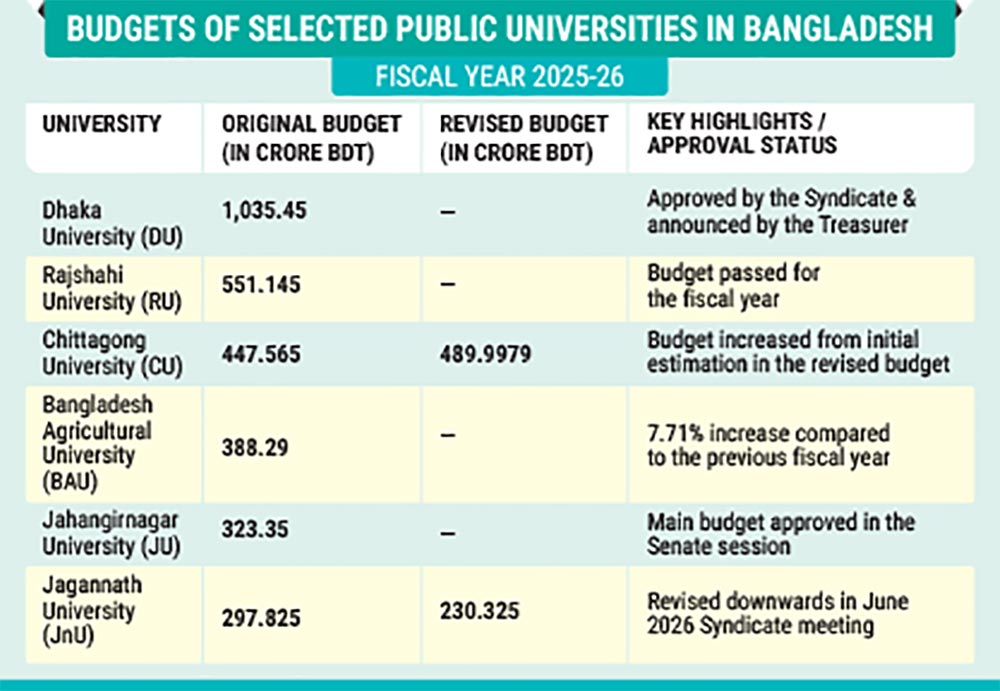
According to the approved budget for fiscal year 2025-26, the University of Dhaka has allocated Tk 21.57 crore for research out of a total budget of Tk 1,035.45 crore, representing only 2.08 percent of its overall expenditure. Most of the budget is spent on salaries, pensions, allowances and administrative costs.
Speaking to The Daily Observer, University of Dhaka Treasurer Prof Jahangir Alam Chowdhury said the university's financial flexibility remains limited under the expenditure framework set by the UGC.
"We recognise the importance of expanding research activities. However, public universities have to operate within the financial structure approved by the UGC, leaving limited room for significantly increasing research allocations," he said.
Former DU Treasurer Prof Mumtaz Uddin Ahmed echoed the concern, saying government funding is largely consumed by recurring expenditures.
"The available research fund is insufficient for conducting large-scale, internationally competitive research. A dedicated and expanded research financing mechanism is necessary," he said.
UGC's 2020 annual report shows that the country's 38 public universities collectively spent Tk 72.91 crore on research during the year. In contrast, 77 private universities spent Tk 111.73 crore from their own institutional funds, despite receiving no government operational grants.
Among private universities, BRAC University spent Tk 55.23 crore on research, followed by Daffodil International University with Tk 12.16 crore, American International University-Bangladesh (AIUB) with Tk 9.30 crore, University of Liberal Arts Bangladesh (ULAB) with Tk 8.37 crore and North South University with Tk 6.17 crore.
The investment pattern is also reflected in international research publications. According to Scientific Bangladesh's final Scopus-based statistics released in January 2026, Bangladeshi researchers produced 18,613 internationally indexed scientific publications in 2025.
The University of Dhaka ranked first with 1,731 publications, while Daffodil International University secured the second position with more than 1,500 publications. Bangladesh University of Engineering and Technology (BUET), Bangladesh Agricultural University, Jahangirnagar University, North South University, BRAC University, AIUB and Khulna University also ranked among the country's leading research institutions.
Bangladeshi researchers have also gained increasing international recognition. According to the 2025 global ranking jointly prepared by Stanford University and Elsevier, 35 faculty members from the University of Dhaka were included among the world's top two percent of scientists. Researchers from several private universities also earned recognition for their individual research achievements.
However, experts caution that the performance of a handful of leading private universities does not reflect the condition of the sector as a whole.
UGC data for 2023 show that around 28 private universities allocated no funds at all for research in their annual budgets, while many others earmarked only nominal amounts ranging from a few thousand taka to around Tk 100,000. As a result, research performance within the private sector remains heavily concentrated among a small number of institutions.
Educationists say increasing research funding alone will not be enough unless the money is utilised efficiently and supported by stronger governance.
Former UGC Chairman Prof Abdul Mannan said research expenditure should be viewed as a long-term national investment rather than a financial burden.
"Public universities need larger and more competitive research grants. At the same time, regulatory authorities should ensure that private universities maintain minimum standards of research investment as required by law," he said.
Prof Siddiqur Rahman of the Institute of Education and Research at the University of Dhaka said research excellence depends not only on funding but also on laboratories, international collaboration, qualified researchers and a supportive academic environment.
"Healthy competition between public and private universities will strengthen Bangladesh's higher education and research ecosystem," he added.
Experts believe Bangladesh must increase research funding, expand institutional autonomy, strengthen accountability and encourage international collaboration if it aims to build a globally competitive knowledge economy. They argue that sustained investment in research and innovation across both public and private universities will be essential for achieving the country's long-term development goals.
Loading...
Loading...



Editor : Iqbal Sobhan Chowdhury
Published by the Editor on behalf of the Observer Ltd. from Globe Printers, 24/A, New Eskaton Road, Ramna, Dhaka.
Editorial, News and Commercial Offices : Aziz Bhaban (2nd floor), 93, Motijheel C/A, Dhaka-1000.
Phone: PABX- 41053001-06; Advertisement: 41053012; 01793317829, 01550707291, E-mail: [email protected], [email protected] Online: email: [email protected] 41053014; 01550707297 Advertisement: 01550707296
Published by the Editor on behalf of the Observer Ltd. from Globe Printers, 24/A, New Eskaton Road, Ramna, Dhaka.
Editorial, News and Commercial Offices : Aziz Bhaban (2nd floor), 93, Motijheel C/A, Dhaka-1000.
Phone: PABX- 41053001-06; Advertisement: 41053012; 01793317829, 01550707291, E-mail: [email protected], [email protected] Online: email: [email protected] 41053014; 01550707297 Advertisement: 01550707296


