



| HEADLINE |

|
IED at Motijheel Metro: A Warning That Must Not Be Ignored
Published : Sunday, 26 July, 2026 at 12:00 AM
Emran Emon


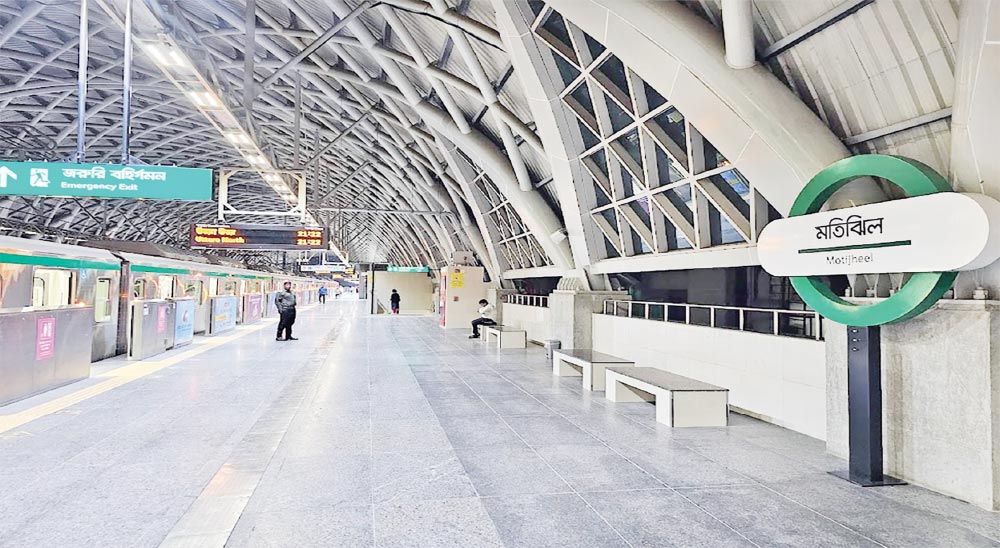
 On a seemingly ordinary Friday, July 24, the heart of Dhaka’s modern transit network became the site of an ominous discovery. Inside an everyday, unassuming umbrella left at the Motijheel Metro Station laid an Improvised Explosive Device (IED). A bomb disposal team was dispatched, the threat was neutralised and a catastrophe was averted. To the casual observer, this may appear as a lone security lapse�"a localised threat swiftly mitigated by police efficiency. But to dismiss the incident as a mere isolated event would be a fatal error of national proportions.
The Motijheel Metro Station is the financial and operational nexus of our capital, a lifeline for hundreds of thousands of hard-working citizens and a symbol of Bangladesh’s march towards modernisation. Placing an explosive device there sends a message that is both sinister and undeniable: no one is safe, nowhere is secure and the state’s stability is under active assault.
Over the past two years, following the monumental political shifts of August 5, 2024, a silent, dangerous recalibration has been taking place across the country. Bangladesh now stands at a perilous crossroads, targeted by a complex coalition of domestic extremists, dormant militant outfits and foreign deep-state actors’ intent on reducing the nation to a state of perpetual chaos.
High-density public transport systems are built on an unspoken social contract of trust, predictability and safety. When an explosive device is introduced into such an environment, the primary goal is rarely just physical destruction; it is the psychological paralysis of an entire society. If the citizens of Dhaka begin to fear their daily commute, the ripple effects could be catastrophic. Disrupting the movement of the workforce and commerce can paralyse corporate operations and undermine investor confidence. The psychological toll of fear transforms everyday public life into a nerve-racking ordeal, eroding public faith in the state's ability to provide security. It also exposes perceived gaps in the state’s intelligence and security infrastructure, projecting an image of a vulnerable and compromised government.
To fully comprehend the gravity of the incident, we must examine the security dynamics that have unfolded over the past two years. While the state focused on political transition, institutional reform and administrative realignments, covert adversaries recognised a window of opportunity. Banned militant outfits and dormant extremist organisations have actively sought resurgence. Operating under new aliases, infiltrating youth movements and utilising encrypted communication channels, these entities have spent the last 24 months rebuilding their infrastructure. They are no longer merely ideology-driven fringe elements; they have evolved into streamlined, tactical proxies capable of executing covert operations in the heart of the capital.
 The threat facing Bangladesh cannot be categorised solely as domestic law-and-order failure. It is fundamentally tied to regional geopolitics and hybrid warfare. Bangladesh’s sovereign posture, economic potential and strategic location in the Bay of Bengal make it a prised battleground for external powers and foreign deep-state actors. A stable government, prosperous and self-reliant Bangladesh does not align with the geopolitical interests of certain vested quarters and foreign entities who prefer a weak, pliable and perpetually crisis-ridden country. For those operating within the shadows of foreign intelligence agencies and covert deep-state apparatuses, destabilising Bangladesh serves multiple strategic aims.
A successful attack on a major public transport system would have consequences far beyond the immediate loss of life or property. It could undermine investor confidence by reinforcing perceptions of instability, discourage foreign investment, and increase the perceived risks of doing business in Bangladesh. Disruptions to critical transportation networks would impede the movement of people and goods, affecting productivity, trade and commercial activities. Such uncertainty could also drive up the cost of investment, insurance and business operations, ultimately slowing economic growth and weakening the country’s overall economic resilience.
Beyond the immediate physical damage, an attack on critical public infrastructure can also have profound social consequences. It spreads fear in public spaces, erodes trust in law enforcement and security institutions, weakens social cohesion, and fuels rumours, misinformation and public panic.
More importantly, a major terrorist incident can also undermine national sovereignty. It may damage Bangladesh’s international reputation as a stable and secure destination for investment and cooperation, expose vulnerabilities in its security infrastructure, weaken its diplomatic leverage, and create opportunities for external actors to exert pressure under the pretext of security concerns.
What is perhaps most alarming about the incident is the potential for institutional complacency. If intelligence agencies and law enforcement view this incident merely as a prevented crime rather than an initiated campaign, Bangladesh is heading towards disaster. Neutralising the bomb was a commendable act of frontline heroism by the police bomb disposal team. However, tactical success at the scene must not blind us to strategic failure at the intelligence level.
If state agencies do not wake up to the reality of this threat immediately, the country risks entering a dark era of systemic urban terrorism. Reactive measures are no longer sufficient. When an enemy reaches the stage of placing IEDs in mass transit hubs, the window for diplomatic posture and administrative hesitation has officially closed. We need to think that when an explosive device like IED is found in the veins of a capital city, it is not a warning shot�"it is the opening salvo of a battle for the survival of the state.
To protect the country’s safety, economic vitality and national sovereignty, the state must adopt a comprehensive, high-alert security posture to safeguard its public transport systems and other critical infrastructure. Security protocols should be strengthened through advanced screening technologies, explosive-detection capabilities, specialised response units and regular security assessments. Intelligence agencies must intensify their focus on counter-terrorism by identifying and dismantling extremist networks, disrupting their logistical and financial support, and enhancing coordination among relevant institutions. Border security should also be reinforced to prevent the illicit movement of explosives, weapons, and individuals involved in extremist activities.
Equally important is fostering public vigilance through sustained awareness campaigns that encourage citizens to report unattended objects and suspicious behaviour without creating unnecessary panic. At the same time, the authorities must pursue a firm, law-based approach against all those who plan, finance, facilitate, or support acts of terrorism, ensuring that national security is upheld while preserving the rule of law.
Bangladesh’s journey over the decades has been defined by resilience in the face of monumental adversity. We have fought for our language, our freedom and our right to exist as a sovereign nation. We cannot and must not allow covert networks, banned terrorist organisations and foreign deep-state actors to tear apart the fabric of our society from within. The IED bomb covered with an umbrella found at Motijheel Metro Station was a terrifying glimpse into an abyss. It is now up to the state and its people to close that abyss once and for all�"with uncompromising strength, absolute vigilance and an unyielding commitment to the nation’s security.
The writer is a journalist
Loading...
Loading...
Also read



Editor : Iqbal Sobhan Chowdhury
Published by the Editor on behalf of the Observer Ltd. from Globe Printers, 24/A, New Eskaton Road, Ramna, Dhaka.
Editorial, News and Commercial Offices : Aziz Bhaban (2nd floor), 93, Motijheel C/A, Dhaka-1000.
Phone: PABX- 41053001-06; Advertisement: 41053012; 01793317829, 01550707291, E-mail: [email protected], [email protected] Online: email: [email protected] 41053014; 01550707297 Advertisement: 01550707296
Published by the Editor on behalf of the Observer Ltd. from Globe Printers, 24/A, New Eskaton Road, Ramna, Dhaka.
Editorial, News and Commercial Offices : Aziz Bhaban (2nd floor), 93, Motijheel C/A, Dhaka-1000.
Phone: PABX- 41053001-06; Advertisement: 41053012; 01793317829, 01550707291, E-mail: [email protected], [email protected] Online: email: [email protected] 41053014; 01550707297 Advertisement: 01550707296


