



| HEADLINE |

|
The Dirty Truth About Kitchen Scrubbers
Published : Tuesday, 28 July, 2026 at 1:00 PM
Sakia Kawser Siddique


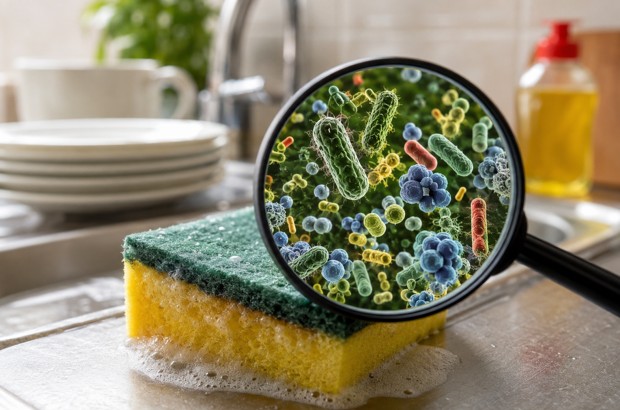
generated from AI
Scientists say the everyday cleaning tool could harbour billions of bacteria"but the real concern is what those bacteria can spread
It is one of the hardest-working items in the kitchen, used every day to scrub away grease, food residue and stains from dishes and cookware. Yet the humble dish scrubber"often overlooked during routine cleaning"may itself become one of the most heavily contaminated objects in the home.
Research has shown that used kitchen scrubbers and sponges can harbour enormous numbers of bacteria. Their porous structure, combined with constant moisture and trapped food particles, creates favourable conditions for microorganisms to multiply. While this may sound alarming, microbiologists caution that the number of bacteria alone is not what determines the health risk.
Instead, experts say the greater concern is whether harmful foodborne pathogens find their way into the scrubber and spread through cross-contamination.
Citing the findings, the BBC reported that used kitchen sponges may contain bacterial densities of up to 54 billion bacteria per square centimetre.
The study noted that the bacterial density was comparable to that found in samples of human faeces. However, the researchers emphasised that the comparison referred to the amount of bacteria, not that the bacteria present were the same as those found in faeces.
Why dish scrubbers become breeding grounds
Unlike many kitchen utensils, scrubbers rarely dry completely between uses.
Tiny food particles become trapped inside their porous structure during washing. Combined with moisture and room-temperature conditions, these residues provide an environment where bacteria can survive and multiply.
The researchers found that most of the bacteria identified in the sponges were environmental microorganisms that are not generally associated with disease in healthy people. Their presence alone does not necessarily indicate a health hazard.
That finding highlights an important distinction. A sponge containing billions of bacteria is not automatically dangerous. The risk increases when disease-causing microorganisms are introduced during food preparation.
The role of cross-contamination
According to the US Department of Agriculture (USDA), one of the most common causes of food borne illness in home kitchens is cross-contamination"the transfer of harmful bacteria from one surface or food to another.
Raw meat, poultry, seafood and eggs may carry pathogens including Salmonella, Campylobacter, Escherichia coli (E. coli) and Listeria. If a contaminated cutting board, knife or countertop is cleaned with a dish scrubber, those microorganisms can remain inside the scrubber and later be transferred to clean dishes or food-contact surfaces.
The US Food and Drug Administration (FDA) also identifies cross-contamination as a major food safety concern and advises consumers to keep raw foods separate from ready-to-eat foods and to clean food-contact surfaces thoroughly after handling raw animal products.
The US Centers for Disease Control and Prevention (CDC) estimates that foodborne illnesses affect about 48 million people in the United States each year, resulting in approximately 128,000 hospitalisations and 3,000 deaths. Although these illnesses arise from many different sources, public health agencies consistently identify poor kitchen hygiene and cross-contamination as preventable risk factors.
Foodborne infections commonly cause diarrhoea, vomiting, nausea, stomach cramps and fever. In severe cases, they may lead to dehydration or more serious complications, particularly among young children, older adults, pregnant women and people with weakened immune systems.
Can disinfecting a scrubber solve the problem?
Many households try to prolong the life of kitchen scrubbers by soaking them in disinfectant, immersing them in boiling water or heating them in a microwave.
Research suggests these methods may reduce bacterial numbers but do not eliminate every microorganism.
The Scientific Reports study found that some bacteria survive because they exist within biofilms"protective communities of microorganisms enclosed in a self-produced matrix that makes them more resistant to environmental stress and cleaning methods.
The researchers concluded that although sanitation methods may reduce microbial populations, they do not completely remove contamination from heavily used sponges.
Dish brushes may be a more hygienic alternative
Researchers from the University of Bergen in Norway found that dish brushes generally harboured fewer bacteria than kitchen sponges. Published in the Journal of Applied Microbiology, the study suggested that brushes dry more quickly after use, creating conditions that are less favourable for bacterial survival and growth.
Their findings showed that dish brushes generally contained fewer bacteria than sponges. The researchers attributed this difference largely to the fact that brushes dry much more quickly after use, making them a less favourable environment for bacterial growth.
The study concluded that faster drying is likely to be an important factor in limiting bacterial survival.
Keeping kitchen cleaning tools safe
Food safety authorities recommend several practical steps to reduce the risk of contamination:
• Squeeze excess water from scrubbers after every use.
• Store scrubbers or brushes where they can dry completely between uses.
• Avoid using the same scrubber to clean surfaces contaminated by raw meat and items used for ready-to-eat foods.
• Wash hands thoroughly after handling raw meat before touching cleaning equipment.
• Replace scrubbers when they become worn, develop persistent odours or no longer dry properly.
The UK Food Standards Agency (FSA) similarly advises keeping kitchen cleaning cloths and sponges clean, allowing them to dry between uses and replacing them when they become heavily soiled.
A small tool with a big role in food safety
Research into kitchen hygiene has shifted attention from obvious problem areas, such as sinks and rubbish bins, to the tools used to clean them.
Scientists stress that bacteria are a natural part of everyday environments, and most of the microorganisms found in kitchen scrubbers are not harmful to healthy people. The greater challenge is preventing foodborne pathogens from becoming established and spreading through routine kitchen activities.
Good food safety practices "including careful handling of raw foods, preventing cross-contamination and maintaining clean kitchen tools "remain the most effective ways to reduce the risk of illness.
While kitchen scrubbers are designed to remove dirt, research suggests they can also become reservoirs for bacteria if not properly maintained. Food safety experts agree that good hygiene extends beyond washing dishes "it also means keeping the tools used to clean them in good condition. Allowing
Loading...
Loading...
Also read









Editor : Iqbal Sobhan Chowdhury
Published by the Editor on behalf of the Observer Ltd. from Globe Printers, 24/A, New Eskaton Road, Ramna, Dhaka.
Editorial, News and Commercial Offices : Aziz Bhaban (2nd floor), 93, Motijheel C/A, Dhaka-1000.
Phone: PABX- 41053001-06; Advertisement: 41053012; 01793317829, 01550707291, E-mail: [email protected], [email protected] Online: email: [email protected] 41053014; 01550707297 Advertisement: 01550707296
Published by the Editor on behalf of the Observer Ltd. from Globe Printers, 24/A, New Eskaton Road, Ramna, Dhaka.
Editorial, News and Commercial Offices : Aziz Bhaban (2nd floor), 93, Motijheel C/A, Dhaka-1000.
Phone: PABX- 41053001-06; Advertisement: 41053012; 01793317829, 01550707291, E-mail: [email protected], [email protected] Online: email: [email protected] 41053014; 01550707297 Advertisement: 01550707296


