



| HEADLINE |

|

BD, Australia Seek to Deepen Trade, Investment and Skills Cooperation
Published : Friday, 7 August, 2026 at 12:00 AM
Business Correspondent


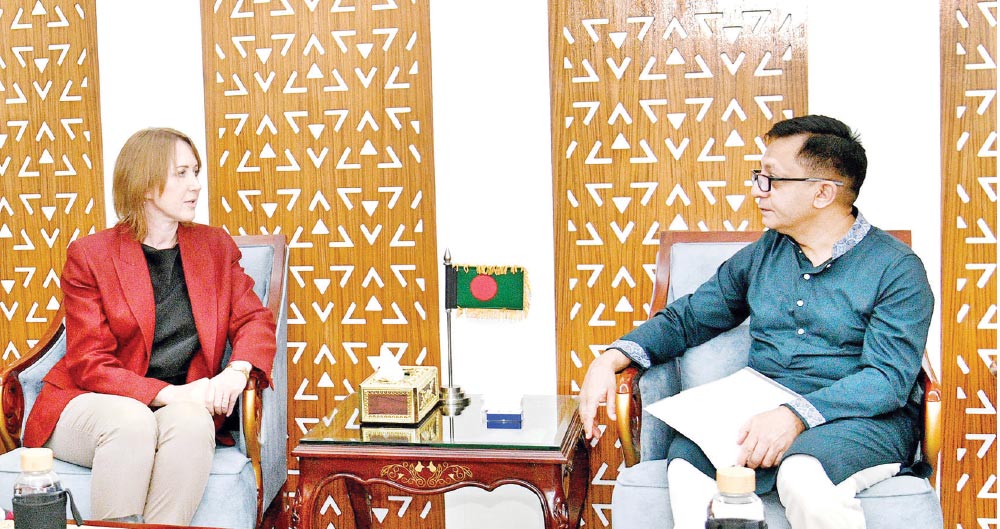 Bangladesh and Australia have underscored the need to further expand and institutionalise cooperation in trade, investment, skills development and research.
The issue came up for discussion at a meeting between Commerce Minister Khandaker Abdul Muktadir and Australian High Commissioner to Bangladesh Susan Ryle at the Ministry of Commerce on Thursday. Commerce Secretary Md Ataur Rahman Khan was also present.
The two sides discussed enhancing Bangladesh's capacity in trade negotiations, research collaboration, education, agriculture, livestock and investment, among other areas.
The commerce minister said the government plans to introduce long-term, institutional training programmes to enhance the skills of government officials in international trade, particularly in World Trade Organization (WTO) rules and trade negotiations.
He said an initiative has been taken to establish a research and study centre, which could eventually serve as a regional hub for knowledge-sharing and capacity building.
Muktadir also stressed the importance of strengthening the capacity of project directors to ensure the successful implementation of development projects. He said specialised training programmes would be introduced for this purpose.
In response, High Commissioner Susan Ryle said Australia was interested in supporting such long-term capacity-building initiatives. She said discussions were underway to introduce more structured and continuous programmes covering trade negotiations, the legal aspects of international agreements and policymaking skills.
She also suggested involving other development partners in the initiative.
The meeting also discussed Bangladesh's trade preferences after its graduation from the Least Developed Country (LDC) category, its position in the international trading system and future market access. Both sides stressed the importance of maintaining regular dialogue on these issues.
Ryle said bilateral trade between Bangladesh and Australia currently stands at around US$5.5 billion and has been growing steadily.
She identified education, transnational education, renewable energy, agriculture, food processing and business investment as key areas with strong potential for expanded cooperation.

Loading...
Loading...
Also read



Editor : Iqbal Sobhan Chowdhury
Published by the Editor on behalf of the Observer Ltd. from Globe Printers, 24/A, New Eskaton Road, Ramna, Dhaka.
Editorial, News and Commercial Offices : Aziz Bhaban (2nd floor), 93, Motijheel C/A, Dhaka-1000.
Phone: PABX- 41053001-06; Advertisement: 41053012; 01793317829, 01550707291, E-mail: [email protected], [email protected] Online: email: [email protected] 41053014; 01550707297 Advertisement: 01550707296
Published by the Editor on behalf of the Observer Ltd. from Globe Printers, 24/A, New Eskaton Road, Ramna, Dhaka.
Editorial, News and Commercial Offices : Aziz Bhaban (2nd floor), 93, Motijheel C/A, Dhaka-1000.
Phone: PABX- 41053001-06; Advertisement: 41053012; 01793317829, 01550707291, E-mail: [email protected], [email protected] Online: email: [email protected] 41053014; 01550707297 Advertisement: 01550707296


