



| HEADLINE |

|

Who Pays for Carbon?
Carbon Justice needs a nard-law revolution
Published : Saturday, 8 August, 2026 at 12:00 AM
Foyjunnesa Sharmin


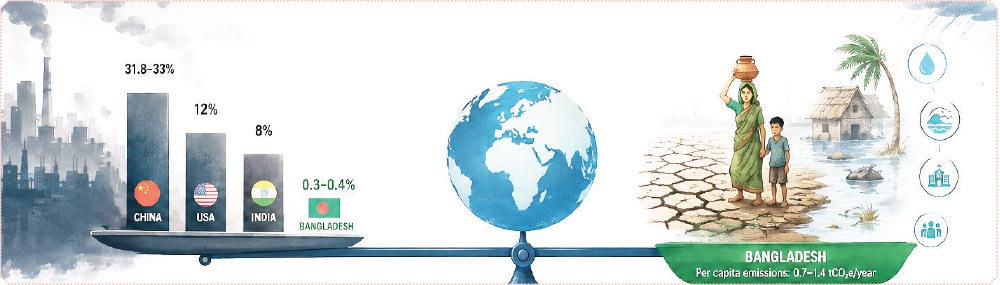 Carbon justice rests on a simple truth: those who leave the lightest footprint should not carry the heaviest burden. Yet the global climate order often tells another story. Through mechanisms such as the European Union's Carbon Border Adjustment Mechanism (CBAM), developing economies are being pressed to decarbonise rapidly or face trade barriers. For Bangladesh, whose ready-made garment (RMG) sector generates more than 80% of export earnings and relies heavily on the EU, which accounts for 21.57% of the bloc's apparel imports, the challenge is no longer merely environmental�"it reaches the country's economic lifeline.
The imbalance begins with emissions. Since 1750, the United States has produced about 25% of all historical CO₂ emissions. Today, China emits around 13,125 megatonnes annually (31.8�"33% of global emissions), the United States 4,632 megatonnes (12%), and India 3,154 megatonnes (8%). Bangladesh, by contrast, contributes only 0.3�"0.4% of global emissions, while its per capita emissions remain just 0.7�"1.4 metric tonnes of CO₂ equivalent annually, compared with over 17 metric tonnes in the United States. Yet it stands among the world's most climate-vulnerable nations.
Such disparity demands more than emission targets; it demands a global carbon fund rooted in equity. Those who have consumed the largest share of the world's carbon space should finance adaptation, loss and damage, technology transfer and green industrial transition in low-emitting countries. Climate finance must follow the ‘polluter pays’ principle, not the arithmetic of geopolitical influence.
The law is slowly catching up. The United States relies on the Clean Air Act, China pursues its 2030 emissions peak and 2060 carbon neutrality through state planning, while India's Supreme Court has expanded Article 21 to include protection from climate harm, supported by the National Green Tribunal. More significantly, the International Court of Justice's Advisory Opinion on Climate Change affirmed that states bear a binding duty under customary international law to curb emissions and protect human rights. The European Union, meanwhile, has legally committed to a 55% reduction in net greenhouse gas emissions by 2030 from 1990 levels and climate neutrality by 2050.
Bangladesh reveals the deepest irony. Carbon is generated disproportionately by urban industries, affluent households, and paper-heavy public and private offices. Yet the bill is paid by village women walking farther for fresh water, coastal families watching salt swallow fertile land, and children growing up beneath gathering storms. UNICEF estimates that 59 million Bangladeshi children face at least one major climate hazard, while 89.5% (5.3 crore) endure at least three overlapping risks. Around 5.79 crore children are affected by drought, 54.18% of young people by river flooding, and 25,430 educational institutions lie in disaster-prone areas, with nearly 20% unable to recover after previous disasters.
Bangladesh has relied on constitutional interpretation to bridge legal gaps. In Dr. Mohiuddin Farooque v. Bangladesh case, the High Court, following litigation by BELA, recognised a healthy environment as part of the Article 32 in the Constitution of Bangladesh, ehich guarantees the protection of right to life. Yet stronger laws are overdue. The Environment Conservation Act, 1995 should expressly define carbon emissions and climate harm, while the Environment Court Act, 2010 should establish specialised Climate Justice Tribunals, expand class-action and child-led climate litigation, enforce the polluter pays principle, and introduce a statutory carbon-accounting framework to help export industries adapt to CBAM.
I want to emphasis again on restructuring of Bangladesh sectoral laws, we can transform its legal apparatus from a manager of climate fallout into an active enforcer of environmental rights, protecting its economy and its children from a crisis they did not cause. The suggestions I have shared here might be too structural model which would take long period to see the positive impact, but the upcoming generation will get a healthy environment. We should think of these reforms as an investment for the future.
Loading...
Loading...



Editor : Iqbal Sobhan Chowdhury
Published by the Editor on behalf of the Observer Ltd. from Globe Printers, 24/A, New Eskaton Road, Ramna, Dhaka.
Editorial, News and Commercial Offices : Aziz Bhaban (2nd floor), 93, Motijheel C/A, Dhaka-1000.
Phone: PABX- 41053001-06; Advertisement: 41053012; 01793317829, 01550707291, E-mail: [email protected], [email protected] Online: email: [email protected] 41053014; 01550707297 Advertisement: 01550707296
Published by the Editor on behalf of the Observer Ltd. from Globe Printers, 24/A, New Eskaton Road, Ramna, Dhaka.
Editorial, News and Commercial Offices : Aziz Bhaban (2nd floor), 93, Motijheel C/A, Dhaka-1000.
Phone: PABX- 41053001-06; Advertisement: 41053012; 01793317829, 01550707291, E-mail: [email protected], [email protected] Online: email: [email protected] 41053014; 01550707297 Advertisement: 01550707296


