



| HEADLINE |

|

Air Pollution
A Public Health Catastrophe


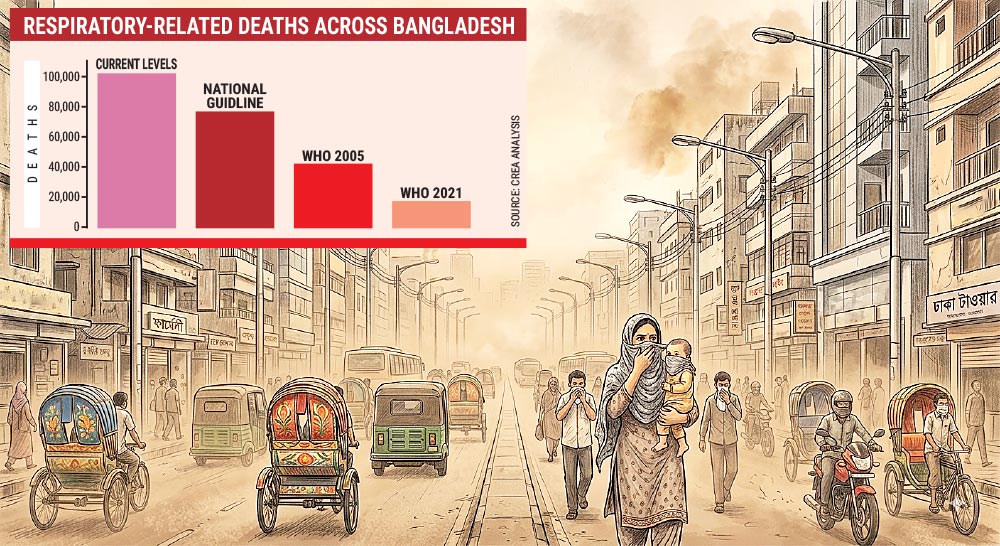 For millions of Bangladeshis, the greatest threat to health may be something they cannot see. Microscopic particles suspended in the air are entering homes, schools, workplaces and lungs, quietly shortening lives and imposing a huge burden on the country’s health and economy.
Air pollution in Bangladesh has reached catastrophic levels, with the country’s air quality ranking among the worst globally. The most serious health threat comes from PM2.5-"particulate matter measuring 2.5 micrometres or less in diameter. These invisible particles can bypass the body’s natural defences, penetrate deep into the lungs and enter the bloodstream when inhaled.
Bangladesh faces a year-round air pollution crisis, with experts calling for urgent policy action to curb deadly PM2.5 exposure and protect public health
The consequences are severe. Exposure to high levels of air pollution increases the risk of heart attacks, strokes, respiratory infections, asthma exacerbations and lung cancer. While it is impossible to definitively attribute a particular health condition in an individual to air pollution, extensive research shows that higher pollution levels increase the proportion of people suffering from and dying from these diseases.
We all need clean air to live, grow and thrive. Yet 99 per cent of us breathe air that is harmful and dirty, making air pollution one of our biggest health threats.
Around 90,000 Bangladeshis die prematurely every year due to air pollution exposure. The crisis also carries a huge economic cost through chronic illness, reduced productivity and diminished well-being. Growing evidence shows that pollution can reduce productivity in both physically demanding and cognitively intensive jobs, ultimately making the country less productive and poorer.
Over 9 million people die prematurely every year as a result of air pollution -" more than twice as many as from malaria, tuberculosis and HIV/AIDS combined. It doesn’t have to be this way.
The scale of the problem is starkly illustrated by the Air Quality Life Index (AQLI). Bangladesh’s national average PM2.5 concentration reached 62 µg/m³ in 2023-"12 times the World Health Organization guideline of 5 µg/m³. As a result, the average Bangladeshi loses around 5.5 years of life expectancy. In heavily polluted districts such as Dhaka and Gazipur, the loss exceeds seven years.
MISCONCEPTIONS CLOUD THE CRISIS
Despite the seriousness of the threat, several misconceptions continue to hinder effective action.
One is that staying indoors automatically provides protection. Recent co-authored research in Mirpur found indoor pollution levels to be remarkably similar to those outdoors, challenging the assumption that homes provide a safe refuge from polluted air.
Nor are rural areas safe havens. Although urban centres such as Dhaka face particularly high pollution, rural Bangladesh also records dangerously high concentrations of pollutants. Air quality, therefore, must be treated as a national public health priority rather than simply an urban problem.
SIX STEPS THAT CAN MAKE A DIFFERENCE
Experts have outlined six feasible policy measures that could bring substantial public health gains.
First, raise taxes on highly polluting fuels. Higher duties on coal, diesel and oil could encourage producers and consumers to move towards cleaner alternatives while generating government revenue. Rather than micromanaging the transition, market incentives could help drive the change.
Second, phase out coal-fired brick kilns. Around 25 per cent of kilns account for half of the health harms, while almost all operate in violation of regulations. The Department of Environment should prioritise enforcement against the most harmful kilns, particularly those located upwind of major cities. The recent ban in Savar is a step in the right direction and should be expanded nationwide.
Third, promote cleaner cooking stoves. Moving rural households from solid fuels to LPG gas stoves would reduce both indoor and ambient pollution, addressing a major health threat, particularly for women. Subsidising LPG cylinders could help accelerate the transition.
Fourth, reduce dependence on coal and oil for electricity generation. No new coal- or oil-fired power plants should be permitted, while older plants such as Barapukuria should be phased out. Bangladesh should accelerate solar panel installation and expand hydropower imports from Nepal and Bhutan.
Fifth, strictly enforce the ban on open waste burning. Businesses and individuals burning waste or crop residues should face stringent fines, while municipal corporations need to improve waste collection and management. Effective enforcement requires both penalties and better disposal infrastructure.
Finally, phase out old, polluting vehicles. Public transport buses should be replaced and old trucks retrofitted with catalytic converters and filters. Such measures should be implemented nationwide, rather than being limited to Dhaka. Although the investment would be substantial, the public health returns could be significant.
WHAT INDIVIDUALS CAN DO
Policy action is essential, but individuals can also take measures to reduce their exposure.
The right mask matters. N95, KN95 and FFP2 masks offer substantial protection against PM2.5, while cloth and simple surgical masks do not provide adequate filtration.
Air purifiers can also help. According to recent research, a HEPA-filter purifier placed in a bedroom and operated throughout the night during winter can reduce indoor pollution by up to 80 per cent when doors and windows are kept closed.
Schools, hospitals and workplaces should also be equipped with air purifiers during winter. Mandating such measures could protect children, patients and workers while improving productivity.
LOOK HOME BEFORE LOOKING ACROSS BORDERS
Transboundary pollution-"pollution drifting into Bangladesh from neighbouring countries-"is real and significant. But experts say Bangladesh should first focus on domestic pollution, as the majority of emissions originate within the country and are therefore within the government’s ability to control.
International agreements and future pledges should not distract from immediate action at home. Bangladesh can learn from the successes of other countries and adopt effective solutions without waiting for international treaties or high-level political cooperation. If countries across South Asia tackle their own emissions, cross-border pollution will also decline.
A CRISIS THAT DEMANDS PERSISTENCE
Media and civil society organisations have an important role to play in keeping public attention focused on the issue. Awareness should not be limited to periods when Dhaka temporarily tops global pollution rankings. The threat is year-round and requires sustained public understanding.
At the same time, expectations must remain realistic. Even China, where air pollution declined rapidly, took five years to achieve a 40 per cent reduction. Progress will take time, but every step in the right direction can save lives and improve health.
The experience of countries such as the United Kingdom, the United States and China shows that substantial reductions in air pollution are possible when governments, industries, the media and the public act together.
Bangladesh now faces the same challenge. The problem is immense, but it is not beyond the country’s ability to solve. Growing public awareness, civil society pressure, government action and individual responsibility can together create a realistic path towards cleaner air and better health.

Loading...
Loading...
Also read



Editor : Iqbal Sobhan Chowdhury
Published by the Editor on behalf of the Observer Ltd. from Globe Printers, 24/A, New Eskaton Road, Ramna, Dhaka.
Editorial, News and Commercial Offices : Aziz Bhaban (2nd floor), 93, Motijheel C/A, Dhaka-1000.
Phone: PABX- 41053001-06; Advertisement: 41053012; 01793317829, 01550707291, E-mail: [email protected], [email protected] Online: email: [email protected] 41053014; 01550707297 Advertisement: 01550707296
Published by the Editor on behalf of the Observer Ltd. from Globe Printers, 24/A, New Eskaton Road, Ramna, Dhaka.
Editorial, News and Commercial Offices : Aziz Bhaban (2nd floor), 93, Motijheel C/A, Dhaka-1000.
Phone: PABX- 41053001-06; Advertisement: 41053012; 01793317829, 01550707291, E-mail: [email protected], [email protected] Online: email: [email protected] 41053014; 01550707297 Advertisement: 01550707296


