



| HEADLINE |

|

Bangladesh Ranks 3rd globally for forest loss
BANGLADESH'S VANISHING LUNGS



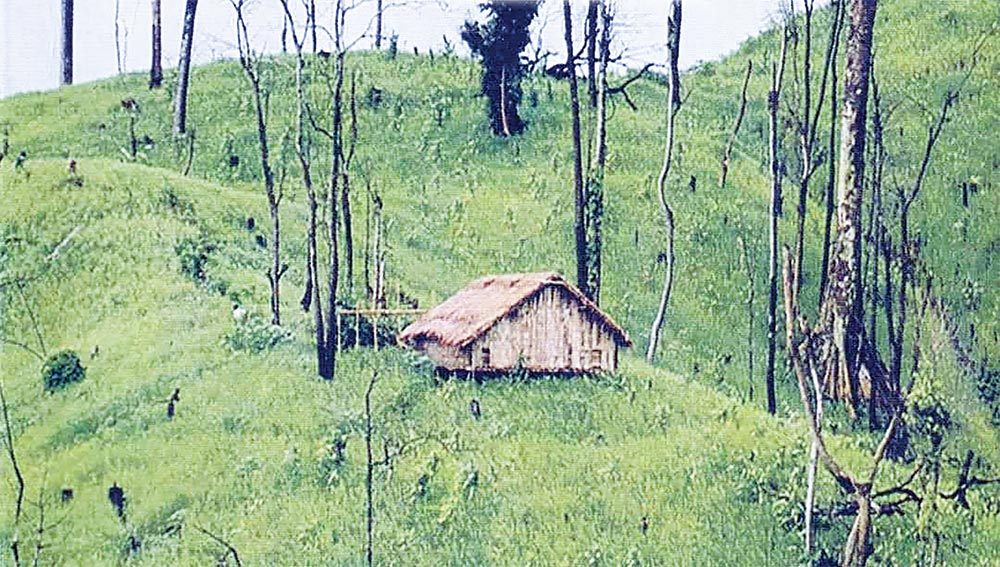 Bangladesh is losing its forests at a pace that should trigger a national emergency. Instead, what is increasingly visible is institutional indifference, fragmented responsibility and weak enforcement-"precisely when the country can least afford to lose its remaining green cover.
The warning signs are no longer confined to remote forest areas. They are visible in rising urban temperatures, deteriorating air quality, shrinking natural habitats and the steady disappearance of trees that once formed a protective buffer against heat, floods and erosion.
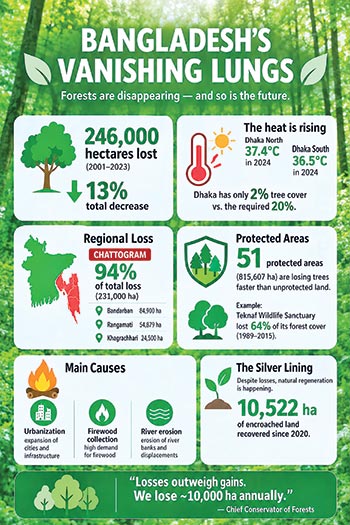
According to figures cited from Global Forest Watch (GFW), Bangladesh lost approximately 246,000 hectares of forested area between 2001 and 2023, a 13 percent decline, with the largest annual loss recorded in 2017 at around 28,328 hectares. The data also indicate that Bangladesh lost about 17,806 hectares of forest area in 2023 alone.
Another measure paints an equally worrying picture. GFW estimates that Bangladesh lost around 9,400 hectares of humid primary forest between 2002 and 2025, while the country’s humid primary forests shrank by about 10 percent over two decades.These figures are not simply environmental statistics. They represent the gradual destruction of one of the country’s most important natural defenses.
 A country falling far short of its forest target. Bangladesh is widely expected to maintain forest cover of at least 25 percent of its total area to support a healthy ecological balance. Yet, according to a figure previously cited by the environment ministry, forest land accounts for only 15.58 percent of the country’s total area.
The gap is enormous. And it is becoming more difficult to explain how the country can repeatedly acknowledge the importance of trees while continuing to lose forests to development, encroachment, extraction and unregulated land use.
The contradiction is particularly troubling because Bangladesh does not lack laws, government agencies or conservation institutions. It has a Forest Department, Department of Environment, district administrations, environmental laws and policies, protected-area rules and court interventions. What it appears to lack is a sufficiently coordinated system capable of making these mechanisms work together.
Garjan Forest: when everyone is responsible, nobody is responsible
A recent report on the once-pristine Garjan Forest near PaglirBil Road in Chakaria, around 2.5 kilometres southeast of Dulahazara Bazar, illustrates the depth of the problem.
The area was once dominated by towering Garjan trees. Today, much of that forest has disappeared, replaced by wild shrubs and smaller acacia trees. Illegal sand extraction and encroachment have added to the destruction. The government’s response reveals a disturbing institutional deadlock.
Forest officials have reportedly argued that they cannot take legal action over sand extraction because the area is not a reserved forest. District administration officials have pointed to the Department of Environment. The Department of Environment, in turn, has said the existing legal framework does not give it sufficient scope to act in this particular case and has pointed back to the district administration.
This is more than bureaucratic confusion. It is a conservation failure.
A forest can be destroyed by trucks carrying away sand regardless of which agency claims jurisdiction. Trees do not disappear according to administrative boundaries. Once a forest is cleared, no government memo can restore the ecological system that has been lost.
The question is therefore simple: when a forest is being destroyed in plain sight, who is responsible for stopping it?
Chattogram bears the heaviest burden
The country’s forest crisis is not evenly distributed. According to the GFW data cited above, Chattogram accounted for nearly 231,000 hectares, or about 94 percent, of Bangladesh’s total forest loss between 2001 and 2023.
Within the broader Chattogram region, the losses are particularly severe in the hill districts. Bandarban lost around 84,900 hectares, while Rangamati lost approximately 54,879 hectares and Khagrachhari around 24,500 hectares. Chattogram district and Cox’s Bazar also suffered major losses.
The concentration of forest loss in the Chattogram Hill Tracts should concern policymakers far beyond environmental circles. These forests are critical watersheds, biodiversity reservoirs and climate buffers. Their destruction increases pressure on soil and water systems and threatens communities that depend directly or indirectly on forest ecosystems.
Protected areas are not necessarily protected
One of the most troubling findings is that legal designation alone does not guarantee conservation.Data cited in the supplied research indicate that 51 protected areas covering about 815,607 hectares are losing trees faster than unprotected land.The Teknaf Wildlife Sanctuary, for example, reportedly lost 64 percent of its forest cover between 1989 and 2015.
The heat is becoming the price of deforestation
Figures cited in the supplied data show temperatures in Dhaka North rising from 33.4°C in 2017 to 37.4°C in 2024, while Dhaka South rose from 33.5°C to 36.5°C.At the same time, Dhaka reportedly has only about 2 percent tree cover, compared with a cited requirement of around 20 percent for a healthy urban environment.These numbers should force policymakers to rethink the treatment of trees as optional decoration. The same principle applies nationally. Forests are not empty land waiting for a project. They are infrastructure provided by nature.
The biggest problem: losses are outpacing recovery
Planting trees somewhere else cannot automatically replace the ecological functions of an old or natural forest. A plantation is not necessarily equivalent to a mature forest. Carbon storage, biodiversity, soil stability, watershed protection and habitat all depend on the quality and age of vegetation�"not simply the number of seedlings planted.
The consequences extend to climate change. The supplied research estimates that if the lost forest area had remained intact, at least 75 megatonnes of CO₂ emissions could have been prevented.
Why are Bangladesh’s forests disappearing?
Unplanned urbanisation is consuming green spaces and fragmenting remaining forest areas. New roads, buildings and infrastructure increasingly push into natural landscapes.Illegal settlements and encroachment turn public forest land into private or commercial property.Sand extraction and other forms of resource extraction physically destroy forest landscapes and alter the surrounding ecological systems.Firewood collection continues to place pressure on forests in areas where households depend on biomass for energy.River erosion destroys forest land naturally, but human pressure can make ecological recovery far more difficult.
There is some recovery-"but it is not enough
Research cited in the supplied information shows that between 2000 and 2020, natural regeneration occurred in several parts of the country, including roughly 106,954 hectares in Chattogram and 66,072 hectares in Dhaka.The Forest Department has also reported progress in reclaiming encroached land. Of approximately 116,328 hectares of forest land reportedly under encroachment in 2020, the government says 10,522 hectares have since been recovered, with reforestation carried out in those areas.
Bangladesh cannot afford to manage forests through jurisdictional confusion
According to Global Forest Watch data cited in the supplied material, alerts in April identified 22,445 locations where tree felling could occur, with potentially around 255 hectares of forest at risk. Between April 10 and April 17 alone, warnings were issued for 4,595 locations, potentially affecting around 53 hectares.
Chattogram accounted for roughly 72 percent of the forest area identified as being at risk, with Dhaka, Sylhet, Rangpur, Khulna, Rajshahi and Barishal also appearing in the warnings.The technology exists. The satellite monitoring exists. The laws exist. The institutions exist.
What remains weak is the political and administrative determination to act before destruction becomes irreversible.

Loading...
Loading...
Also read



Editor : Iqbal Sobhan Chowdhury
Published by the Editor on behalf of the Observer Ltd. from Globe Printers, 24/A, New Eskaton Road, Ramna, Dhaka.
Editorial, News and Commercial Offices : Aziz Bhaban (2nd floor), 93, Motijheel C/A, Dhaka-1000.
Phone: PABX- 41053001-06; Advertisement: 41053012; 01793317829, 01550707291, E-mail: [email protected], [email protected] Online: email: [email protected] 41053014; 01550707297 Advertisement: 01550707296
Published by the Editor on behalf of the Observer Ltd. from Globe Printers, 24/A, New Eskaton Road, Ramna, Dhaka.
Editorial, News and Commercial Offices : Aziz Bhaban (2nd floor), 93, Motijheel C/A, Dhaka-1000.
Phone: PABX- 41053001-06; Advertisement: 41053012; 01793317829, 01550707291, E-mail: [email protected], [email protected] Online: email: [email protected] 41053014; 01550707297 Advertisement: 01550707296


