



| HEADLINE |

|

Why did the disaster strike Nepal suddenly? What scientists and experts say
Published : Thursday, 27 August, 2026 at 4:10 PM
Observer Online Report


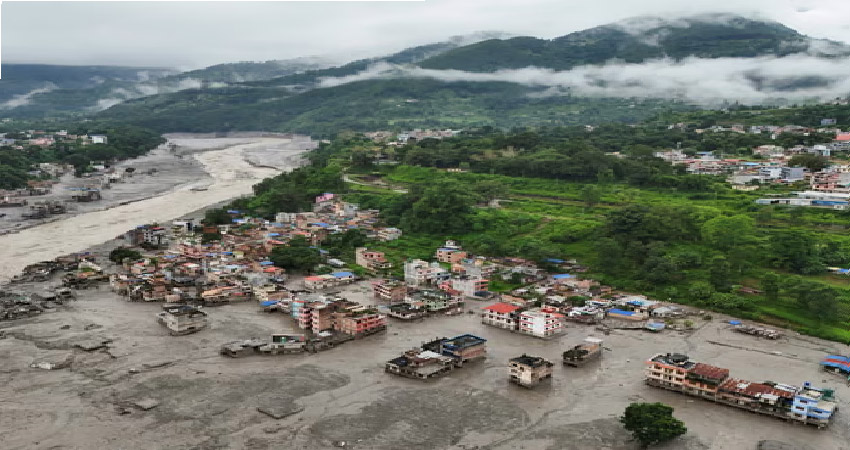
The sudden and devastating landslide and flood that hit Nepal on Wednesday sent a powerful torrent of mud, water and debris down the mountains, resembling “liquid concrete.” Such a powerful flow is virtually impossible to predict in advance, making it extremely difficult for people to escape by running.
The exact cause of the landslide and flood in Nepal’s region along the Tibet border has yet to be confirmed. However, experts say the complex terrain of the Himalayas significantly increases the risk of such sudden disasters. At least 162 people have so far been reported dead in the disaster. According to a Reuters report, around 1,500 people, including 800 foreigners, remain missing.
Footage captured by security cameras on the Chinese side of the border shows a powerful torrent of mud, water and debris crashing into a building several storeys high. The building was submerged within moments. Buses and vehicles were swept away like toys.
It is still too early to say whether the disaster is directly linked to climate change. However, there is clear evidence of several changes taking place in the Himalayan region, known as the “roof of the world.” These changes have also increased the risk of such disasters.
Nepal’s Foreign Minister Shishir Khanal said the landslide may have been triggered by an earthquake. The landslide blocked the course of a river, creating a natural dam. The dam later broke, sending a powerful surge of water downstream.
However, in a new note, the US Geological Survey (USGS) said a magnitude 4.4 earthquake occurred in the area. It was initially suggested that the earthquake may have triggered the landslide. But subsequent analysis found that the landslide itself caused the seismic activity.
A preliminary assessment by the Kathmandu-based International Centre for Integrated Mountain Development (ICIMOD) found no abnormalities on the Chinese side of the border.
Sarthak Shrestha, a remote-sensing and geospatial information analyst at the intergovernmental organisation, told AFP, “We suspect that a rock-ice avalanche occurred on the Nepalese side. This blocked the Lende River, resulting in severe flooding.”
Hydrologist Hatim Sharif of the University of Texas at San Antonio said it was surprising that there had been very little rain at or around the site before the disaster.
He said, “This is the kind of event that could render almost all effective flood-warning systems in the world ineffective.”
Many people may have seen the powerful torrent of mud and water rushing down the mountain. Some may even have tried to run to safety. But would that have helped much?
There had been very little rain at or around the site before the disaster, which was quite surprising.
Hatim Sharif, hydrologist at the University of Texas at San Antonio.
Sharif said that in such a situation, it becomes too late within moments. Running away is of little use, nor is trying to escape by car. The rapidly moving torrent of mud and water can be extremely deadly, behaving much like “liquid concrete.”
In such circumstances, the most effective survival strategy is to climb to higher ground as quickly as possible. According to Sharif, people should move at least 20 feet higher.
Dorothy Heinrich, a researcher at the University of Reading in the UK, told AFP that rivers in many parts of Nepal’s mountainous regions are quite narrow. If the flow of a river is blocked by a snow avalanche or landslide, a huge volume of water can accumulate. This can later trigger a powerful flash flood.
The US Geological Survey said a magnitude 4.4 earthquake occurred in the area. It was initially suggested that the earthquake may have triggered the landslide. But later analysis showed that the landslide itself caused the seismic activity.
Chiangong Zhang, head of the Climate and Environmental Risks Division at ICIMOD, is concerned about the possibility of another powerful surge. According to him, the river is still blocked upstream, meaning another major flood could occur.
Nepal is at risk of glacial lake outburst floods (GLOFs), in which a huge volume of water suddenly escapes from lakes formed by melting glacier ice, causing devastating floods.
A similar devastating incident occurred in July last year. A powerful surge from China’s Gyirong County hit Nepal’s Rasuwa district. However, authorities have not yet confirmed whether a GLOF was responsible for Wednesday’s disaster.
Sharif said that in such a situation, people can find themselves with almost no time to escape. Running away is of little use, and trying to flee by car is also ineffective because the rapidly advancing mud-and-water torrent can be extremely deadly, much like “liquid concrete.”
Over the coming days and weeks, scientists from around the world will investigate whether there is a link between climate change and the disaster in Nepal. A specialised study known as an “attribution study” will be conducted for this purpose.
The study will assess how likely such an event would be under today’s warming climate driven by fossil-fuel use. Researchers will also compare the findings with climate conditions before the Industrial Revolution.
Dorothy Heinrich said, “We know how climate change is affecting the Himalayas. Heatwaves are increasing. Glaciers are retreating. Permanently frozen ground is melting. These changes can contribute to disasters such as landslides and sudden floods from glacial lakes.”
-MT
Loading...
Loading...
Also read







Editor : Iqbal Sobhan Chowdhury
Published by the Editor on behalf of the Observer Ltd. from Globe Printers, 24/A, New Eskaton Road, Ramna, Dhaka.
Editorial, News and Commercial Offices : Aziz Bhaban (2nd floor), 93, Motijheel C/A, Dhaka-1000.
Phone: PABX- 41053001-06; Advertisement: 41053012; 01793317829, 01550707291, E-mail: [email protected], [email protected] Online: email: [email protected] 41053014; 01550707297 Advertisement: 01550707296
Published by the Editor on behalf of the Observer Ltd. from Globe Printers, 24/A, New Eskaton Road, Ramna, Dhaka.
Editorial, News and Commercial Offices : Aziz Bhaban (2nd floor), 93, Motijheel C/A, Dhaka-1000.
Phone: PABX- 41053001-06; Advertisement: 41053012; 01793317829, 01550707291, E-mail: [email protected], [email protected] Online: email: [email protected] 41053014; 01550707297 Advertisement: 01550707296


