



| HEADLINE |

|

a tribute to
The Poet Who Made the Moon
a Piece of Burnt Bread
Published : Saturday, 29 August, 2026 at 12:00 AM
Shaon Arafat


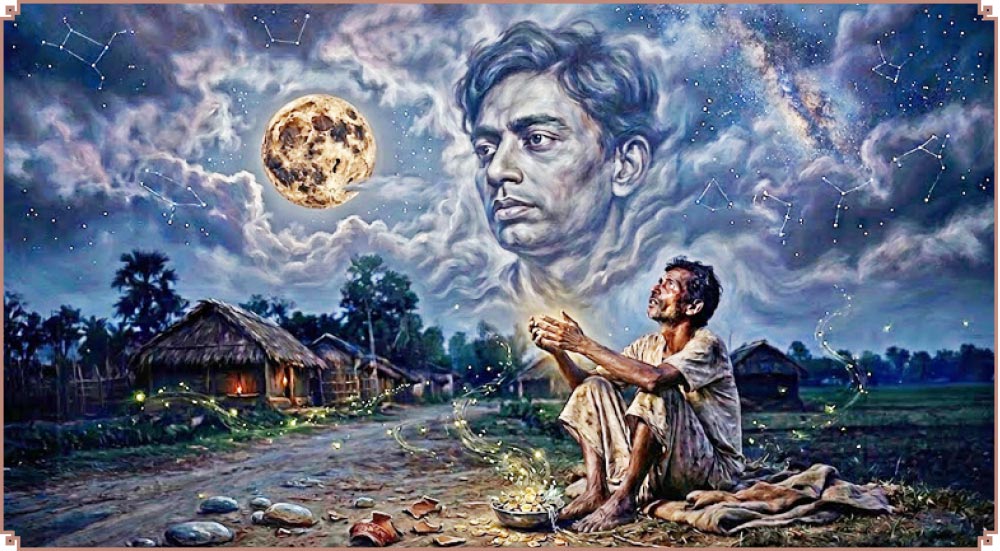
 Imagine a hungry man looking up at the full moon.
The moon is bright. And beautiful. And it has inspired generations of poets. But the man is hungry. His stomach is so empty. Now imagine asking him what he sees in that beauty.
For Sukanta Bhattacharya, that was not just an interesting poetic thought but a truth about the world he lived in. Born on August 15, 1926, Sukanta came of age in a Bengal marked by war, colonial rule, poverty and political unrest. Then came the Bengal Famine of 1943. At the time, hunger was no longer something one could read about in newspapers. It was on the streets, in people’s faces, in the bodies of those who had nothing to eat.
Sukanta was very young, but he refused to look away. He wrote about what he saw. And what he saw was not pretty. Nor did he find that the old language of poetry was sufficient for the world around him. Flowers and moonlight could still be beautiful, but they could not tell the whole story. At least not when people were starving. So he opened the doors of poetry to hunger. He brought in labour, poverty, war, and the everyday lives of ordinary human beings. His poetry became a place where people who were usually pushed to the margins could finally be seen.
Take ‘Hey Mahajibon.’ The moon is there. But it is not the romantic moon we know from countless poems. To the hungry, Sukanta tells us, it looks like a burnt piece of bread.
The image is simple yet unforgettable.
Think about it. If you are hungry enough, would you really care about the beauty of the full moon? Or would you think about food?
 Then comes ‘Atharo Bochor Boyosh.’ Here, Sukanta turns towards youth itself. Eighteen, in his poem, is not an age for waiting. But an age of energy. Of courage. Of uncertainty, perhaps, but also of possibility. The poem carries the excitement of someone standing at the edge of life and refusing to remain passive.
And Sukanta himself lived that way. He did not wait to become an established poet. He did not wait for someone to give him permission to speak. He became involved in literary and social activities while still very young. He helped establish a library. He edited a handwritten magazine. He took part in progressive cultural and political activities. During the famine, he was also involved in relief work.
For him, poetry was not something separate from life. Life came first. Poetry followed.
That is also why ‘Chharpatra’ remains so moving. At the centre of the work is the arrival of a child. A new life is coming into the world. And suddenly the question changes: What kind of world are we leaving behind? The child has done nothing wrong. The child did not create the poverty, war or injustice of the old world. Yet the child will inherit all of it. Sukanta asks the older generation to clear away the mess before the child arrives. There is something deeply tender about that image.
There is an almost painful irony in reading those lines today. Sukanta himself never reached that future. He died on May 13, 1947, just months before the end of British rule in the subcontinent. He was 20 then. Just 20. Sometimes that fact alone is enough to make us pause. What would he have written at 30? At 40? At 60? We will never know.
What we do know is what he left behind. And there is so much life in it. There is anger in his poetry. But there is also affection. There is despair. But there is hope too. He looked at a broken world without believing that it had to remain broken forever. That may be the reason Sukanta continues to matter. He was not blind to darkness. He simply refused to surrender to it.
A hundred years after his birth, Sukanta should not remain only a name attached to a chapter in Bengali literary history. He should be read as a poet whose work still asks us to slow down and look. Look at the moon. Look at the hungry. Look at the young. Look at the world we are preparing for those who come after us.
Perhaps that is the simplest tribute to Sukanta at 100.
Open ‘Chharpatra’. Return to ‘Hey Mahajibon.’ Follow the footsteps of ‘Ranar.’ Stand beside the eighteen-year-old in ‘Atharo Bochor Boyosh.’
And listen.
Listen to the voice that belongs to a young man who died nearly eight decades ago. Yet it has not grown old.
The writer is Editorial Assistant, The Daily Observer

Loading...
Loading...
Also read



Editor : Iqbal Sobhan Chowdhury
Published by the Editor on behalf of the Observer Ltd. from Globe Printers, 24/A, New Eskaton Road, Ramna, Dhaka.
Editorial, News and Commercial Offices : Aziz Bhaban (2nd floor), 93, Motijheel C/A, Dhaka-1000.
Phone: PABX- 41053001-06; Advertisement: 41053012; 01793317829, 01550707291, 01550707296
E-mail: [email protected], [email protected]. [email protected], [email protected], [email protected], [email protected], Online-email: [email protected]
Published by the Editor on behalf of the Observer Ltd. from Globe Printers, 24/A, New Eskaton Road, Ramna, Dhaka.
Editorial, News and Commercial Offices : Aziz Bhaban (2nd floor), 93, Motijheel C/A, Dhaka-1000.
Phone: PABX- 41053001-06; Advertisement: 41053012; 01793317829, 01550707291, 01550707296
E-mail: [email protected], [email protected]. [email protected], [email protected], [email protected], [email protected], Online-email: [email protected]


