



| HEADLINE |

|

Struggles of Bangladesh’s Hijra Community
Published : Monday, 7 September, 2026 at 12:00 AM
Samira Anneysha


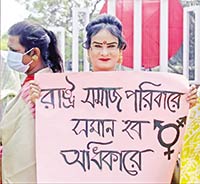 If human rights belong to every human being, why are transgender people still forced to fight for rights that others take for granted? Despite receiving legal recognition as a third gender in Bangladesh, members of the Hijra community continue to face severe discrimination, social exclusion, limited educational opportunities and a lack of employment. As a result, many are forced to depend on traditional forms of livelihood, such as dancing and singing at newborn and wedding ceremonies, asking for money in markets, buses and on the streets, and, in some cases, begging or sex work.
These activities are often not a matter of personal choice but a means of survival. Eva Ahmed Kotha, President of Forty Up Bangladesh, an organisation working with the Hijra community, said members of the community continue to face physical abuse because of the difficult circumstances in which they are forced to live and work. “Although we were recognised as a third gender in 2013, employment opportunities were not created for us. Therefore, to survive, we have to depend on dancing and singing, blessing newborns and couples at weddings, and sometimes begging,” she said.
According to Kotha, the government provides a monthly allowance of Tk600, but the amount is insufficient to meet basic needs. She called for vocational training, including opportunities to work in beauty parlours and with sewing machines. She also urged the government to create employment opportunities in government offices based on the qualifications of members of the community.
Professor Salma Akter of the Department of Sociology at the University of Dhaka said attempts had previously been made to rehabilitate members of the Hijra community, but many of those initiatives were not successfully implemented. She suggested creating opportunities that would allow them to work from home or through online platforms.
According to information from the Ministry of Social Welfare, Bangladesh has 12,629 people belonging to the third-gender community. However, various non-governmental organisations and Hijra community organisations estimate that the actual number may be close to 100,000. They live in different parts of the country. Under government programmes aimed at improving the living standards of the Hijra community, 12,229 people are currently receiving allowances. Around 400 Hijra students across the country are also receiving educational stipends. The monthly stipends are Tk700 at the primary level, Tk800 at the secondary level, Tk1,000 at the higher-secondary level and Tk1,200 at the higher-education level.
The government officially recognised the Hijra community as a third gender in November 2013 as part of an effort to reduce discrimination and bring the community into the mainstream of society. A government gazette providing state recognition was published on January 26, 2014. Mohammad Mosharraf Hossain, director of the Social Security Sub-Division of the Department of Social Services, said the government provides educational stipends to Hijra students and allowances to elderly members of the community. He added that various training programmes are also being provided to help create employment opportunities.
However, members of the community say that legal recognition has not resulted in meaningful changes in their everyday lives. Hijra community member Tamanna said that despite receiving recognition as a third gender, members of the community continue to be deprived of rights and civic facilities. “I could not become educated because I did not receive the opportunity to study. As a result, I have been deprived of employment opportunities. Even those among us who are educated often cannot find jobs,” she added.
Tamanna further said members of the third-gender community live in areas including Kamrangirchar, Madhubagh and Mirpur in Dhaka as well as different parts of the country. She added that many people avoid them on the streets because of negative social attitudes.
Legal recognition was an important step, but recognition alone cannot ensure dignity, equality or economic independence. If members of the Hijra community continue to face barriers to education, employment and basic civic facilities, then their legal status will remain largely symbolic. Therefore, the government and society must go beyond recognition and create genuine opportunities for education, skills development and decent employment.
The community does not simply need welfare support; it needs the opportunity to become self-reliant. Vocational training, online employment, suitable government jobs and effective rehabilitation programmes can help create that opportunity. More importantly, society must challenge the prejudice that keeps members of the Hijra community excluded.
Only when legal recognition translates into equal access to education, employment and civic rights can Bangladesh claim to have truly brought the Hijra community into the mainstream of society.
The writer is a student, Institute of Business Administration, Jahangirnagar University
Loading...
Loading...
Also read



Editor : Iqbal Sobhan Chowdhury
Published by the Editor on behalf of the Observer Ltd. from Globe Printers, 24/A, New Eskaton Road, Ramna, Dhaka.
Editorial, News and Commercial Offices : Aziz Bhaban (2nd floor), 93, Motijheel C/A, Dhaka-1000.
Phone: PABX- 41053001-06; Advertisement: 41053012; 01793317829, 01550707291, E-mail: [email protected], [email protected] Online: email: [email protected] 41053014; 01550707297 Advertisement: 01550707296
Published by the Editor on behalf of the Observer Ltd. from Globe Printers, 24/A, New Eskaton Road, Ramna, Dhaka.
Editorial, News and Commercial Offices : Aziz Bhaban (2nd floor), 93, Motijheel C/A, Dhaka-1000.
Phone: PABX- 41053001-06; Advertisement: 41053012; 01793317829, 01550707291, E-mail: [email protected], [email protected] Online: email: [email protected] 41053014; 01550707297 Advertisement: 01550707296


