



| HEADLINE |

|

Road safety vital for liveable Dhaka [Part-II]
Bangladesh’s roads have become a national tragedy, claiming thousands of lives every year amid reckless driving, unfit vehicles, corrupt licensing, footpath encroachment, transport syndicates and weak enforcement. A four-part Daily Observer investigation traces the crisis, the failures that sustain it and the reforms needed to make the country’s roads safer.



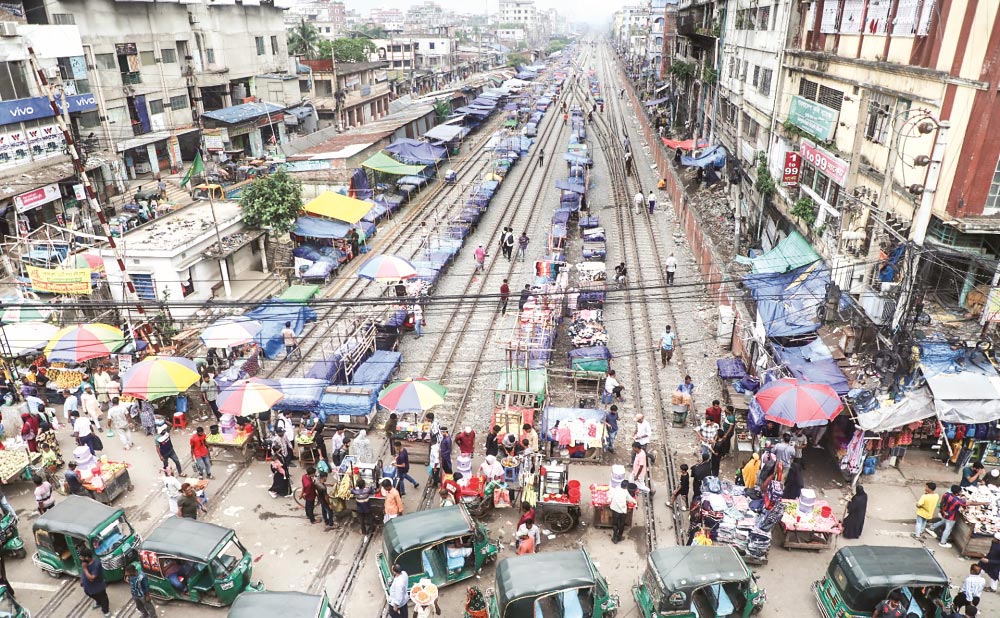 Ask any Bangladeshi road-safety researcher what causes a crash and the honest answer is: almost never one thing. A 2024 study by BRAC University’s Centre for Climate Change and Environmental Research, commissioned by the Police Headquarters’ Research, Planning and Innovation wing, put figures to the chaos. Reckless driving accounted for 42 percent of crashes, with drivers blaming their own exhaustion after excessive hours behind the wheel. A further 29 percent were attributed to poor road conditions, 19 percent to the absence of zebra crossings, 5 percent to mechanical faults, 3 percent to intoxicated driving and 2 percent to distraction.
Behind those percentages lies a story the authorities have yet to address in full. Bangladesh’s highways have expanded dramatically �" two-lane roads widened to four, expressways rising over water and land �" yet driver training has not kept pace. Rickshaws still use national highways built for high-speed traffic, while field visits along the Dhaka�"Chittagong, Dhaka�"Sylhet and Dhaka�"Tangail highways found long stretches pitted with craters and subsided sections, forcing sudden braking or swerving.
Waterlogging during the monsoon compounds the danger. Roads without dividers, or with poorly designed ones, also invite head-on collisions on many single-lane inter-district and inter-thana roads, where overtaking leaves drivers "very little time or space", according to a safety expert. Slow-moving three-wheelers and motorbikes are particularly vulnerable when large buses squeeze past each other.
WHEN EVERY TRIP BECOMES A RACE
The human factor is not simply about error but also incentive. The BUET Accident Research Institute notes that bus drivers are paid by the trip rather than by salary: "the more trips, the more money - and that creates enormous psychological pressure."
A transport-sector source described the daily reality bluntly: "They start driving in the morning already 'intoxicated.' They know no rules - only competition. They won't give way to anyone, not even to an emergency light."
The Bangladesh Road Transport Owners' Association estimated last May that around half of Dhaka's transport workers use narcotics. The Accident Research Institute observed that intoxication robs drivers of the ability to make the right decision even for a few moments, turning risky situations into crashes that might otherwise have been avoided.
A PROFESSION WITHOUT DIGNITY BREEDS RISK
Underpinning the recklessness is a driver population drawn overwhelmingly from the socio-economically marginal, argues Touhidul Haque, a teacher at Dhaka University's Institute of Social Welfare.
"We have never managed, as a society, to build driving into a respected profession," he said. "A person's rights, sense of dignity and social acceptance are what create wellbeing in professional life. Their absence creates psychological instability."
He said transport workers remain anxious about their social identity and demoralised by financial insecurity. "Given that state of mind, it is only natural that accidents happen - because he is living in constant turmoil," he said.
THE ROAD IS THEIR TRAINING GROUND
That turmoil often begins early. Many helpers - often boys well under 18 - learn to drive informally on the job, with no institutional training, before eventually taking the wheel themselves, sometimes on borrowed or purchased licences.
The law sets the minimum age at 18 for a non-professional licence and 21 for a professional one, but there is no maximum age. Even the minimum age is patchily enforced among helpers, three-wheeler drivers and operators of nosimon and tempo vehicles.
Passengers, meanwhile, often contribute to their own vulnerability. Many still cross highways rather than use footbridges, ignore zebra crossings that barely exist in the first place, and talk on mobile phones while crossing - habits that have never been seriously tackled through a sustained national safety culture.
A LICENCE CAN BE BOUGHT. A LIFE CANNOT
If Bangladesh's driver population lacks training, its licensing system lacks integrity. The Road Transport Act, 2018 requires at least an eighth-grade education, a medical certificate and a competency test - on paper.
In practice, one long-time observer of the sector said, "I would say more than half of all driving licences are fake. If you crack down on fake licences, half the country's vehicles would stop running."
He alleged that BRTA officials and a "class of brokers" have built a "powerful syndicate" around licensing. Even genuine applicants, he said, often pay training schools that function as little more than certificate mills, with the amount to be paid to a broker agreed in advance.
BRTA figures show some 18.77 lakh (1.877 million) drivers nationwide have no valid licence at all. Separately, roughly 20,000 licences were rendered void during the BNP era because fees paid to BRTA did not reach government coffers or enter the official register.
UNFIT VEHICLES, FIT CERTIFICATES
The vehicles those drivers operate fare little better. As of 19 June this year, Bangladesh had 6.394 million registered vehicles, including around 4.7 million motorcycles exempt from fitness certification. Of the more than 1.7 million vehicles legally required to hold fitness certificates, roughly 650,000 do not.
Even where certificates exist, BUET's historical data recorded 66,661 crashes between 1998 and 2013 involving vehicles that were unfit to be on the road.
Fitness testing itself, experts say, remains dangerously unscientific. A single inspector may be expected to examine hundreds of vehicles a day, relying largely on visual judgement without an automated or scientific process. That creates a gap in which a bribe can turn an "unfit" vehicle into a "fit" one.
EVEN THE CONDEMNED RETURN TO THE ROAD
Even when a vehicle is condemned, there is often nowhere to keep it. Bangladesh has no permanent, secure and adequately sized dumping station for seized vehicles. Lacking sufficient space to impound them, authorities frequently fine offending vehicles and release them - only for them to return to the road within a day.
A CITY BUILT BEYOND ITS CAPACITY
All these failures are compounded by Dhaka's own geography of dysfunction. Unplanned urbanisation has drawn an ever-growing population into a city whose infrastructure was never designed to absorb it.
Public transport remains too weak and unreliable to compete effectively with private cars, despite a single bus being capable of carrying 40-45 passengers compared with two or three in a private car.
The Highway Police, meanwhile, is itself constrained. The minister concerned has admitted that the force lacks the manpower, vehicles and motorcycles needed to patrol the country's arterial roads effectively.
The result is a system in which unsafe roads, poorly trained and pressured drivers, questionable licences, unfit vehicles and inadequate enforcement reinforce one another - making road safety a problem far larger than any single crash or reckless driver.

Loading...
Loading...
Also read



Editor : Iqbal Sobhan Chowdhury
Published by the Editor on behalf of the Observer Ltd. from Globe Printers, 24/A, New Eskaton Road, Ramna, Dhaka.
Editorial, News and Commercial Offices : Aziz Bhaban (2nd floor), 93, Motijheel C/A, Dhaka-1000.
Phone: PABX- 41053001-06; Advertisement: 41053012; 01793317829, 01550707291, E-mail: [email protected], [email protected] Online: email: [email protected] 41053014; 01550707297 Advertisement: 01550707296
Published by the Editor on behalf of the Observer Ltd. from Globe Printers, 24/A, New Eskaton Road, Ramna, Dhaka.
Editorial, News and Commercial Offices : Aziz Bhaban (2nd floor), 93, Motijheel C/A, Dhaka-1000.
Phone: PABX- 41053001-06; Advertisement: 41053012; 01793317829, 01550707291, E-mail: [email protected], [email protected] Online: email: [email protected] 41053014; 01550707297 Advertisement: 01550707296


