



| HEADLINE |

|

Gas crisis hits deeper into household budgets
Authorities turn a blind eye as families pay gas bills and spend more on electricity and LPG
Published : Thursday, 17 September, 2026 at 12:00 AM
Tanvir Raihan


 Housewife Mahmuda Akter, a resident of Mirpur, has been losing sleep for months as she struggles to cook daily meals for her six-member family amid a prolonged gas shortage. For the past two months, there has been virtually no gas in her line, forcing her to rely on an electric cooker and spend an additional Tk2,000 a month. Yet she continues to pay the monthly gas bill. Even the electric cooker cannot always provide a solution, as frequent load-shedding often interrupts cooking.
Her experience is increasingly common across Dhaka, where prolonged gas shortages are forcing households to spend more to prepare the same meals. Families are paying fixed charges for gas connections despite inadequate supply, while also bearing higher electricity costs and, in some cases, purchasing LPG as an alternative.
In many neighbourhoods, gas pressure remains too weak for cooking during the day, forcing families to wait until late at night when pressure improves. In some areas, however, the supply remains unavailable for days, leaving households with little choice but to turn to electric stoves or LPG.
The result is a growing double or even triple financial burden: consumers pay for their gas connections, spend more on electricity to compensate for the unreliable supply and sometimes buy LPG when neither gas nor electricity can be relied upon.
For many families, the crisis has gone beyond inconvenience. It is disrupting household routines, increasing the cost of cooking and forcing homemakers to sacrifice sleep simply to prepare meals.
"By the time the gas pressure becomes suitable for cooking, it is often 11:30pm or midnight. I then start cooking and finish even later before going to bed," Mahmuda said.
She said her family continues to pay Tk1,080 a month for a two-burner gas connection despite being unable to use it properly.
"I have to stay awake at night just to cook. It affects my sleep and other household work. Even when guests arrive unexpectedly, it becomes difficult to serve them," she said.
Another housewife, Shahanaz, said gas pressure is frequently insufficient in the morning, forcing her to use an induction cooker. But sudden power cuts can interrupt cooking, leaving food partially cooked or, at times, forcing the family to discard it.
The financial burden is also reflected in electricity bills.
Belal Hossain, a private-sector employee in Mirpur, said his prepaid electricity expenditure rose from Tk1,672 in June to Tk2,296 in August after his family began relying more heavily on electricity for cooking.
The Tk624 increase represents a 37.3 percent rise in just two months.
"I have a post-paid gas connection, but gas is hardly available when we need it. Yet I have to pay the fixed monthly charge of Tk1,080 for two burners," he said.
Belal said his family now has to bear the combined cost of gas and electricity and, at times, LPG. He also spent around Tk 8,000 to buy an induction cooker and other cooking equipment.
Advocate SM Nazer Hossain, vice-president of the Consumers Association of Bangladesh (CAB), said consumers should not be required to pay the full charge for a service they cannot properly use.
"If gas supply cannot be ensured, customers should not be charged the full gas bill," he said, adding that a reasonable fixed charge could be considered for maintaining an active connection.
Repeated attempts to contact Titas Gas Transmission and Distribution PLC Managing Director Shahnewaz Parvez were unsuccessful.
However, Titas officials, speaking on condition of anonymity, said the company was facing difficulties in meeting residential demand.
Kazi Mohammad Saidul Hasan, general manager of Titas Gas's Operations Division, said illegal connections in Dhaka made it difficult to determine actual residential demand.
He said Titas receives bills for around 160 million cubic feet of gas but is currently able to supply around 120 million cubic feet.
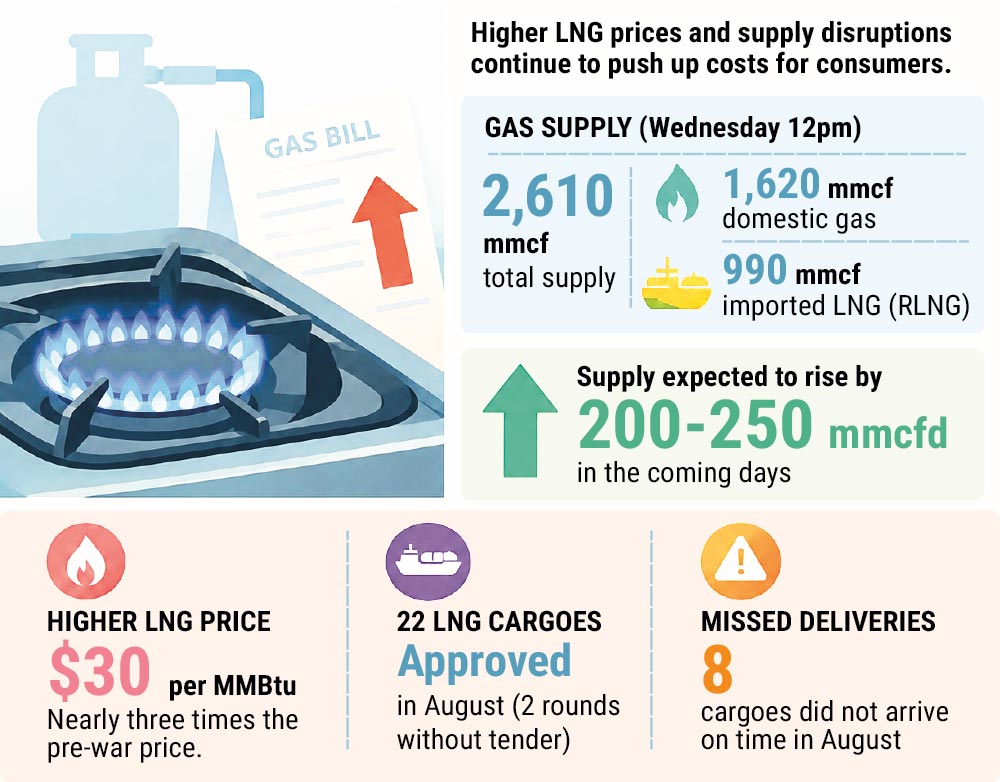
Petrobangla has informed Titas that gas supply could increase by 200-250 million cubic feet from September 15, he said, potentially providing some relief to consumers.
The problem, however, extends beyond Dhaka.
Bangladesh's daily gas demand is around 3,825 million cubic feet, while domestic production and imported LNG together provide about 2,300 MMCFD, leaving a shortfall of roughly 1,500 MMCFD.
According to Petrobangla's demand forecast, the power sector requires around 1,415 MMCFD, industries 989 MMCFD and captive power plants 743 MMCFD. Together, these three sectors account for around 82 percent of total demand, while residential consumers require about 290 MMCFD.
Energy expert Prof Dr Badrul Imam, honorary professor of the Department of Geology at Dhaka University, said the crisis could not be solved through temporary increases in supply alone.
He stressed the need to expand domestic gas exploration and production while strengthening local institutions and maintaining the involvement of foreign companies in exploration and development.
For Dhaka's households, however, the immediate problem is much more basic: how to cook without paying repeatedly for an unreliable energy supply.
As gas pressure disappears from kitchens during the hours when families need it most, midnight has become a new cooking hour - and an increasingly expensive one.

Loading...
Loading...
Also read



Editor : Iqbal Sobhan Chowdhury
Published by the Editor on behalf of the Observer Ltd. from Globe Printers, 24/A, New Eskaton Road, Ramna, Dhaka.
Editorial, News and Commercial Offices : Aziz Bhaban (2nd floor), 93, Motijheel C/A, Dhaka-1000.
Phone: PABX- 41053001-06; Advertisement: 41053012; 01793317829, 01550707291, E-mail: [email protected], [email protected] Online: email: [email protected] 41053014; 01550707297 Advertisement: 01550707296
Published by the Editor on behalf of the Observer Ltd. from Globe Printers, 24/A, New Eskaton Road, Ramna, Dhaka.
Editorial, News and Commercial Offices : Aziz Bhaban (2nd floor), 93, Motijheel C/A, Dhaka-1000.
Phone: PABX- 41053001-06; Advertisement: 41053012; 01793317829, 01550707291, E-mail: [email protected], [email protected] Online: email: [email protected] 41053014; 01550707297 Advertisement: 01550707296


