



| HEADLINE |

|
Abahani field is no longer Abahani's
What happens to Dhaka's historic ground now?
Published : Friday, 18 September, 2026 at 12:00 AM
Sports Reporter


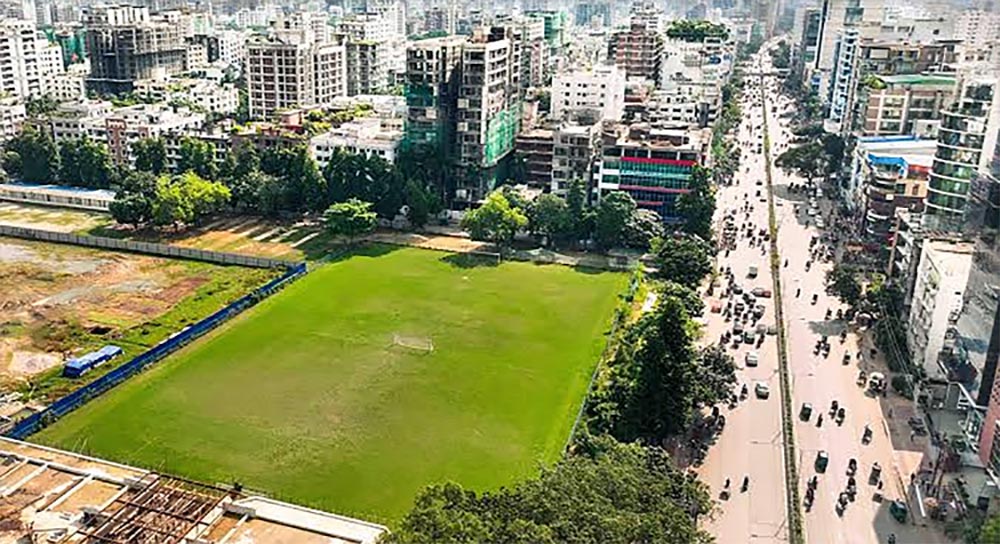 For more than five decades, the name Abahani has been inseparable from the large sporting ground in the heart of Dhanmondi. Generations of footballers and cricketers trained there, while the field became part of the identity of one of Bangladesh's most prominent sports clubs.
That long association has now come to an end.
The government has taken back control of the ground after cancelling Abahani Limited's long-term lease, and the facility has been renamed Dhanmondi Cricket Field. The Ministry of Youth and Sports has taken responsibility for its preservation, maintenance and management under a new agreement with the Ministry of Housing and Public Works.
The change, however, is bigger than a change of ownership or a new signboard. The government says the ground will no longer remain effectively tied to a single club. It is to be opened to the public, while its existing sports facilities will be upgraded and new activities introduced.
How Abahani became linked to the ground
The field predates Abahani's association with it.
The Dhanmondi land was once used as a brick kiln before being developed into a playing field. When Abahani was established in 1972, the club began using the ground for training and sporting activities. Over time, the field became popularly known as Abahani Ground.
The club later obtained the land through a long-term lease. Abahani applied in 1996 for a 99-year lease of 9.76 acres. In 1998, most of that land was leased to the club, followed by another 0.89 acres in 2010. The total leased area came to 10.65 acres.
That arrangement has now been terminated.
Why was the lease cancelled?
The government has cited several issues behind the decision.
According to the housing and public works minister, Abahani failed to pay lease-related dues within the stipulated period and did not fulfil some of the conditions of the agreement. The government also said structures had been built without the required approvals from the ministry and RAJUK, while there were concerns about attempts to use some facilities commercially.
The lease had required the land to be used for sporting purposes, with restrictions on commercial construction. The government's decision followed a process that included rejecting an appeal on August 3 seeking reinstatement of the lease.
What happens to the structures?
This is one of the most important questions surrounding the takeover.
Abahani had already developed several facilities on the property. There are football and cricket facilities, a basketball court, gymnasium and club-related infrastructure. The club also began construction of the Sheikh Kamal Sports Complex on the northern side of the ground. The complex, whose foundation was laid in 2011, remains unfinished. An academy building was constructed on the eastern side in 2013.
The government is not planning to simply clear those structures.
Youth and Sports Minister Aminul Haque said the existing infrastructure would be retained and renovated rather than demolished. The plan is to make better use of what is already there while adding facilities for different sports.
A field for more than one sport
The proposed future of the ground is broader than football or cricket.
The government has discussed introducing facilities for sports such as futsal, padel, shooting, archery and a small hockey turf. Officials have also stressed that development will have to be matched by regular maintenance, an issue that has often determined whether sports facilities remain usable after construction.
The stated objective is to make the ground available to children, young people, women and other members of the community rather than keeping it restricted to a particular club or group. The exact system for booking facilities, setting playing hours or collecting any fees has yet to be finalised.
What does it mean for Abahani?
For Abahani, the change marks the end of a relationship that lasted from the club's foundation in 1972.
The club can no longer treat the Dhanmondi ground as its long-term home under the old lease arrangement. That could affect training, youth development and the way its sporting activities are organised.
But the government's stated plan is not to erase Abahani's sporting history from the site. Instead, it intends to preserve and repurpose the existing infrastructure while changing who manages the ground and who can use it.
The wider policy is also significant
The government has taken responsibility for the adjacent Dhanmondi field as well, and officials have indicated that other government-owned playgrounds could gradually come under similar arrangements. The stated aim is to protect scarce playing spaces in Dhaka and make them more accessible to the public.
For Dhanmondi, therefore, the real test begins now
The field has a new name, a new manager and a new public mandate. What remains to be seen is whether the government can turn a ground historically identified with one club into a properly maintained sporting space where the wider community can actually play.
The end of the Abahani lease is only the first chapter. The bigger story will be what happens on the field next.
Loading...
Loading...
Also read



Editor : Iqbal Sobhan Chowdhury
Published by the Editor on behalf of the Observer Ltd. from Globe Printers, 24/A, New Eskaton Road, Ramna, Dhaka.
Editorial, News and Commercial Offices : Aziz Bhaban (2nd floor), 93, Motijheel C/A, Dhaka-1000.
Phone: PABX- 41053001-06; Advertisement: 41053012; 01793317829, 01550707291, E-mail: [email protected], [email protected] Online: email: [email protected] 41053014; 01550707297 Advertisement: 01550707296
Published by the Editor on behalf of the Observer Ltd. from Globe Printers, 24/A, New Eskaton Road, Ramna, Dhaka.
Editorial, News and Commercial Offices : Aziz Bhaban (2nd floor), 93, Motijheel C/A, Dhaka-1000.
Phone: PABX- 41053001-06; Advertisement: 41053012; 01793317829, 01550707291, E-mail: [email protected], [email protected] Online: email: [email protected] 41053014; 01550707297 Advertisement: 01550707296


