



| HEADLINE |

|
BRICS 2026 | The New Delhi Declaration Signals a Quiet Financial Revolution
Why the Global South's biggest economic bloc is rewriting the rules of global finance without declaring war on the US dollar
Published : Saturday, 19 September, 2026 at 12:00 AM


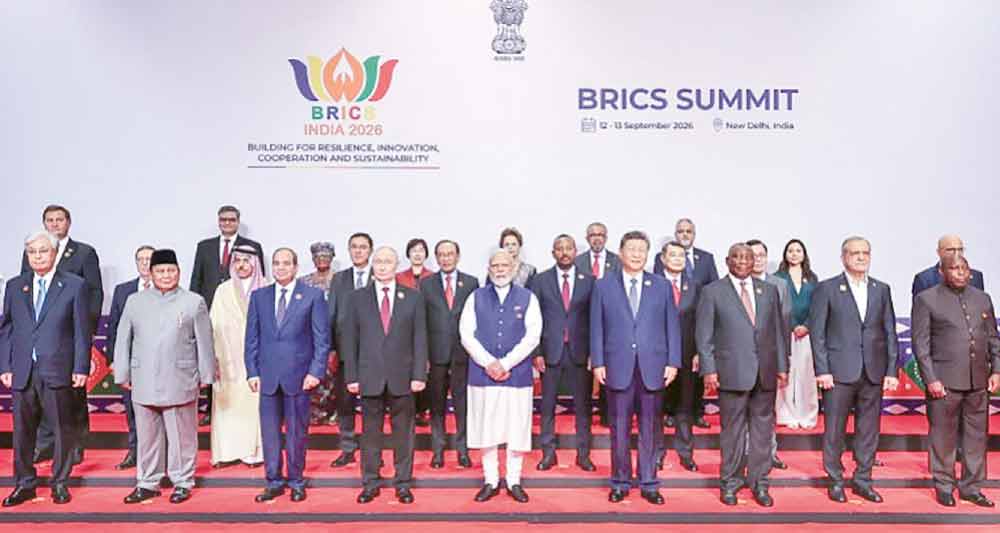 The world's financial order may have reached a historic turning point in New Delhi �" not with the launch of a new currency, but with the unveiling of a new financial strategy that could gradually weaken the US dollar's unrivalled dominance over global trade and development finance.
The 18th BRICS Summit ended with a 140-point New Delhi Declaration that goes far beyond routine diplomatic rhetoric.
It lays out an ambitious economic blueprint for the expanded 11-member bloc to build faster cross-border payment systems, expand trade in local currencies, reform the IMF and World Bank, strengthen the New Development Bank, and accelerate cooperation in digital finance, artificial intelligence and energy security.
The message is unmistakable: BRICS is preparing the Global South for a more multipolar financial world.
Yet the summit also delivered a surprise. Despite years of speculation, BRICS abandoned the idea of creating a common currency, choosing instead a pragmatic path towards de-dollarisation through financial infrastructure rather than monetary confrontation.
For Bangladesh �" an economy deeply tied to dollar-denominated exports, imports, remittances and external debt �" the decisions taken in New Delhi could have far-reaching implications.
The Dollar Is Under Pressure, But Not Under Collapse
For nearly eight decades, the US dollar has been the backbone of the international financial system. It remains the world's dominant reserve currency, accounting for about 57 per cent of global foreign exchange reserves, while most commodities, including oil, are still priced and traded in dollars.
However, BRICS leaders argue that the current system leaves developing nations excessively dependent on a financial architecture controlled largely by Western institutions.
The turning point came in 2022 when Russian sovereign reserves were frozen and Russian banks were removed from the SWIFT financial messaging network following the invasion of Ukraine. That episode convinced many governments across Asia, Africa and Latin America that reserve assets and payment systems could become instruments of geopolitical leverage.
Rather than attempting to overthrow the dollar, BRICS is now trying to ensure that countries have alternatives.
A New Financial Architecture Takes Shape
The New Delhi Declaration represents the bloc's most comprehensive economic agenda since BRICS was founded nearly two decades ago.
Its centrepiece is the expansion of local-currency trade settlements among member countries. Instead of routing transactions through the dollar, BRICS wants greater use of the yuan, rupee, rouble, real and other national currencies for trade and investment.
Alongside that, leaders agreed to strengthen the BRICS Payment Task Force, which is working on interoperable cross-border payment systems that promise faster, cheaper and more transparent international transactions. Discussions also include greater cooperation on digital payment infrastructure and central bank digital currencies, although no unified BRICS digital currency has been approved.
Economists say this marks a shift from building a new currency to building new financial plumbing �" the networks through which money moves across borders.
Reforming Bretton Woods from within
The summit's economic message extended well beyond de-dollarisation.
BRICS renewed its strongest call yet for reforms of the International Monetary Fund and the World Bank, arguing that the governance structure of the Bretton Woods institutions no longer reflects the realities of the global economy.
The declaration demands faster implementation of IMF quota reforms, greater voting power for emerging markets and developing economies, and a more transparent selection process for the leadership of the IMF and World Bank. Leaders argued that countries driving much of global growth remain underrepresented in institutions created after the Second World War.
Indian Prime Minister Narendra Modi said the Global South must move from being "rule-takers" to becoming "rule-shapers" in global economic governance.
New Development Bank Expands Its Role
The New Development Bank also emerged as a key pillar of the BRICS financial strategy.
Leaders endorsed expanding lending in local currencies to reduce borrowers' exposure to exchange-rate volatility and rising dollar debt burdens. The bank is also expected to play a larger role in financing infrastructure, climate resilience and sustainable development projects across member countries.
The declaration also supports new initiatives on trade finance for small and medium-sized enterprises, including an invoice discounting mechanism designed to improve working capital for exporters within BRICS markets.
Trade, Technology And Energy Reshape the Agenda
Economic cooperation at the summit extended into technology, supply chains and energy security.
The declaration promotes collaboration in artificial intelligence, digital public infrastructure, cybersecurity, fintech and innovation, reflecting growing recognition that technological sovereignty is becoming an essential component of economic sovereignty.
BRICS also called for resilient supply chains, cooperation on critical minerals and greater digitalisation of energy systems.
On climate policy, leaders backed a "just, orderly, equitable and inclusive" energy transition while acknowledging that fossil fuels will continue to play an important role in emerging economies. The declaration also criticised unilateral carbon border measures that could affect developing countries' exports.
Why The Summit Matters for Bangladesh
The BRICS decisions come at a critical moment for Bangladesh.
China, India, Saudi Arabia and the United Arab Emirates are among Bangladesh's largest trading partners, investment sources and remittance destinations. Wider use of local-currency settlements and regional payment connectivity could eventually reduce transaction costs and diversify trade financing options.
Bangladesh's rapidly expanding digital financial ecosystem �" particularly mobile financial services and QR-based payments �" could also benefit from future interoperability with regional payment networks across Asia and the Middle East.
At the same time, Bangladesh remains heavily dependent on the dollar. More than four-fifths of export earnings come from the ready-made garments sector, where transactions are overwhelmingly denominated in dollars or euros. External debt servicing, fuel imports and reserve management also remain closely linked to the greenback.
The challenge for Bangladesh is therefore not choosing between the dollar and BRICS, but preparing for a world where multiple currencies and payment systems coexist.
A Multipolar Financial World Is Emerging
The New Delhi Declaration may ultimately be remembered as the moment BRICS changed the conversation on global finance.
The bloc did not announce the end of the dollar. Instead, it announced the beginning of a financial transition �" one built on local currencies, digital payments, alternative development finance and demands for a more representative global economic order.
Whether BRICS can translate its ambitions into a functioning alternative remains uncertain. Internal economic differences, geopolitical rivalries and the enduring strength of the dollar continue to limit the pace of change.
But one conclusion from New Delhi is difficult to ignore: the age of unquestioned dollar monopoly is being challenged, not by a single rival currency, but by the gradual emergence of a parallel financial architecture led by the world's fastest-growing emerging economies.
For Bangladesh and the wider Global South, that quiet revolution could become one of the defining economic stories of the decade.
Loading...
Loading...
Also read



Editor : Iqbal Sobhan Chowdhury
Published by the Editor on behalf of the Observer Ltd. from Globe Printers, 24/A, New Eskaton Road, Ramna, Dhaka.
Editorial, News and Commercial Offices : Aziz Bhaban (2nd floor), 93, Motijheel C/A, Dhaka-1000.
Phone: PABX- 41053001-06; Advertisement: 41053012; 01793317829, 01550707291, E-mail: [email protected], [email protected] Online: email: [email protected] 41053014; 01550707297 Advertisement: 01550707296
Published by the Editor on behalf of the Observer Ltd. from Globe Printers, 24/A, New Eskaton Road, Ramna, Dhaka.
Editorial, News and Commercial Offices : Aziz Bhaban (2nd floor), 93, Motijheel C/A, Dhaka-1000.
Phone: PABX- 41053001-06; Advertisement: 41053012; 01793317829, 01550707291, E-mail: [email protected], [email protected] Online: email: [email protected] 41053014; 01550707297 Advertisement: 01550707296


