



| HEADLINE |

|
THE PIRATE QUEEN
Published : Saturday, 19 September, 2026 at 12:00 AM
Ariel Lawhon


 Reviewed by Alicia Calvo Hernández
In The Pirate Queen, Ariel Lawhon explores the legend of Grace O'Malley, Irish chieftain, pirate, mother, rebel-a woman too formidable to be contained, even by history...
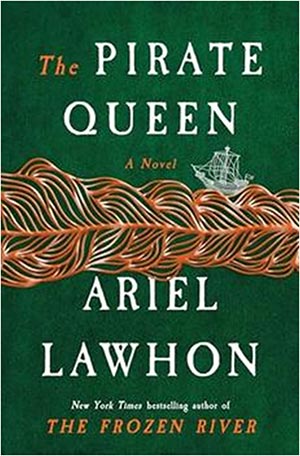
The Pirate Queen starts with a powerful image-a young girl cutting off her braid in defiance-and ends with the same image many years later, only the girl is now a woman, the defiance has turned to resigned surrender, and the braid, once fire-red, is silver gray.
In between, Ariel Lawhon, celebrated for other historical novels such as The Frozen River (2023), draws the history of one of Ireland's most well-known figures: Grace O'Malley, Gráinne Ni Mháile in the Irish language she grew up speaking (and which was, back then, still the primary language of her land), the sixteenth century woman who defied English rule, commanded ships, and controlled the Irish seas through trade, piracy, and an iron will.
The story is woven, like Grace's braid, into three parts: it follows her life as a maiden, a mother, and a matriarch, with the timelines alternating so a "maiden" chapter is followed by a "mother," and then "matriarch" chapter, and so on. This structure, as the epigraph explains, comes from the Trinity Knot, a triangular symbol made up of three overlapping arcs that "in ancient Celtic artwork was often used to symbolize the lifespan of a woman."
The narrative voice, omniscient, lightly touches on other characters' emotions and thoughts, but only on those that surround Grace, who is always at the center. There is a romance storyline as well, but the real heart of the novel is Grace's extraordinary life.
Lawhon hits all of the significant events: how, as a girl, Grace cut her braid off after her father refused to take her aboard his ship to Spain; how she was imprisoned in Dublin Castle twice, and twice released; how her father took her and her brother to sea to determine who could best sense a storm coming; how she aided Spanish sailors when ships from the Armada, sent to fight the English, washed up on Ireland's western coast; how she rescued a shipwrecked survivor, took him as her lover, and later avenged his murder; how she learned Latin as a young girl and used it when she met Elizabeth I in 1593 to petition for the release of her brother and youngest son, as well as a livelihood and the right to continue her activities at sea.
All of these events, and the many more retold by Lawhon, have come to us through fragments of history, but mainly through folklore. Because, as explained in the Author's Note, there is no record of Grace in the Irish annals. After all, she was a woman and therefore had no official titles or power. When she does appear in the historical record it is in the English State Papers, which weren't inclined to portray her in a sympathetic light, given her rebellious actions and piracy. But stories about Grace O'Malley from folklore are plentiful-tales passed down through generations, held for centuries in the waves that wash the coast of Ireland.
Lawhon retrieves those stories and expands on them. She gives them her own interpretation so that the novel doesn't feel like a mere list of episodes, and this is perhaps what makes The Pirate Queen distinct from other works on Grace O'Malley as a figure. Here, there are invented characters, imagined emotions, and some events shifted in time. After all, this is not a history textbook but a historical novel, and as such is much more interested in the people, their dynamics, conflicts, rivalries, and relationships, than in providing a detailed retelling of dry historical fact.
That does not mean there isn't a strong sense of place and time: Irish food, clothing, laws, traditions, and customs breathe through the text and ground Grace's story in the land she inhabited and loved.
That said, the reader could benefit from a little more historical context. If the three-timeline structure works beautifully for Grace's story, it can prove confusing from a purely historical point of view. During her lifetime, the English rule in Ireland increased, and that transformation is patent in the novel, but not always easy to follow.
At the beginning, the author includes a list of characters and a guide to the pronunciation and meaning of the Irish words scattered throughout the text. Some sort of contextual preface could have been useful here as well. In fact, the Author's Note placed at the end of the book proves very enlightening, and even though Lawhon herself advises not to read it before finishing the book, I would recommend otherwise. It provides valuable context for understanding what is historical, what comes from folklore, and what the author has imagined, and this, rather than diminishing the novel, makes it richer.
One could also choose to read the plot in a linear fashion-first all the Maiden chapters, then Mother, and finally Matriarch. But that would potentially diminish one's experience of the soul of the book, and perhaps the point Lawhon is making, the gradual assembling of a portrait of a woman who refuses to be confined by the expectations of her time. The three strands are meant to be intertwined, like the three arcs of the Trinity Knot. They tell the story of "the young girl running barefoot in the waves. The mother fighting for her children. And the old woman, wistful at the end of a long, vibrant life."
Courtesy: BookBrowse
Loading...
Loading...



Editor : Iqbal Sobhan Chowdhury
Published by the Editor on behalf of the Observer Ltd. from Globe Printers, 24/A, New Eskaton Road, Ramna, Dhaka.
Editorial, News and Commercial Offices : Aziz Bhaban (2nd floor), 93, Motijheel C/A, Dhaka-1000.
Phone: PABX- 41053001-06; Advertisement: 41053012; 01793317829, 01550707291, E-mail: [email protected], [email protected] Online: email: [email protected] 41053014; 01550707297 Advertisement: 01550707296
Published by the Editor on behalf of the Observer Ltd. from Globe Printers, 24/A, New Eskaton Road, Ramna, Dhaka.
Editorial, News and Commercial Offices : Aziz Bhaban (2nd floor), 93, Motijheel C/A, Dhaka-1000.
Phone: PABX- 41053001-06; Advertisement: 41053012; 01793317829, 01550707291, E-mail: [email protected], [email protected] Online: email: [email protected] 41053014; 01550707297 Advertisement: 01550707296


