



| HEADLINE |

|

Hilsa finds a new home in the waters of Gujarat



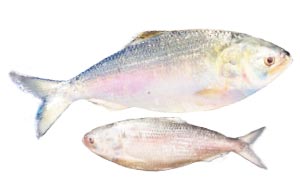 Bangladesh has started importing its national GI fish hilsa from India as hilsa is not available here in Bangladesh. The fish are now abundantly netted in Ahmedabad, the city of Gujarat.
 Why is hilsa scarce in Bangladesh?Coastal rivers like Andharmanik, Payra, Rabnabad, Bishkhali and Baleshwar in Patuakhali and Barguna are now the dumping zone of carbon dioxide, toxic sulfur, lead, and heavy metals. They no longer have native fish species, including hilsa.
Fishermen like Karim Baypari still go out to sea. He knows the hilsa is there. But it no longer comes to the estuaries as it once did.Karim Baypari has cast his nets in the monsoon tides of the Meghna estuary for more than three decades. He remembers when shoals of hilsa would rise with the full moon, filling the estuaries where generations of fishermen had worked before him.
"I have been fishing for hilsa for more than three decades, but over the past seven or eight years, the catch has steadily declined," says the fisherman from Jhalokathi. Karim does not believe the fish has disappeared. "There is plenty of hilsa in the deep sea, but they won't come up," he whispered.
"The real question is why the fish won't stay in the 20-40ft-deep water layers anymore."
His observation captures the central puzzle surrounding Bangladesh's national fish. Hilsa may still exist in the Bay of Bengal, but where fishermen can find and catch them is changing. And evidence from rivers and spawning grounds suggests something deeper is happening to the fishery as well.

123 Once famous for its hilsa sanctuaries, the Andharmanik and Payra river system in Patuakhali and Barguna now bears the weight of three coal-fired power plants along with other causes of climate change. As fish vanish, fishermen abandon their trade, and a silent environmental crisis deepens, experts warn of disaster within a 14-kilometer radius. 123
A National Fish in Crisis: In 2022-23, Bangladesh's national hilsa production reached a record of roughly 5.71 lakh tonnes. But over the next two years, production fell by about 12.5 percent. In 2023-24, the national haul dropped to roughly 500,000 tonnes - its lowest level in seven years. The decline has only accelerated. In July and August 2025, the catch reportedly fell by around 45 percent compared with the same period a year earlier. According to Department of Fisheries data, this year's catch during July-August stood at 29,519 tonnes, compared with 40,291 tonnes last year - a drop of 10,771.78 tonnes.
Of the 11 hilsa-producing countries in the world, Bangladesh alone harvests around 80 percent of total global production. Nearly 7 lakh fishermen are directly engaged in hilsa fishing, and the fish contributes nearly 1 percent of the country's GDP. Is all this data is going to be faded?
The Coal Connection: The situation taken a different momentum in 2017, when the Bangladesh government planned to established Bangladesh and China joint coal fired project called Payra Thermal Power Plant Project-1 in Patuakhali. Two years later, in 2019, the RPCL-Norinco International Power Limited (RNPL) thermal power plant was constructed nearby. And 2021 the Payra Thermal Power Plant Project-2 in Barguna's Taltali area began operation.
These three coal-based power plants transport fuel by open ships via waterways. The waste discharged from the plants pollutes the environment and ecosystems. The biodiversity of the Payra, Andharmanik, Rabnabad, Bishkhali, and Baleshwar rivers is under threat. Fish production in these rivers has decreased. Interestingly, the only lab at the Barisal Environmental Department for testing water quality of this area was closed just when the first project was kicked off.

Sanctuaries at Risk: The Bangladesh-China joint venture power plant is being installed just beside one of the most important hilsa sanctuaries on the Andharmanik river in Patuakhali district, according to the Power Division of Bangladesh. Another important sanctuary in the Tentulia river is located about 10 kilometres upstream of the project site.
These two sanctuaries alone produce around 10,000 metric tonnes of hilsa annually. Currently, five river spots are declared as hilsa sanctuaries in Bangladesh.
According to the Fisheries Statistical Report of Bangladesh 2014-15, the country's total hilsa production was 387,211 metric tonnes. Of this, 251,815 (65 percent) metric tonnes came from the sea, and 135,396 (35 percent) metric tonnes were from inland rivers.
In addition, the transportation of coal through the Golachipa river - the major hilsa upstream migration route located adjacent to the plant - might cause harm to the fish.
A Fishery Blocked: The problem is not just pollution. Hilsa migration is now blocked at 20 points, including the Meghna, Payra, Baleshwar, Bishkhali, Andharmanik, Tetulia, Sugandha, and Gozaria rivers, according to the Barishal Fisheries Office.
In some areas, depth has fallen to just 18-20 feet, far short of the 75-80 feet needed for breeding. From Chandpur to Monpura, sandbars now block channels, leaving only narrow navigable routes.Experts say the depth of estuaries has fallen, hampering hilsa migration. While 30 feet of water is required for free movement, many estuaries now fall to just 8-9 feet during low tide.
Mir Mohammad Ali, assistant professor at Sher-e-Bangla Agricultural University's Aquaculture Department, says, "Hilsa is a highly sensitive species. When its habitat changes, it alters its migratory routes."
According to him, apart from the construction of coal-based power plants along the Ramnabad River in Kalapara and the Payra-Bishkhali-Baleshwar estuaries in Barguna, industrialisation around breeding grounds has polluted rivers, forcing hilsa to change course. "This is directly affecting the country's hilsa production," he added.
The Bigger Picture
Researchers point to rainfall, temperature, river current, depth, flooding, food supply and water quality as crucial factors in hilsa spawning and harvest. In southern rivers, siltation and sandbars have reduced depth, while industrial waste has polluted waters and raised temperatures. Rainfall during monsoons has also been unusually low in recent years.
Researchers point to declining river flow and siltation as major concerns. Reduced flow associated with the Farakka Barrage and the formation of chars have affected the Padma.
Echoing the issue,RB Vala and AM Parmar, assistant professors at the College of Fisheries Science, Kamdhenu University, Gandhinagar, India said West Bengal's prized hilsa has found a new home in the waters of Gujarat amid shifting environmental currents and favourable monsoon conditions, sparking an unprecedented catch in the Narmada river.
"Hilsa is an anadromous migratory fish that spends most of its life in the sea but migrates towards the freshwater of rivers for breeding," explained RB Vala and AM Parmar. Changing environment, mainly during the monsoon when nutrient-rich water flows into the sea, is one of the reasons. Additionally, the ideal mixing of fresh and salt water in the estuary near Bharuch along the lower stretch of the Narmada has created perfect conditions for the fish to shift towards Gujarat.
"The Ganga-Hooghly river system of Bangladesh and West Bengal was previously among the primary breeding grounds for hilsa. However, over time, conditions such as the Farakka Barrage, increasing construction on rivers, changes in river depth, pollution, and climate change have affected the traditional migration and breeding areas of hilsa," the experts noted.

Loading...
Loading...
Also read



Editor : Iqbal Sobhan Chowdhury
Published by the Editor on behalf of the Observer Ltd. from Globe Printers, 24/A, New Eskaton Road, Ramna, Dhaka.
Editorial, News and Commercial Offices : Aziz Bhaban (2nd floor), 93, Motijheel C/A, Dhaka-1000.
Phone: PABX- 41053001-06; Advertisement: 41053012; 01793317829, 01550707291, E-mail: [email protected], [email protected] Online: email: [email protected] 41053014; 01550707297 Advertisement: 01550707296
Published by the Editor on behalf of the Observer Ltd. from Globe Printers, 24/A, New Eskaton Road, Ramna, Dhaka.
Editorial, News and Commercial Offices : Aziz Bhaban (2nd floor), 93, Motijheel C/A, Dhaka-1000.
Phone: PABX- 41053001-06; Advertisement: 41053012; 01793317829, 01550707291, E-mail: [email protected], [email protected] Online: email: [email protected] 41053014; 01550707297 Advertisement: 01550707296


