



| HEADLINE |

|

Educational instts turn into potential mosquito breeding grounds
Published : Tuesday, 29 September, 2026 at 12:06 PM
Tanjeem


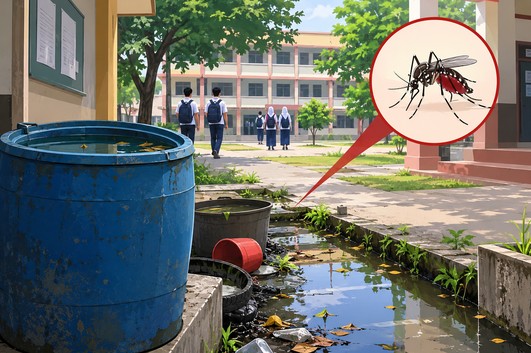
Poor drainage, stagnant water and neglected corners of educational institutions are raising concerns over the spread of Aedes mosquitoes in the capital.
Behind the classrooms, around old buildings and beside clogged drains, small pools of stagnant water are quietly creating potential breeding grounds for Aedes mosquitoes across educational institutions in Dhaka.
A recent inspection of several schools and colleges in the capital found stagnant rainwater in drains, fields and unused spaces, while discarded plastic bottles, broken buckets, flowerpots and construction materials were holding pockets of water.
Although many institutions maintain relatively clean main buildings and entrances, less-used areas-- including rear sections of campuses, spaces beneath staircases, old buildings, canteens, staff areas and abandoned corners--often receive far less attention.
With dengue cases rising and the rainy and post-monsoon seasons creating ideal conditions for Aedes mosquitoes, public health concerns are growing over whether routine cleaning, drainage and monitoring at educational institutions are keeping pace with the risk.
The danger is often in the neglected corners
The problem appears particularly pronounced at older institutions, where ageing buildings, inadequate drainage and damp surroundings can prevent rainwater from draining quickly.
At some locations, drains were found without covers, while others were partially blocked by rubbish. In places where drainage systems exist, weak water flow can leave stagnant water for extended periods after rainfall.
Such sites can become potential breeding grounds for Aedes mosquitoes, which can transmit dengue.
At Dhaka College, the front portion of the campus appeared comparatively clean, but parts of the residential area and less-used sections showed signs of accumulated waste and stagnant water.
Students also reported mosquito activity during the daytime, with the problem becoming more noticeable in the evening.
They said dormitories, storerooms, old buildings, canteens, the edges of playgrounds, construction sites and areas used to store discarded materials should receive regular inspections.
Even a small amount of rainwater left undisturbed in such places can potentially provide a breeding site.
Similar conditions were observed around Government Laboratory High School, where stagnant water was found in several locations.
In some places, drainage facilities were inadequate; in others, surrounding waste appeared to obstruct the movement of water.
The proximity of such areas to places regularly used by students has also raised concerns among parents.
Some parents have called for potentially vulnerable parts of school premises to be inspected before students arrive each day. Where mosquito breeding sites are identified, they said, they should be removed promptly.
They have also called for mosquito-control measures to be carried out in vacant classrooms or other appropriate areas only through approved methods and with necessary safety precautions.
‘Clean School Teams’ launched to tackle dengue risk
The government has stepped up institution-based cleaning and awareness programmes across Dhaka and other parts of the country as part of dengue prevention efforts.
Under initiatives directed by local administrations, educational institutions are being encouraged to form ‘Clean School Teams’ to identify and address potential mosquito breeding sites.
A directive from the Dhaka district administration calls for each team to be headed by the institution's principal. The team is also to include a parent representative, a ward councillor or a representative nominated by the upazila nirbahi officer (UNO), two students and a teacher nominated by the institution to serve as member-secretary.
Educational institutions have also been instructed to organise awareness meetings, seminars and campaigns involving students and parents.
However, authorities have stressed that students must not be exposed to hazardous cleaning work.
Students are not to be assigned to clean toxic, hazardous or unhygienic waste or enter dangerous areas. The focus is intended to be on awareness and safe participation under the supervision of teachers and responsible officials.
The Directorate of Technical Education has separately instructed technical educational institutions to conduct dengue-control and cleaning activities every Saturday.
Institutions have been asked to preserve photographs, brief reports and supporting evidence of the activities and submit them weekly through designated email channels.
Earlier directives also called on schools, colleges, madrasas, government and private institutions, market committees, religious institutions, social organisations and volunteer groups to conduct regular cleaning drives.
‘Clean School Teams will be a new shield against dengue’
Dhaka District Commissioner Farida Khanom said government action alone would not be sufficient to prevent dengue.
“Administrative drives alone are not enough. Ordinary people, particularly students, must also be involved.''
Students spend a significant part of each day at educational institutions, she noted. If they become more aware of keeping their campuses and surrounding areas clean, opportunities for Aedes breeding sites can be reduced.
“That is why ‘Clean School Teams’ have been formed in educational institutions,” she said.
Khanom, however, stressed that students themselves should not enter hazardous locations or carry out risky cleaning work. Awareness activities should be conducted safely under the supervision of teachers and responsible officials, she said.
Dr Khan Moinuddin Al Mahmood Sohel, director general of the Directorate of Secondary and Higher Education, also stressed collective responsibility.
He said institution authorities alone could not prevent dengue and that teachers, students and parents all needed to be involved.
Regular cleaning and greater awareness, he said, could substantially reduce dengue risks on educational campuses.
Survey finds breeding sites across Dhaka
A recent survey by the Dhaka South City Corporation (DSCC) has added to concerns over Aedes breeding sites in the capital.
According to the survey, multi-storey buildings accounted for the largest share of locations where Aedes larvae were found, at 35.23 per cent. Single-family homes and construction sites followed.
By type of breeding site, 12.26 per cent of larvae were found in water accumulated on floors, 10.34 per cent in buckets and 8.89 per cent in plastic drums.
The findings underline the fact that mosquito breeding does not necessarily require large bodies of standing water. Small, overlooked containers and pockets of stagnant water can also become potential breeding sites.
Dengue cases climb sharply
The concerns come as Bangladesh continues to face a significant dengue burden this year.
According to Directorate General of Health Services data, 75,730 people had been hospitalised with dengue and 233 had died by September 28 this year.
September has recorded the highest number of deaths so far, with 136 deaths, compared with 43 in August, 36 in July, 13 in June and one in May. Two deaths each were recorded in January and February.
The figures highlight the continuing pressure on the health system as the country moves through the peak dengue season.
In 2025, Bangladesh recorded 102,861 dengue cases and 413 deaths, according to health authorities. In 2024, 101,214 people were infected and 575 died.
The country's deadliest recent dengue outbreak came in 2023, when 321,179 cases and 1,705 deaths were recorded. In 2022, there were 62,382 reported cases and 281 deaths.
The challenge beyond the classroom
For Dhaka's schools and colleges, dengue prevention is increasingly becoming a question not only of spraying or emergency campaigns, but of everyday maintenance.
A clogged drain, an abandoned container or a forgotten corner behind an old building may appear insignificant. But during the rainy season, such overlooked spaces can provide exactly the kind of environment in which Aedes mosquitoes can breed.
As educational institutions remain crowded spaces where thousands of students spend much of their day, regular inspection, rapid removal of stagnant water and proper drainage could become critical components of dengue prevention.
The government's new ‘Clean School Team’ initiative is intended to strengthen that effort. Its effectiveness, however, will depend on how consistently institutions inspect their campuses, address neglected areas and maintain drainage and cleanliness beyond periodic campaigns.

Loading...
Loading...
Also read







Editor : Iqbal Sobhan Chowdhury
Published by the Editor on behalf of the Observer Ltd. from Globe Printers, 24/A, New Eskaton Road, Ramna, Dhaka.
Editorial, News and Commercial Offices : Aziz Bhaban (2nd floor), 93, Motijheel C/A, Dhaka-1000.
Phone: PABX- 41053001-06; Advertisement: 41053012; 01793317829, 01550707291, E-mail: [email protected], [email protected] Online: email: [email protected] 41053014; 01550707297 Advertisement: 01550707296
Published by the Editor on behalf of the Observer Ltd. from Globe Printers, 24/A, New Eskaton Road, Ramna, Dhaka.
Editorial, News and Commercial Offices : Aziz Bhaban (2nd floor), 93, Motijheel C/A, Dhaka-1000.
Phone: PABX- 41053001-06; Advertisement: 41053012; 01793317829, 01550707291, E-mail: [email protected], [email protected] Online: email: [email protected] 41053014; 01550707297 Advertisement: 01550707296


