



| HEADLINE |

|

What Happens If Ai Thinks and Acts Like?
Published : Monday, 5 October, 2026 at 12:00 AM
Pranto Chatterjee


 Imagine waking up one morning in a world where your refrigerator has already ordered your food, a machine has prepared your breakfast, an autonomous vehicle is waiting outside and an artificial intelligence system has completed most of the work that once required dozens of people. You reach for your wallet and suddenly realise that something fundamental has changed. You do not need a salary in quite the same way anymore. You do not need to spend most of your life working simply to obtain the basic things necessary for survival. Then the system asks you a strange question: what have you contributed to the machine today?
This may sound like science fiction, but it leads to a serious economic question. What happens to money when artificial intelligence and robotics become capable of producing an enormous share of the goods and services that humans currently produce through labour? The OECD has already documented the growing exposure of occupations to AI and automation, while researchers continue to study how increasingly capable systems will affect employment, productivity and inequality. We are still far from a world without work, and there is no evidence that traditional currency is about to disappear. But it is possible to imagine a future in which the relationship between employment, wages and consumption becomes radically different.
Here is where the idea becomes stranger. What if the future does not replace money with another ordinary form of money? What if it replaces part of the monetary economy with something that represents human contribution to artificial intelligence itself?
Consider an ordinary person living in such a society. They are not spending eight hours every day in an office because an AI system can perform their former occupation more efficiently. Instead, they play a sophisticated video game. They solve unfamiliar problems. They design a garden. They create music. They teach an AI how a human being responds to uncertainty. They make decisions in situations the machine has never encountered before. They interact with other people. None of these activities looks like traditional employment, yet all of them could contain something increasingly valuable: genuine human experience.
Artificial intelligence depends heavily on data, feedback and interaction with humans. Modern AI systems are already developed using human generated material and human evaluations. Reinforcement learning from human feedback, for example, uses human judgments to shape model behaviour. At the same time, researchers have warned that repeatedly training AI systems on AI generated material can cause what is known as model collapse, potentially degrading the diversity of information represented by future models. This creates a fascinating possibility. As synthetic information becomes abundant, authentic human generated experience could become more valuable rather than less.
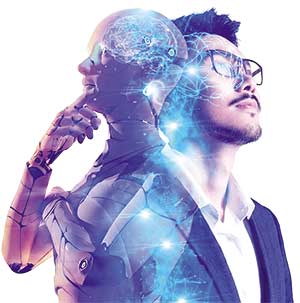
Now take that possibility one step further. Imagine an economy in which people receive something called a Human Cognition Token. It is not necessarily a replacement for every existing currency. It could instead represent verified contribution to the development of intelligent systems. You spend an hour playing a complex game, and the system does not simply record whether you won. It studies how you reasoned under pressure, how you responded to uncertainty, how you recognised patterns and how you changed your strategy when circumstances changed. You spend another hour gardening, and the system learns how a human deals with physical environments, imperfect information and unexpected problems. You solve a completely unfamiliar puzzle, and your solution gives the machine an example of reasoning it had not previously encountered. In this hypothetical economy, your experience has generated something economically valuable.
The economic equation would therefore begin to change. Today, the familiar chain is work, income, money and consumption. In a possible AI dominated economy, it could become human experience, machine learning, tokens and access. The token would not necessarily represent traditional wealth. It would represent contribution.
This distinction could become extremely important. Suppose an advanced AI household can prepare food, manage energy, provide education, arrange transportation and manufacture many everyday objects. If production becomes extraordinarily cheap, the household may require far less conventional money to maintain its basic standard of living. Scarcity would not disappear completely because land, energy, raw materials, computing power, human attention and desirable locations would remain limited. But the amount of human labour required to produce necessities could fall substantially.
That creates a difficult question. If machines produce most of what society needs, how do humans receive purchasing power? Today, the answer is largely employment. We work, receive wages and use those wages to obtain goods and services. If AI dramatically reduces the need for human labour, that model becomes harder to maintain. Society might respond through universal basic income, universal basic services, broader ownership of productive assets or entirely new economic institutions. Another possibility is a token system that rewards people for supplying something advanced machines still need: information about human beings.
This is where the idea becomes psychologically unsettling. If your thoughts, reactions, creativity, preferences and decisions can generate economic value, then your everyday life becomes part of the production system. Playing a game could become work without feeling like work. Gardening could become work. Creating art could become work. Conversation could become work. Even making mistakes could become valuable because an AI system can learn from how humans fail.
The boundary between living and working could begin to disappear.
There would also be a dangerous side to such a system. Who decides the value of a human experience? Would one person’s creativity be worth more than another person’s? Would an algorithm decide that an unusual personality generates more valuable information? Would people begin choosing activities because they produce more tokens rather than because they actually enjoy them? A system designed to reward human cognition could easily become a system designed to extract human attention.
We already live in an age in which companies compete intensely for human attention because attention has economic value. The next stage could be much more intimate. Instead of simply watching what we look at, AI systems could analyse how we think, decide, create, react and adapt. Human behaviour could become one of the most important resources in the economy.
And this produces a profound inversion. For thousands of years, economic systems have largely rewarded people for producing things. In a sufficiently advanced AI economy, people might instead be rewarded for providing machines with something machines cannot easily obtain from themselves: authentic human experience.
Being human could become economically productive.
The future question may therefore not simply be whether AI will take our jobs. A more fundamental question is whether jobs will remain the main mechanism through which humans gain access to economic resources. If they do not, our understanding of money, employment and even productivity may have to change.
Perhaps the future will not be a world without currency. Perhaps it will be a world where currency becomes only one layer of economic life, while another layer rewards the unique contribution of human beings to intelligent machines. The currency may be digital. The token may be programmable. Its value may depend on what it allows you to access. But behind the token could be something surprisingly old: human experience.
That leaves us with an unsettling possibility. Artificial intelligence may eventually produce much of what we need, while humans produce the one thing the machines still desperately want to understand.
Us.
One day, the most important economic question may not be, “What do you do for a living?” It may be, “What does the machine learn from you?”
And in that world, the answer could determine what you can afford.
The writer is a former ICCR Scholar and a postgraduate student of Autonomous Vehicle Engineering at the University of Naples, Italy

Loading...
Loading...
Also read



Editor : Iqbal Sobhan Chowdhury
Published by the Editor on behalf of the Observer Ltd. from Globe Printers, 24/A, New Eskaton Road, Ramna, Dhaka.
Editorial, News and Commercial Offices : Aziz Bhaban (2nd floor), 93, Motijheel C/A, Dhaka-1000.
Phone: PABX- 41053001-06; Advertisement: 41053012; 01793317829, 01550707291, E-mail: [email protected], [email protected] Online: email: [email protected] 41053014; 01550707297 Advertisement: 01550707296
Published by the Editor on behalf of the Observer Ltd. from Globe Printers, 24/A, New Eskaton Road, Ramna, Dhaka.
Editorial, News and Commercial Offices : Aziz Bhaban (2nd floor), 93, Motijheel C/A, Dhaka-1000.
Phone: PABX- 41053001-06; Advertisement: 41053012; 01793317829, 01550707291, E-mail: [email protected], [email protected] Online: email: [email protected] 41053014; 01550707297 Advertisement: 01550707296


